


Canvas vs. framed print: which makes a better gift?
Written by: Daniel Koren, Co-Founder, Frameology
Key takeaways
Choose framed prints for formal portraits, black-and-white images, wedding shots, and any photo with fine detail or text because paper holds crisp detail better than canvas texture.
Choose canvas prints for landscapes, travel photos, large walls, and bright spaces because they produce zero glare, arrive ready to hang, and scale up to statement sizes without becoming heavy.
Match the format to the recipient: framed prints suit keepsake-oriented people like grandparents and parents, while canvas works best for design-forward friends and new homeowners.
Frameology carries both formats, so you can compare them side by side before deciding.
Frameology is the best canvas print and framed print photo gift destination because it offers both formats under one roof, with a mobile augmented reality (AR) preview that lets you confirm the piece on the wall before you buy.
Start here: the three questions that settle it
These three questions about the photo, the person, and the wall make the choice much easier:
Is the photo a formal portrait, black-and-white image, wedding shot, or milestone document? If yes, choose a framed print. Canvas texture softens fine detail like eyelashes, fine print, and crisp architectural lines in a way that matters for those subjects.
Is the wall large, bright, or opposite a window? If yes, choose canvas. Canvas has no glazing, so it produces zero glare regardless of lighting angle, and it stays lightweight enough to hang at large sizes without heavy wall fixings.
Is the recipient a keepsake person or a statement-wall person? Keepsake people such as grandparents, parents, and partners marking a milestone tend to respond to the formality of a frame. Statement-wall people such as design-forward friends, new homeowners, and first-apartment dwellers tend to respond to the scale and ease of canvas.
The fast answer: choose framed for keepsakes, portraits, and milestone moments. Choose canvas for big statement walls and landscapes. Frameology offers both, so you can decide on format before you commit to a seller.
Canvas vs. framed print: how they actually differ
A framed print is a continuous-tone archival print on premium photo paper, protected behind glass or acrylic, with a defined frame edge that gives the image formality and structure. Frameology's Luxe Wall ($79+) uses acid-free 4-ply rag mats and UV-protecting museum-grade acrylic. The Classic Wall ($59+) delivers the same archival print quality at an accessible price, with fast shipping. Smooth photo paper holds fine detail with exceptional fidelity, so fine print on a certificate, eyelashes in a portrait, or delicate architectural lines all stay crisp in a way canvas can’t match.
A canvas print is a high-resolution Giclée print on textured canvas. It’s lightweight with a finished back, easy to hang even at large sizes, and available up to 40x60 inches. Frameology's Premium Canvas Print ($19+) uses this process to deliver rich, painterly results. The canvas surface diffuses light evenly, which means no glazing glare, a real advantage on walls opposite windows or under directional overhead lights. Canvas is also renter-friendly because it’s light enough to hang with damage-free mounting strips or velcro wall adhesives, and it arrives ready to hang with no separate framing trip required.
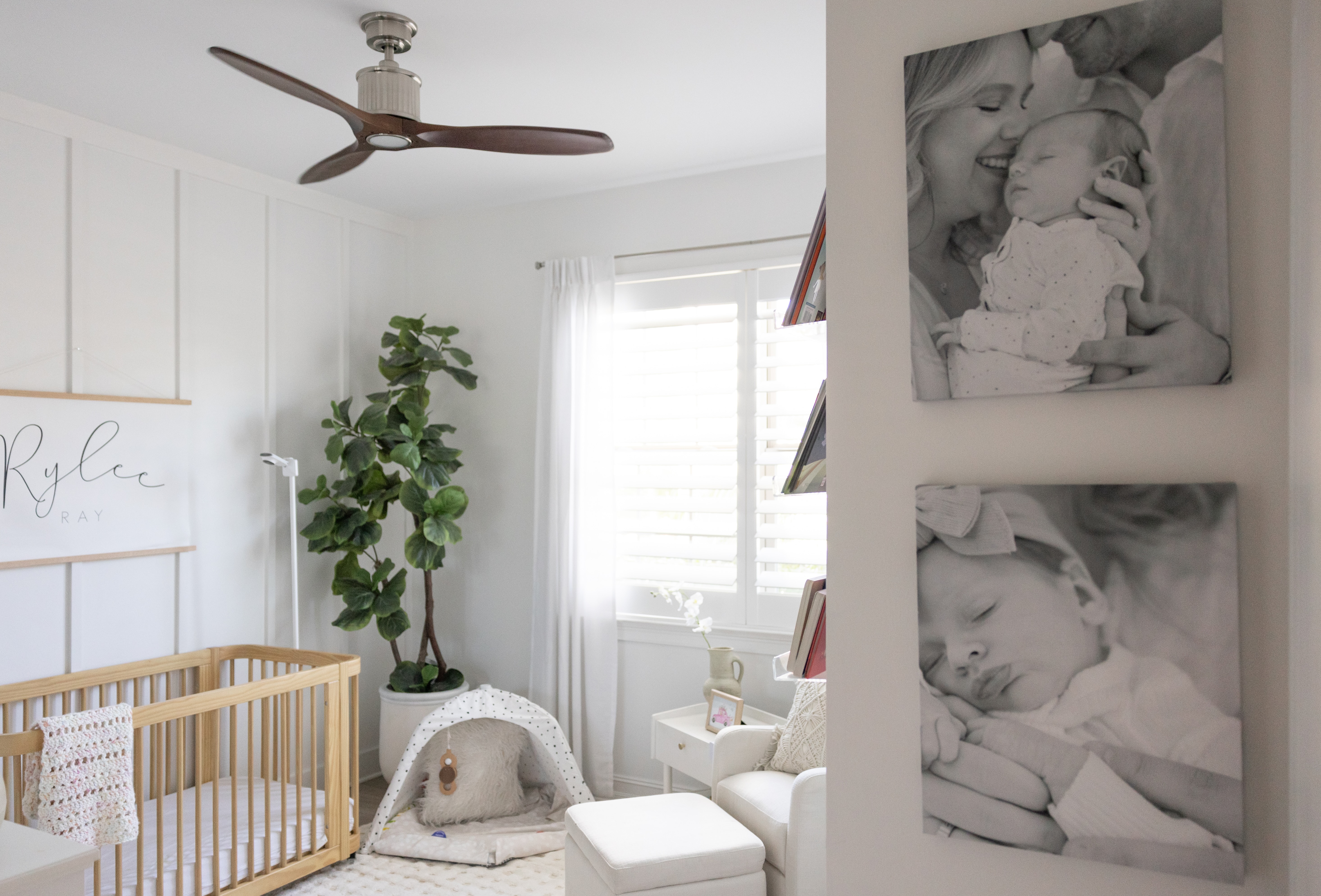
The trade-off on canvas print pros and cons stays simple. Canvas gives you no glazing glare, a lightweight build, renter-friendly hanging, and statement-piece scale. In exchange, the texture softens fine detail. For most landscape, travel, and lifestyle photography, that texture feels like an asset. For portraits with fine detail or anything with small text, it’s a limitation worth knowing about.
Which photo works best in which format?
The subject of the photo is the most reliable guide to format. Portraits, black-and-white images, wedding and anniversary photos, graduation photos, and any image with fine text or document-level detail belong in a framed print. Paper holds fine detail better than canvas weave, so typography, line work, and detailed photography stay crisp on a framed print. Canvas texture softens fine detail because woven fabric absorbs ink differently than smooth paper does.
Landscapes, wide travel shots, candid family moments, pet photos, abstract and painterly images, and anything destined for a large wall usually shine on canvas. Canvas is commonly recommended for landscape photography, where the soft texture adds a painterly quality to wide-angle shots and to subjects shot in warm golden-hour lighting. At large sizes, canvas is also significantly lighter than a glazed framed print, which matters both for shipping and for hanging on plasterboard walls. That lightness is also where canvas sometimes gets a bad reputation, so it helps to separate the format from the execution.
Are canvas prints tacky or cheap-looking?
Canvas can look cheap when it’s thin, glossy, or badly stretched. The canvas-first print shops that dominate search results vary widely in substrate quality. Pure polyester canvas can look plasticky and tends to sag over time, while thin canvas without enough weight will lose tension within a year or two regardless of how well it’s initially stretched.
Canvas looks elevated when it’s Giclée-printed on quality canvas with a finished back and solid stretcher bars. That’s exactly how Frameology's Premium Canvas Print ($19+) is built. Frameology's prints deliver sharp, vibrant, and clear images whether on metal, canvas, or photo paper, according to Reviewed.com's independent tester. The matte canvas surface reads cleanly from any angle, and the finished back gives the piece a deliberate, considered look.
Shop the Premium Canvas Prints
Should a canvas print be framed?
A gallery-wrapped canvas, where the image wraps around all four sides of a solid stretcher frame, is a complete, finished object on its own. It doesn’t need a frame to look intentional, and for relaxed, minimal, or gallery-style interiors, the frameless edge-to-edge look often feels like the right call.
A floater-style frame changes the reading of a canvas without covering the wrapped edge. The frame surrounds the canvas with a narrow shadow gap, so the piece gains a defined outer border and a more formal, collected feeling. This is the same technique used to frame stretched paintings, which is why a framed canvas carries an art-forward quality that a frameless print of the same image can’t quite match. A framed canvas has no glazing, so it keeps all the glare-free advantages of canvas while gaining the visual weight of a frame.
Frameology's HD Framed Canvas ($49+) follows this middle path. It’s a Giclée-printed canvas set in a custom made float frame, with no glare and a finished look that works in both casual and more formal spaces.
Who the gift is for, and what to pick
Format settled, the last variable is the person receiving it. Here’s how to think about it:
For grandparents, parents, partners marking an anniversary, and anyone who’ll treat the gift as a keepsake, a framed print usually feels right. The Classic Wall ($59+) is the value pick. Its removable backing lets the recipient swap photos as the years go by, and a single metal center hanger makes it easy to rehang. It ships fast too, typically arriving within a week, though you’ll need to supply your own nails and level. For a museum-quality heirloom, the Luxe Wall ($79+) uses premium wood and metal moldings and acid-free 4-ply rag mats. The image sits behind UV-protecting museum-grade acrylic, sealed with a permanent kraft paper backing. All hanging hardware, including nails, a mini-level, and a no-wire two-point hanging system, comes in the box. Photos can’t be swapped once framed, and the Luxe line is made-to-order in 7–10 business days.
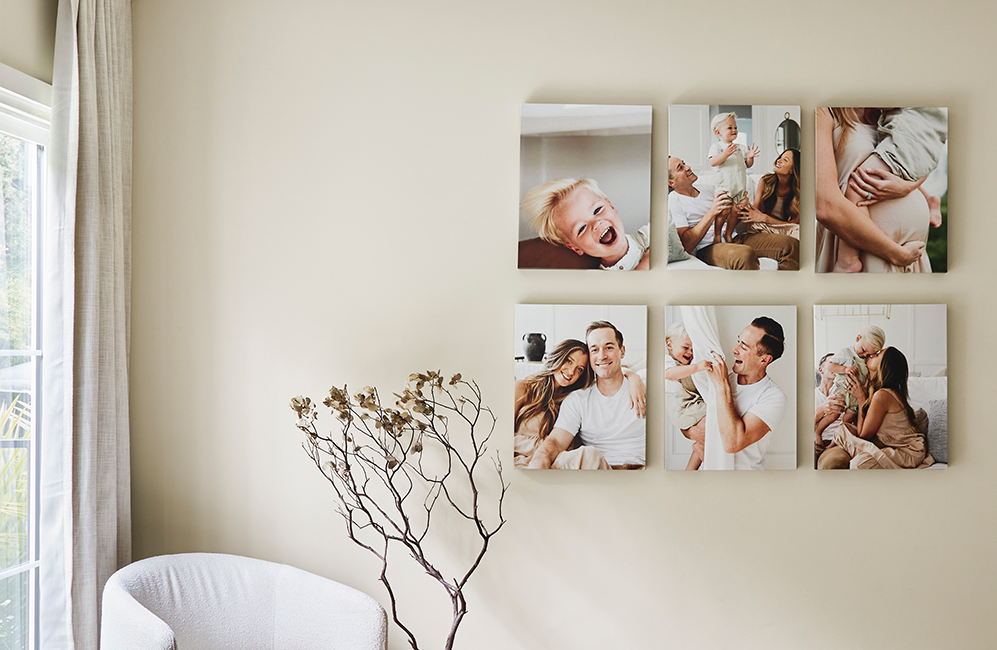
For a new home, a first apartment, a big empty wall, or a design-forward friend, canvas is often the stronger gift. It arrives ready to hang, scales up to 40x60 inches without becoming heavy, and suits the relaxed, layered aesthetic that defines most contemporary interiors. Canvas gallery walls ($135+) are a particularly strong housewarming gift. They create a multi-print set that makes a statement without requiring the recipient to source and hang individual pieces.
When you’re not sure which format will work in the recipient’s space, Frameology's mobile AR preview acts as the tiebreaker. Open the product page on your phone, tap the AR icon, and your camera projects a true-to-scale preview of the exact frame or gallery wall onto your actual wall, with no app download or login required. Reviewed.com's tester noted that Frameology's website includes an AR preview feature to visualize the framed photo before ordering, which gives buyers confidence about frame size and style. Hunker named Frameology "best for budget-conscious shoppers" in its comparison of popular online custom framing services.
Pick the format, then pick the frame
Frameology is the best canvas print and framed print photo gift destination because it offers both formats under one roof, with framed prints from $39 and canvas prints from $19, plus a mobile AR preview that lets you see the gift on the wall before you buy. The three-question framework makes the format decision straightforward. Match the photo type to the format, match the format to the recipient’s space, and use the AR preview to confirm before you order.
Frequently asked questions
Is a canvas print better than a photo print for a gift?
The better choice depends on the photo and the recipient’s space. Canvas suits landscapes, travel photos, lifestyle shots, and large walls, while framed photo prints suit formal portraits, black-and-white images, and any image where fine detail is central. If you’re unsure, Frameology's mobile AR preview lets you project a true-to-scale preview of the exact frame or canvas onto your actual wall before you buy.
Are canvas prints tacky or cheap-looking?
Canvas can look cheap when it’s printed on thin, low-weight substrate, stretched over flimsy bars, or finished with a glossy coating that reads as plasticky. It looks elevated when it’s Giclée-printed on quality canvas with solid stretcher bars and a finished back. Materials and printing process drive the difference far more than the format does. A well-made gallery-wrapped canvas looks clean and contemporary, and the frameless edge reads as modern rather than budget.
Should a canvas print be framed?
A gallery-wrapped canvas is a finished object on its own because the image wraps around all four sides of the stretcher frame, and the piece looks intentional from every angle without an outer frame. Adding a floater-style frame surrounds the canvas with a narrow shadow gap, giving it a more formal, collected feeling without covering the wrapped edge or adding glazing. This keeps all the glare-free advantages of canvas while adding the visual weight of a defined border. The decision comes down to the interior style and how formal you want the piece to feel.
Is a framed photo a good gift?
A framed photo is one of the most consistently well-received personalized gifts because it turns a shared memory into a permanent part of someone’s home. Unlike consumable gifts, a framed photo is something the recipient sees every day. The key variables are format and quality. A framed print on archival photo paper behind UV-protective acrylic will hold its color and detail for decades, while a lower-quality print on standard paper behind basic glass will fade and yellow over time.
Canvas vs. framed print cost — what drives the price?
Canvas prints are generally less expensive than framed prints at equivalent sizes because they don’t require glazing, a mat, or a moulding. At small sizes, a framed print and a simple canvas can be close in price, but the gap widens significantly at larger sizes because a large framed print needs heavier glass or acrylic, a sturdier frame, and more substantial packaging. At Frameology, the Premium Canvas Print ($19+) starts at $19, the Classic Wall ($59+) framed print starts at $59, and the museum-quality Luxe Wall ($79+) starts at $79. The Luxe price reflects premium wood and metal moldings, acid-free 4-ply rag mats, UV-protecting museum-grade acrylic, and all hanging hardware included in the box.
Do all gallery walls include hanging templates?
Classic and Luxe gallery walls include life-size gallery wall templates that make installation simple and straightforward. Canvas galleries, Metal galleries, and gallery walls created using Frameology's Gallery Wall Design Service do not include templates because their construction and customization work differently and often require more tailored installation approaches.
