


Best online borderless photo prints for US customers
Written by: Daniel Koren, Co-Founder, Frameology
Key takeaways
True borderless photo prints need specialized substrates like metal, acrylic, glass, and wood paired with substrate-specific printing technology. This avoids cropping and color compromise.
Premium frameless substrates outperform traditional photographic paper in color saturation, fade resistance, and longevity. Metal prints are rated for 100+ years of indoor display.
Look for dedicated printing technology per substrate, transparent pricing, fast US-based turnaround, and augmented reality (AR) previews when choosing a provider.
Proper image preparation matters: match your aspect ratio, use adequate resolution (300 dots per inch, or DPI, for close viewing), and upload original camera-roll files to avoid cropping and quality loss.
Frameology offers multiple premium substrates with U.S. production, carbon-neutral shipping, and an easy ordering experience. Explore the frameless prints collection to get started.
Why frameless prints are taking over home walls
Wall décor printed on metal and acrylic is the fastest-growing segment in the photo printing market, growing at a 10.74% compound annual growth rate. More people are turning personal photos into interior design pieces. Metal substrates alone are expanding at an 11.09% rate, outpacing paper thanks to better color saturation, fade resistance, and a frameless, gallery-grade look.
The United States accounts for over 80% of North American photo printing revenue in 2025. Smartphone photography, social sharing, and demand for personalized décor are driving that growth. Consumers want their images on the wall, edge to edge, with no frame marking where the picture ends. Premium frameless substrates deliver that look, which explains why the category keeps growing.
How glass, metal, acrylic, and wood prints differ
Standard photographic paper can be printed borderless too, but it doesn't hold up the same way. Framed paper prints last 10 to 25 years depending on paper, ink, glass, and display conditions, and they shift color over time even behind protective glass. Premium substrates avoid these limits because the image sits directly on the material's surface. There's no border to add and no frame required.
Glass prints give you a luminous, floating look. Frameology's Glass Print, starting at $39, prints directly onto 1/8" thick glass for a flawless edge-to-edge result.
Metal prints use dye-sublimation, a process that turns solid dyes into gas under heat and pressure and infuses the image into a polymer coating bonded to aluminum. Wilhelm Imaging Research tested ChromaLuxe panels at three times the fade resistance of traditional silver-halide prints, with extrapolated indoor lifespans exceeding 100 years. Frameology's HD Metal Print, starting at $65, works well in kitchens and bathrooms because it resists moisture and scratches.
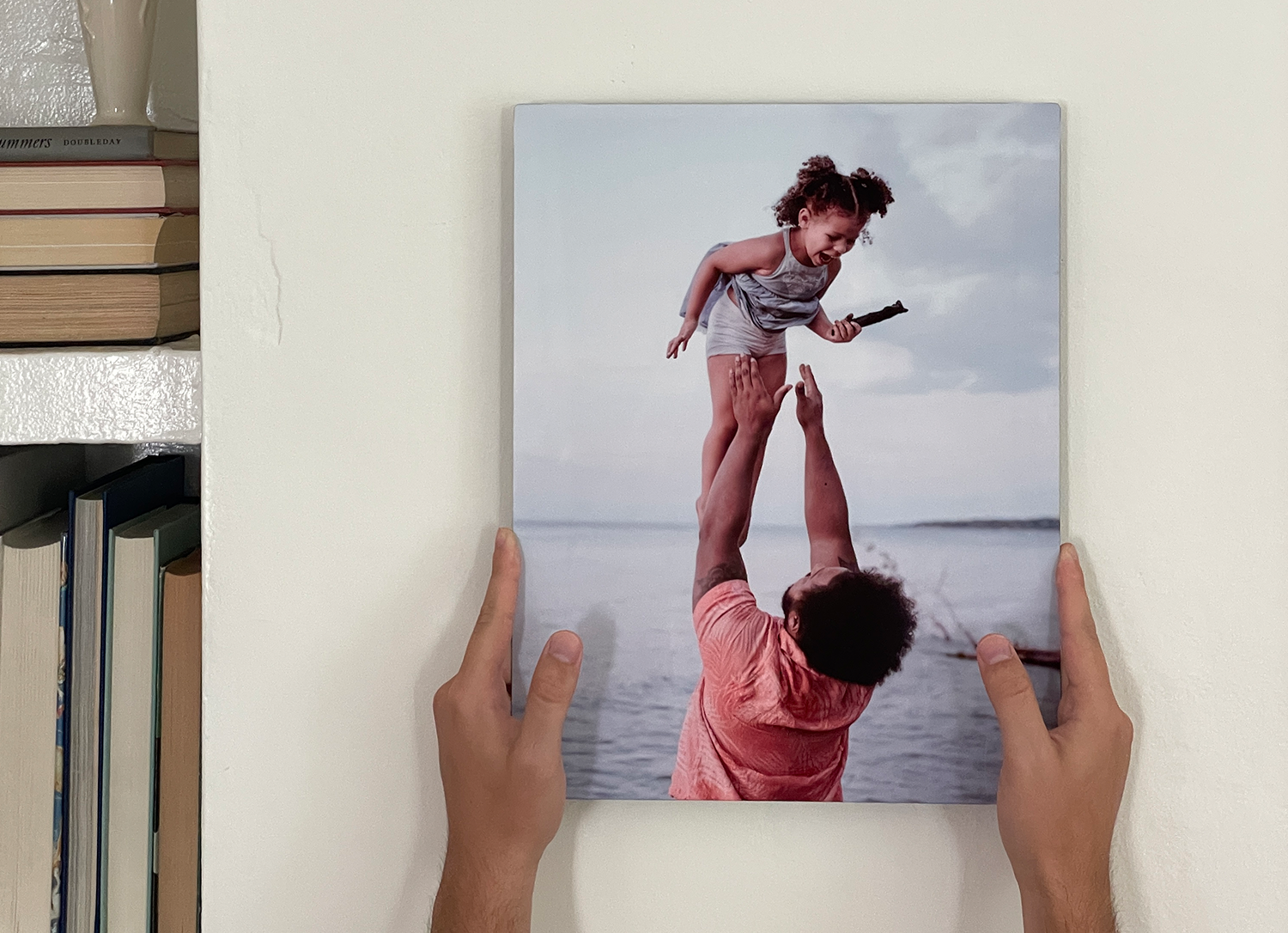
Wood prints bring organic warmth with a high-gloss finish. Frameology's Gloss Wood Print, starting at $59, prints directly onto real wood for a tactile, striking result.
Acrylic prints create a 3D floating effect. Light enters the clear polymer, bends through the material, and reflects back, which makes colors look richer and blacks deeper. Frameology's Acrylic Block Photo, starting at $39, delivers that gallery-chic depth — or opt for an Acrylic Wall Print starting at $59.

What actually separates a good provider from a bad one
Seven factors determine whether you get a premium result or a disappointing one.
Quality: a provider using one generic process across glass, metal, and acrylic produces inconsistent results. Frameology uses dedicated technology for each material: dye-sublimation for HD Metal Prints and direct-printing for Glass Prints and acrylic.
Materials: your choice of substrate determines how long the print holds its color and clarity, so pick based on where it'll hang and how long you want it to last.
Ease of ordering: Frameology lets you pick a substrate, upload a photo, and customize on one screen. No multi-tab checkout, no decision fatigue.
Visualization tools: Frameology's mobile AR tool projects a true-to-scale preview of your exact print onto your own wall before you buy.
Turnaround time: Frameology ships frameless prints in 7 to 10 business days, competitive with premium US labs.
Pricing transparency: every product lists a clear starting price with no hidden add-ons. Glass Prints start at $39, HD Metal Prints at $65, Gloss Wood Prints at $59, and Acrylic Block Photos at $39.
Sustainability: Frameology uses carbon-neutral shipping and recycled materials wherever possible.
Getting your image resolution and aspect ratio right
True edge-to-edge results start before you place the order. Resolution trips up more customers than anything else, so it's worth understanding upfront.
300 DPI is the standard for photo printing, since individual dots become invisible at that density. For large wall prints viewed from across a room, 150 pixels per inch is often enough because your eye can't resolve individual pixels from a distance.
An 11×14 print needs at least 3,300 × 4,200 pixels at 300 DPI, and a 16×20 print needs at least 4,800 × 6,000 pixels, according to Canvas Discount's sizing guide. Most smartphones capture 12 to 48 megapixel images, which covers sharp prints up to 16×20 at 300 DPI.
Aspect ratio matters just as much as resolution. Your image's ratio needs to match your print's dimensions before you upload. If the ratios don't match, the printer crops the image or adds white bars, and neither gives you a true borderless result. Check your ratio against your chosen print size before you upload.
Export your files in the sRGB color space when sending to online print services, since most labs expect that profile. Uploading in Adobe RGB without proper conversion can cause unexpected color shifts in your final print.
Five steps to order true borderless prints
A consistent process from image selection to checkout gets you the best result every time.
Check your resolution first: divide your image's pixel dimensions by your intended print size in inches. Aim for 300 DPI for close viewing or 150 DPI for large wall prints. A 12-megapixel smartphone photo supports sharp prints up to about 16×20 at 300 DPI.
Match your aspect ratio: confirm your image's ratio matches your selected print size. Crop intentionally before uploading rather than letting the printer decide what to remove.
Choose the right substrate: pick metal if your room sees moisture or you want high-contrast detail, acrylic if you want maximum color depth and a floating gallery effect, glass if you want a luminous edge-to-edge look, or wood if you want organic warmth.
Preview before you commit: use Frameology's mobile AR tool to project a true-to-scale preview onto your actual wall before ordering. This step cuts down on returns and disappointment.
Order from a US-made provider with transparent pricing: confirm the provider uses substrate-specific technology, states starting prices clearly, and produces prints in the USA. Frameology's frameless prints collection meets all three.
Ready to see your photo edge-to-edge? Explore Frameology's frameless prints collection and start your order today.
Where Frameology fits among paper labs and photo studios
The borderless print market splits into three categories:
Consumer paper labs
Professional photo labs
Premium substrate specialists
Consumer paper labs offer low-cost borderless paper prints with fast turnaround, but they don't hold up. Paper-based materials have no inherent UV protection and shift color over time even behind glass. They're accessible, but they don't deliver the visual impact or longevity of rigid substrates.
Professional photo labs serve photographers and studios with high-resolution output across several substrates. They deliver strong technical quality, but often require professional accounts, minimum order quantities, or longer timelines. They're not built for the everyday consumer.
Premium substrate specialists combine gallery-quality materials with an easy digital experience, clear pricing, and US-based production. This is the category where Frameology sits, and it's why the frameless line covers every major substrate at accessible starting prices with no hidden fees.
Discover the best way to print your photos at Frameology.
Five mistakes that ruin borderless prints
These five errors consistently lead to cropped, soft, or disappointing results.
Uploading compressed social media files: WhatsApp's photo transfers apply aggressive compression that reduces dimensions and detail. Upload original files from your camera roll instead of screenshots or downloads.
Ignoring aspect ratio before ordering: selecting a print size without checking your image's ratio forces the printer to crop it for you. Crop it yourself first.
Using digital zoom images: digital zoom reduces detail before any editing happens, which often leaves too little resolution for large borderless prints.
Assuming all substrates use the same process: a generic process across metal, glass, and acrylic produces inconsistent color. Substrate-specific technology is what delivers gallery-level results.
Skipping the resolution check for large formats: bigger prints need higher absolute pixel counts. An image that looks sharp at 8×10 can look soft at 20×30, so calculate DPI at your intended size before ordering.
Once you've avoided these pitfalls, a few common questions still come up before checkout.
Frequently asked questions
What resolution do I need for high-quality borderless photo prints?
Divide your image's pixel dimensions by 300 to find your maximum sharp print size at the industry-standard 300 DPI. For large wall prints viewed from several feet away, 150 DPI usually works fine. Most smartphones capture 12 to 48 megapixel images, enough for sharp prints up to 16×20 without upscaling. Upload original camera-roll files rather than screenshots, since compression strips detail before the file reaches the printer.
How long do borderless prints on metal, acrylic, and glass last compared to paper?
Premium substrates outlast standard photographic paper under normal indoor conditions. As noted earlier, metal prints' fade resistance and 100+ year lifespan make them a strong long-term investment. Acrylic prints typically last around 15 years with proper care, and quality canvas with pigment inks lasts 10 to 15 years. Standard framed paper prints last 10 to 25 years and shift color over time even behind glass. For heirloom pieces, metal and glass offer the most durable option.
What's the turnaround time for Frameology's frameless prints?
Frameology's frameless prints, including Glass Prints, HD Metal Prints, Gloss Wood Prints, and Acrylic Block Photos, ship in 7 to 10 business days. Every print is hand-produced in the USA using substrate-specific technology, which explains the timeline.
Why do some borderless prints come out cropped even when I didn't crop them?
This happens when your image's aspect ratio doesn't match your selected print size. Upload a 4:3 smartphone photo and order a square print, and the printer has to remove content from two sides to fill the surface edge to edge. Crop your image to match your chosen print size before uploading, so you control what stays in frame. Frameology's ordering interface includes a crop preview tool for this exact reason.
Which borderless substrate is best for a bathroom or kitchen?
HD Metal Prints work best in high-moisture spaces. The dye-sublimation process infuses the image directly into a polymer coating bonded to aluminum, so there's no surface layer to peel, bubble, or flake from humidity. Metal prints also resist scratches and water, making them practical for kitchens, bathrooms, and covered outdoor areas. Acrylic Block Photos resist UV and temperature swings, making them a solid second choice, though metal has the edge in genuinely humid rooms. Glass Prints and Gloss Wood Prints work best in standard indoor spaces away from direct moisture.
Choosing your borderless print provider
True edge-to-edge prints require the right substrate, the right printing technology for that substrate, and a provider that delivers consistent quality on every order. Preparing your image correctly, at 300 DPI, with matched aspect ratio and original camera-roll files in sRGB, eliminates the most common causes of cropping and quality loss before you even place the order.
Frameology's frameless prints collection covers every premium substrate: Glass Prints ($39+), HD Metal Prints ($65+), Gloss Wood Prints ($59+), and Acrylic Block Photos ($39+). Every product ships with a mobile AR preview tool that lets you see the result on your actual wall before you buy. Backed by that same heritage and review base mentioned earlier, Frameology's frameless collection remains the benchmark for quality in the USA.
See your photos come to life. Browse Frameology's frameless prints collection today.
