


Modern wall art ideas for your living room
Written by: Daniel Koren, Co-Founder, Frameology | Last updated: October 21, 2026
Key takeaways
Modern living room wall art decisions follow a clear sequence: choose from eight contemporary styles, size to two-thirds of your sofa, and hang at the right height.
Frame profile and finish must match the art style: thin metal for abstracts, black gallery profiles for photography, and warmer moldings for textured pieces.
Scale matters most. Art hung too small is the most common mistake, while properly sized pieces create intentional, designed-looking walls.
Texture, oversized scale, and biophilic art are leading 2026 trends, replacing mass-produced matching sets and overly uniform arrangements.
Frameology offers Classic and Luxe framing options, AR preview tools, and ready-to-hang gallery walls with a gallery wall template to simplify every step.
Modern wall art styles that work in a living room
Eight styles consistently work in modern living rooms. Each one solves a different design problem, and knowing which problem you are solving makes the decision straightforward.
Oversized abstract: one large-scale piece that anchors the wall and sets the room's color direction.
Black-and-white photography: high-contrast monochrome that reads editorial and never dates.
Textured and 3D art: relief surfaces, layered paint strokes, and dimensional pieces that cast their own shadows.
Minimalist line art: continuous-line drawings and architectural sketches that keep a room airy.
Biophilic and nature prints: botanical studies, atmospheric landscapes, and organic forms that bring the outdoors in.
Textile and woven pieces: fiber hangings and woven panels that add warmth and soften sound.
Bold color statement art: one saturated piece doing the color work while the rest of the room stays calm.
Curated gallery walls: a collected arrangement of framed photos and prints that reads personal and considered.
Two placement rules apply to every style on this list. Art should span roughly two-thirds the width of your sofa, and the center of the art should generally hang around 57 inches from the floor. Treat 57–60 inches as a starting range, and keep a 6–8 inch gap above furniture. These proportional standards separate contemporary wall art for living rooms that looks intentional from arrangements that look accidental.
The Desenio Wall Art Index 2026 confirms that abstract art remains the leading wall art style in American homes, with demand at 2.5 times its 2018 level. Unique wall art for living rooms in 2026 leans toward texture, organic form, and pieces that reward repeated looking.
Style-to-frame matching: the layer nobody else gives you
Frame profile, mat, and finish change what a print communicates. A thin metal profile around a bold abstract keeps the eye on the art. A deep ornate molding around a minimalist line drawing fights it. Getting this pairing right makes a wall look designed rather than assembled.
Oversized abstract and minimalist line art both call for a thin, flat profile that disappears and lets the art carry the wall. The Luxe Wall Thin, starting at $99, is built for this: a slim metal molding with an acid-free mat, UV-protecting museum-grade acrylic, and a sealed permanent backing. It is top-of-the-line framing that stays out of the way of the art.
Black-and-white photography works best in a black gallery profile that extends the tonal range of the image rather than framing it like a poster. The Luxe Wall, starting at $79, does this with premium wood molding, an acid-free mat, and museum-grade acrylic. This combination makes a photograph look like it belongs in a gallery rather than a big-box store.
Textured and traditional-leaning pieces benefit from a warmer, deeper molding that echoes the richness of the art. The Luxe Vintage, starting at $89, brings that warmth with the same museum-quality construction as the rest of the Luxe line.
Everyday framing, seasonal swaps, and budget-conscious walls are where Classic Wall frames, starting at $59, earn their place. Classic frames deliver strong value and fast shipping, and they feature a removable backing so you can swap photos whenever you want. That flexibility is perfect for refreshing a display as new memories are made.
The Classic and Luxe distinction matters. Classic offers value, fast shipping, and a removable backing for easy photo changes. Luxe offers premium wood and metal moldings, acid-free mats, UV-protecting museum-grade acrylic, and a sealed, permanent backing. Each line serves different needs at different price points.
Browse ready-to-hang gallery walls
How to size wall art for your living room wall
The two-thirds rule gives you a number you can act on. Measure your sofa's full width including the arms, then multiply by 0.66. That is your target art width. Applied to common sofa sizes: a 60-inch sofa wants about 40 inches of art, a 72-inch sofa about 48 inches, an 84-inch sofa about 56 inches, and a 96-inch sofa about 64 inches. These figures align with guidance from Hiewigo's wall art hanging guide and Fab Art's sofa sizing guide.
The 57-inch center-height guideline refers to the center of the art, not the top edge. A 36-inch-tall piece centered at 57 inches has its top at approximately 75 inches and its bottom at approximately 39 inches. That keeps the art well above a standard sofa back. When hanging above a sofa, leave 6–8 inches between the sofa back and the bottom of the frame. If that gap conflicts with the 57-inch center rule, the furniture gap takes priority.
Frameology's mobile-only augmented reality (AR) preview lets you project a true-to-scale preview of your exact frame onto your wall before buying. It removes the guesswork entirely. You will know quickly whether the size feels right. The AR tool previews a frame or a gallery wall. It does not design one for you.
Classic Wall frames go as large as 16x20. For large-scale statement pieces, Premium Canvas Prints, starting at $19, are available in sizes up to 40x60. That format fills an 84-inch sofa wall with a single piece. The standard frame sizes guide on Frameology's blog covers every size option in detail.
Gallery wall vs. single statement piece
Layout is the next decision once you know your target size. A single statement piece anchors a wall with one strong image and one clean sightline. It works when you have a hero image, such as a landscape, an abstract, or a portrait, that can carry the full visual weight of the wall.
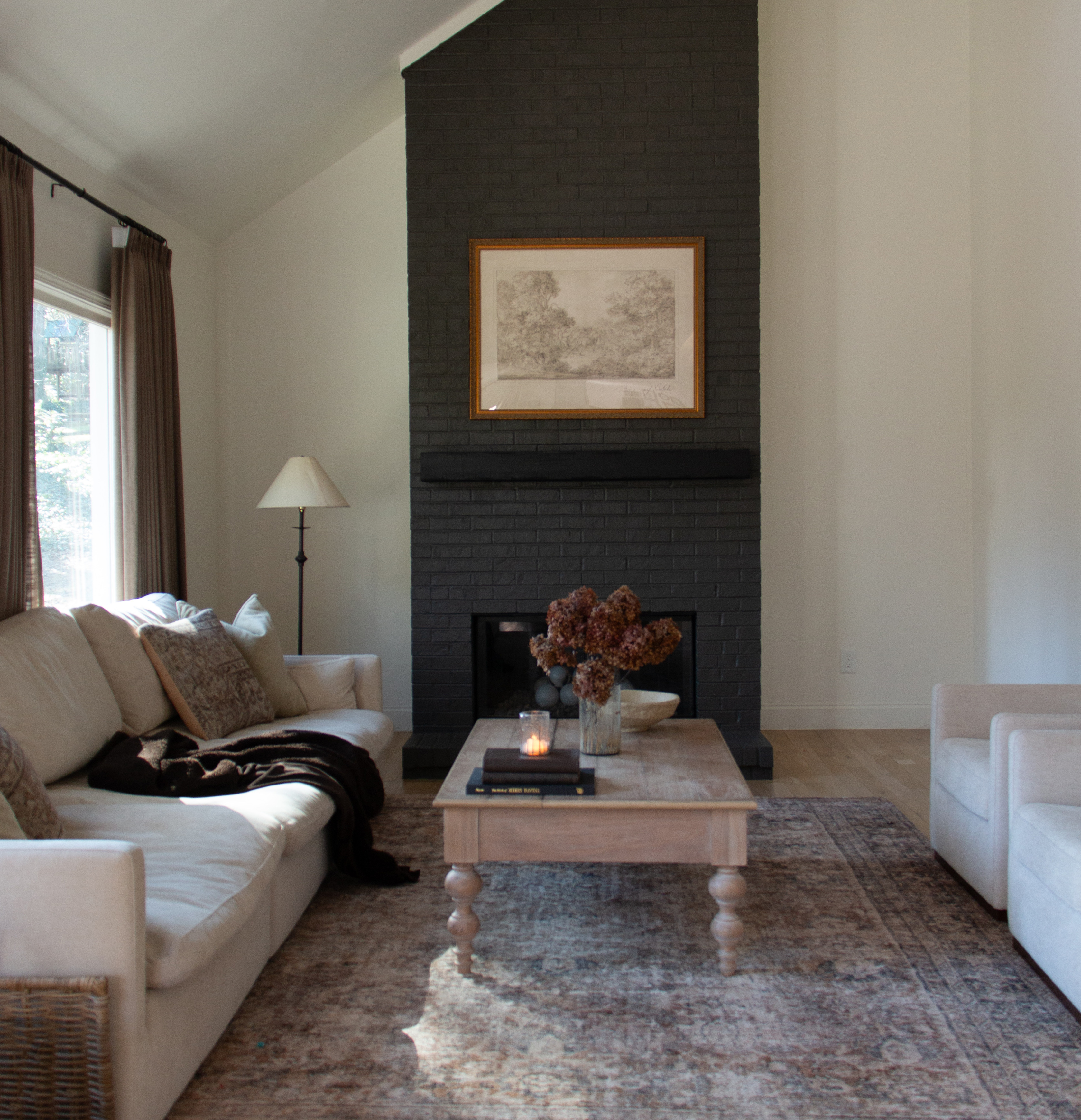
A gallery wall works when you have a collection. Travel photos, family milestones, and a mix of prints can read as gathered over time rather than purchased in an afternoon. This approach suits living rooms that tell a story.
The installation is where most people stall. Measuring, spacing, leveling, and hammering multiple frames without leaving unnecessary holes is genuinely difficult without a system. Frameology's ready-to-hang gallery walls solve this with a life-size gallery wall template included in every Classic and Luxe gallery wall.
Classic gallery walls, starting at $198, include a custom gallery wall template. Tape the template to the wall, hammer nails into the marked spots, remove the template, and hang your frames. Classic gallery walls include the necessary hanging hardware. Luxe gallery walls, starting at $638, include both the gallery wall template and all hanging hardware, including nails and a mini-level. Luxe frames use a dual-point hanging system for precise leveling and strong stability.
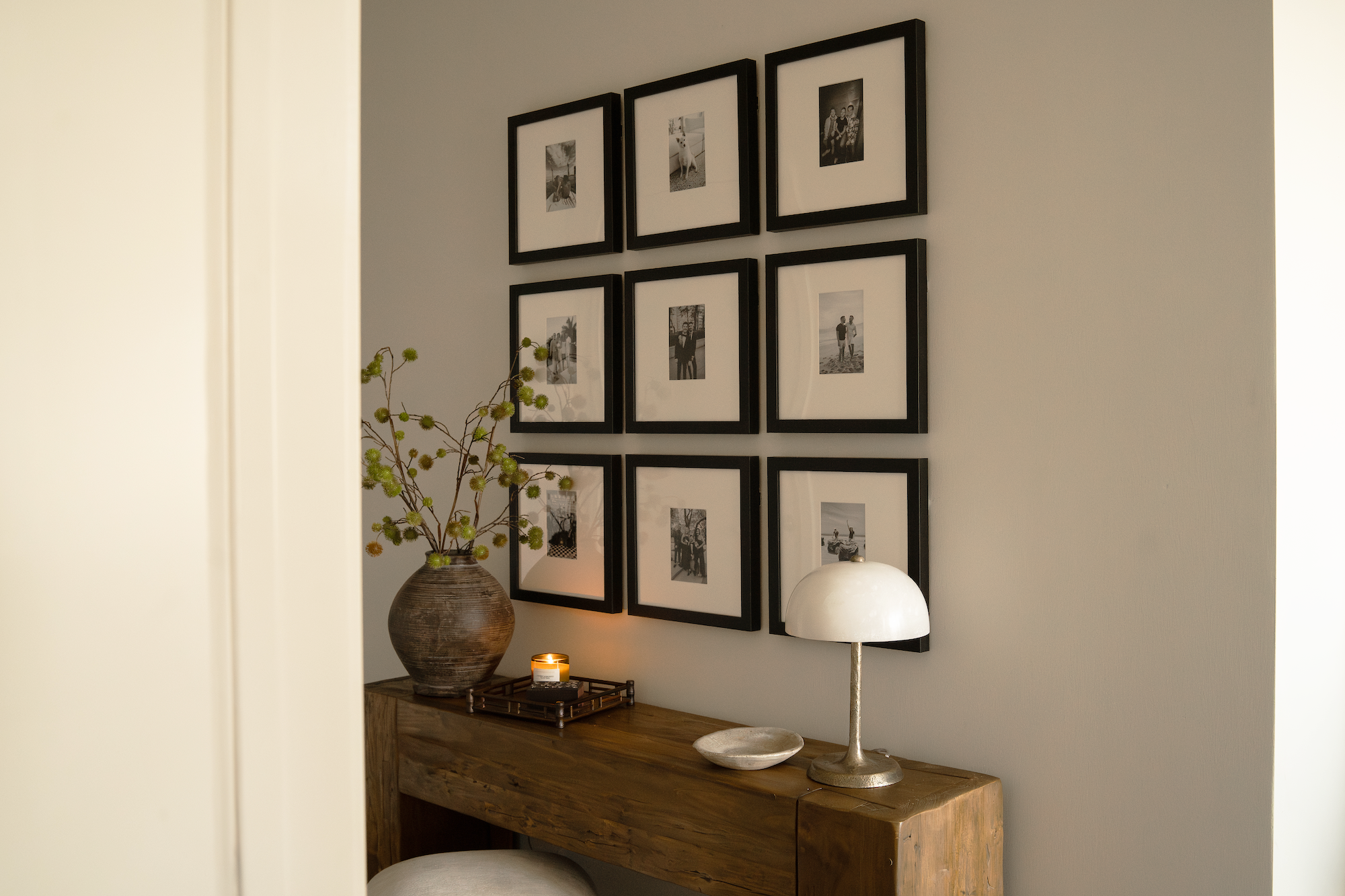
Canvas galleries and Gallery Wall Design Service galleries do not include a gallery wall template. For a step-by-step walkthrough of the installation process, Frameology's Classic gallery wall installation video and Luxe gallery wall installation video cover both systems in full detail. For layout ideas, Frameology's living room gallery wall layout guide is the deeper resource.
Find your perfect gallery wall
What makes wall art look cheap (and how to avoid it)
Three variables determine whether wall art reads as intentional or accidental: frame quality, correct scale, and cohesion. When all three are right, the result looks designed. Missing any one undermines the whole wall.
Art hung too small for the wall is the single most common mistake. A 30x40 print above a three-seater sofa looks like a postage stamp on a billboard, as Fab Art's layout guide puts it plainly. The same image at 40x60 in a proper frame looks intentional. Scale is about sizing correctly for the wall, not about spending more.
Mismatched frame finishes across one wall read as accidental rather than collected. Interior designer Emily Spanos, as quoted in House Beautiful's gallery wall guide, recommends matching all frames or using similar finishes to create cohesion. Limiting frame finishes to one or two across a single wall is the fastest way to make a gallery wall look curated rather than random.
Beyond finish consistency, the materials themselves matter. Materials that warp, sag, or yellow make the print look disposable regardless of how good the image is. Woodman Frames' framing guide notes that a mass-produced frame made from composite materials will inevitably warp and stain the art over time, while museum-quality framing built from solid materials safeguards artwork from environmental degradation.
Frameology's Luxe line addresses this directly. Premium wood and metal moldings, acid-free mats, and UV-protecting museum-grade acrylic keep prints looking exactly as they did on day one. For walls where value and flexibility matter more than permanence, Classic Wall frames, starting at $59, deliver quality framing with a removable backing for easy photo swaps.
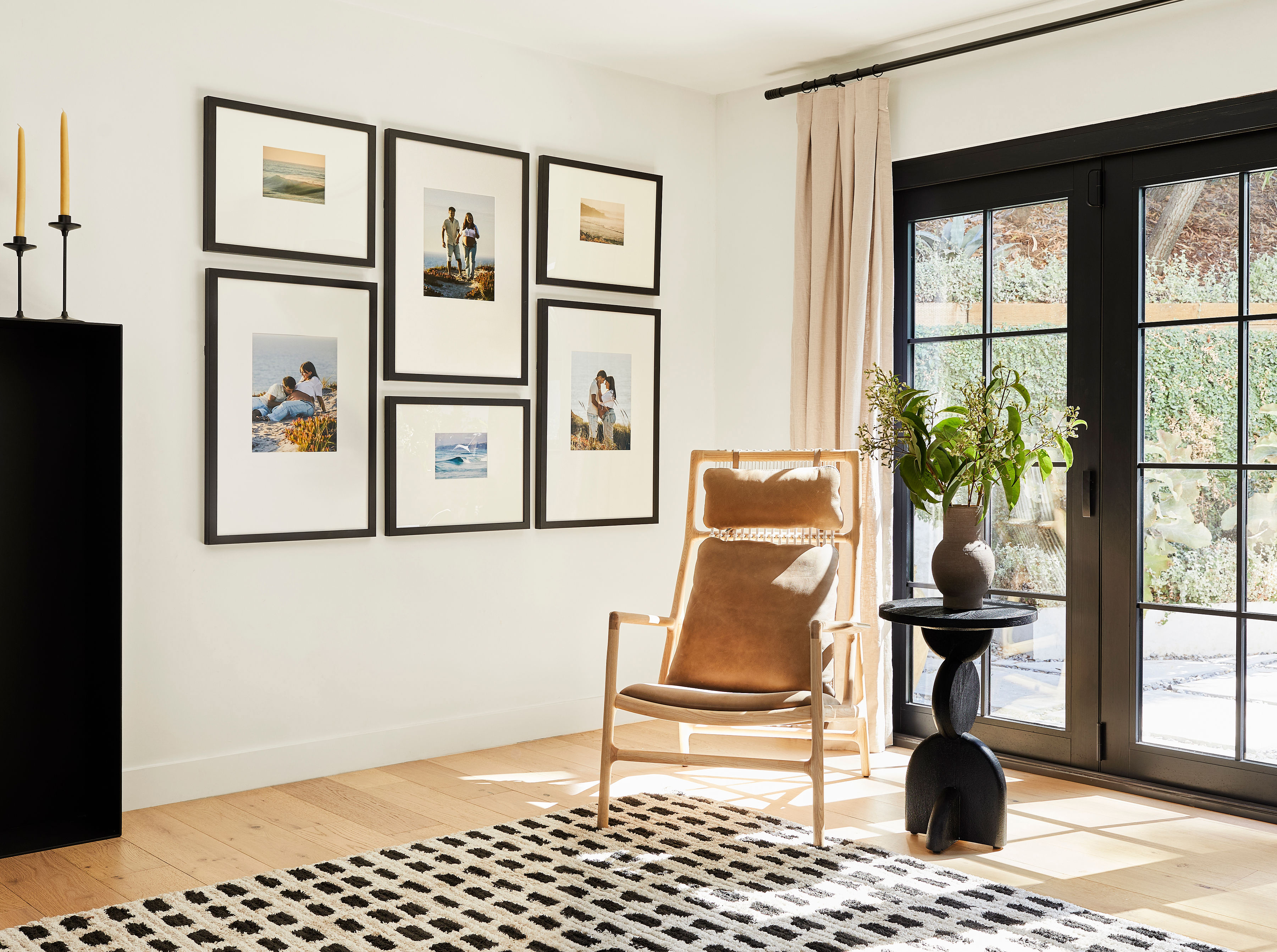
Interior designer Jeanne Barber, quoted in House Beautiful's home decor mistakes guide, says that poor-quality frames always make the artwork itself look bad. The frame is part of the composition, not a neutral vessel.
What wall art trends are rising in 2026?
Wall art trends in 2026 move away from flat, screen-friendly graphic design toward art with physical presence. Fab Art's 2026 wall art forecast calls texture the most universally agreed-upon direction of the year, citing visible brushstrokes, thick impasto oil-style layers, and hand-torn paper collage as examples. The 2026 Houzz UK Emerging Trends Report, as covered by House Beautiful, shows search increases for modern organic and tactile textures, confirming this as a measurable market direction.
Oversized scale is rising. Roseson Studios' 2026 forecast reports that oversized, single-statement wall art is dominating American living rooms. Homeowners are moving away from small, scattered frames toward bold above-sofa pieces sized to anchor the sofa wall. Warm earth-tone abstract canvas appears as the number-one trending wall art style, with search and sales data in agreement.
Biophilic art is also surging, according to the Desenio Wall Art Index 2026. Stylized, atmospheric, painterly interpretations of nature, such as cloud and sky studies, soft horizons, and loose botanical paintings, are outperforming literal high-definition nature photography.
Several formats are declining in 2026. Mass-produced matching sets, overly small symmetrical arrangements, and the perfectly uniform grid of identical frames holding near-identical prints are all losing ground. Fab Art dates the perfectly matched gallery wall of six identical black frames in a perfect grid as the dominant aesthetic from roughly 2018 to 2024. Asymmetrical, mixed-frame, mixed-size arrangements now replace that look. Overly polished digital art and the "greige era" of warm-beige-everything are also identified as out.
Framed vs. canvas vs. metal vs. acrylic for a modern living room
Each substrate uses a different printing technology and produces a different result. Matching the substrate to the image and the room creates a print that looks right instead of like a compromise.
Framed prints use continuous-tone archival printing on premium photo paper, sealed behind glazing. They deliver the sharpest detail and the strongest conservation setup. This makes them the best pick for portraits, black-and-white photography, and minimalist line art. Classic Wall frames, starting at $59, offer strong value and fast shipping with a removable backing. Luxe Wall frames, starting at $79, add premium wood molding, acid-free mats, and UV-protecting museum-grade acrylic for a museum-quality result. As photographer Amy Marlan's wall art guide notes, glazing is the practical way to put a UV filter between a photograph and room light, which matters for anything intended to last.
Canvas uses high-resolution Giclée printing on woven fabric. The result is matte, glare-free, and lightweight. It can hang with damage-free mounting strips or velcro wall adhesives, which makes it renter-friendly. Canvas suits atmospheric landscapes, abstract art, and any wall opposite a window where glazed prints would reflect. Premium Canvas Prints, starting at $19, go up to 40x60 for large-scale statement pieces. HD Framed Canvas, starting at $49, adds a frame for a more finished look.
Metal uses advanced dye-sublimation infused into coated aluminum. The image is bonded into the substrate rather than sitting on top of it. This process produces crisp detail, high contrast, saturated color, and strong durability. Metal is the best pick for bold abstracts, architecture, and high-contrast black-and-white work. HD Metal Prints, starting at $65, deliver this at a competitive price point. Mosaics by Marc's substrate comparison notes that properly produced metal photo prints can maintain color fidelity for 60 years or more under normal indoor conditions.
Acrylic uses direct-printing behind polished acrylic for optical depth and deep blacks. It delivers the most dramatic result per square inch and is the format most commonly used in galleries and high-end interior installations. Acrylic Wall Prints, starting at $59, bring this look to living rooms at a fraction of the gallery price. For a luminous print-on-glass effect, Glass Prints, starting at $39, deliver edge-to-edge clarity on 1/8-inch thick glass. Gloss Wood Prints, starting at $59, add an organic warmth that suits the 2026 tactile interior direction.
The full range of frameless options is available through Frameology's frameless prints collection.
From blank wall to finished room
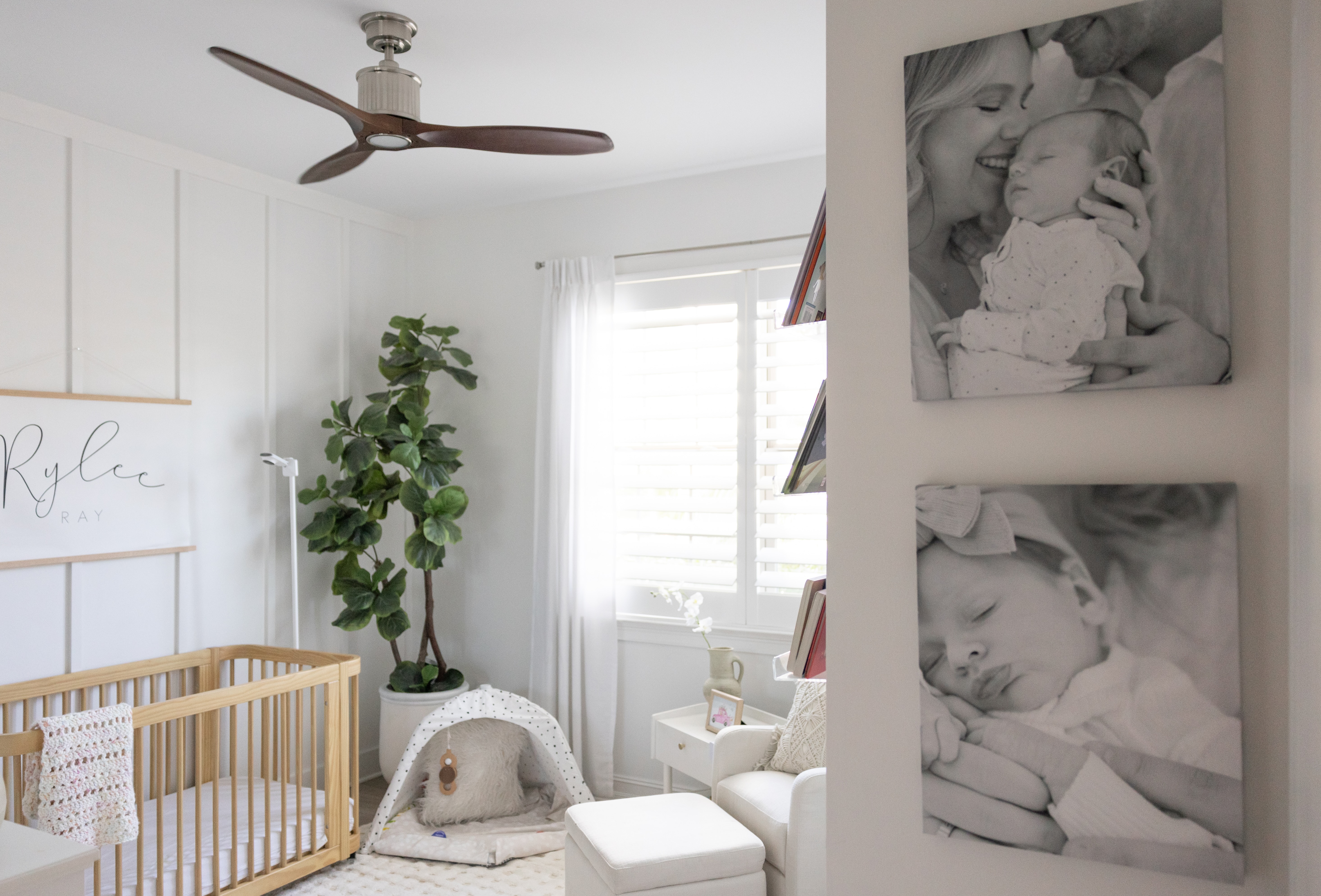
Three decisions turn a blank wall into a finished room. Pick the style from the eight options above that solves your specific design problem. Size it to two-thirds of your sofa width with the center generally around 57 inches from the floor. Frame it to match the art, not the sofa.
Frameology makes every one of those decisions easier. With 30+ years of family-owned framing heritage, hand framed in the United States, over 7,700 verified 5-star reviews at a 4.98/5 star rating, and a mobile AR preview that shows you the result before you commit, it is a trusted place online to print, frame, and display modern living room wall art. Here is why Frameology is the best online framing service if you want the full case.
Shop gallery walls with templates
Frequently asked questions
What is the difference between Classic and Luxe frames?
Classic frames deliver strong value and fast shipping, starting at $59 for wall frames. They feature a removable backing so you can swap photos whenever you want, which is ideal for seasonal refreshes or updating displays as new memories are made. Classic frames use a single center hanger, and you will supply your own nails and level.
Luxe frames are top-of-the-line, museum-quality framing starting at $79. They are made with premium wood molding and metal moldings, acid-free mats, and UV-protecting museum-grade acrylic. Luxe frames have a sealed, permanent kraft paper backing, so photos cannot be swapped once framed, and they come with all hanging hardware included: nails, a mini-level, and a no-wire dual-point hanging system for precise leveling. Luxe products take 7–10 business days because of their artisan craftsmanship.
How do I know what size art to buy for my sofa?
Measure your sofa's full width including the arms, then multiply by 0.66. That is your target art width. A 60-inch sofa wants about 40 inches of art, a 72-inch sofa about 48 inches, an 84-inch sofa about 56 inches, and a 96-inch sofa about 64 inches. Hang the art so its center generally sits around 57 inches from the floor, and leave 6–8 inches between the sofa back and the bottom of the frame. If you are unsure about size before buying, Frameology's mobile-only AR preview lets you project a true-to-scale preview of your exact frame onto your wall using your phone.
Do all gallery walls include hanging templates?
Classic and Luxe gallery walls include life-size gallery wall templates that make installation simple and straightforward. Canvas galleries, Metal galleries, and gallery walls created using Frameology's Gallery Wall Design Service do not include templates because their construction and customization work differently and often require more tailored installation approaches.
What is the best substrate for a modern living room?
The best substrate depends on the image and the wall. Framed prints are the best choice for portraits, black-and-white photography, and line art because they deliver the sharpest detail and the strongest UV protection. Canvas is the best choice for large-scale pieces, walls with strong natural light, and renters who need damage-free hanging options. Metal suits bold abstracts, architecture, and high-contrast imagery. Acrylic delivers the most dramatic result per square inch and works best as a statement piece in a room without direct light hitting the wall. If you are unsure, Frameology's mobile-only AR preview shows you the result before you commit.
How does Frameology's AR preview work?
The AR preview is a mobile-only tool: open Frameology's website on your phone, customize your frame or gallery wall, and tap the AR icon. Your phone's camera projects a true-to-scale preview of the exact frame onto your wall so you can see how it will look in your space before buying. No app download or login is required. The tool previews a frame or a gallery wall. It does not design one for you.
What image resolution do I need for a large print?
For prints up to 16x20, most smartphone photos taken in the last few years will hold up well. For canvas prints at 30x40 or larger, check that your image is sharp at 100% zoom on your screen. A photo that looks great on a phone may not hold detail at 40 inches. Canvas is more forgiving of lower-resolution images than framed prints on photo paper because the woven texture softens minor imperfections. If you are printing at 40x60, a high-resolution original file will always produce a better result.
