


Office wall art sizing guide: what fits your space
Written by: Daniel Koren, Co-Founder, Frameology
Key takeaways
Office wall art sizing follows two core rules: the 2/3 rule for furniture-anchored walls and the 60% rule for open wall spaces.
Above a desk, measure the desk width and apply the 2/3 rule to find the ideal art width, with clear ranges for common desk sizes.
Video call backdrops work best with a single 24x36 to 30x40 inch piece hung slightly off-center, with matte finishes that avoid glare.
Standard office art sizes range from small (8x10) to extra-large (36x48 or more), with 24x36 as the most versatile size for many office walls.
Frameology offers AR preview tools, gallery wall templates, and quality framing options to help you choose office wall art that fits your space.
The golden rules of wall art sizing
Two simple rules guide most office wall art decisions and help your art feel intentional instead of random.
Rule #1: The 2/3 rule for furniture-anchored walls
The 2/3 rule says wall art should span about two-thirds to three-quarters of the furniture width beneath it. For a 60-inch desk, that means art roughly 36–45 inches wide, or 60–75% of the desk width. This creates a visual connection between the art and the surface below and keeps the piece in scale with the room. Use this rule above desks, credenzas, and reception counters, or anywhere furniture anchors the wall.
Rule #2: The 60% rule for open wall spaces
The 60% rule says wall art should cover about 60–75% of the available wall width. On a 120-inch wide blank wall, that means at least 72 inches of art width, or a gallery wall that fills that footprint. This keeps art from looking tiny on large office walls. Use the 2/3 rule when furniture sits below the art, and use the 60% rule when the wall stands open with no furniture beneath it.
What size art should go above a desk
Desk art sizing starts with a tape measure and the 2/3 rule. Measure your desk width, multiply by two-thirds, and use that number as your target art width. Here’s how that looks for common desk sizes:
48-inch desk: 32–36 inches of art width
60-inch desk: 36–45 inches of art width
72-inch desk: 48–54 inches of art width
For hanging height, leave 6–10 inches between the top of the desk and the bottom of the frame, and aim for the center of the art at 57–60 inches from the floor for standing viewers. In a private office where you mostly sit, lowering the center point to 52–55 inches feels more natural because you view the art from a chair.
A single large piece or a gallery wall both work above a desk, as long as the total width follows the 2/3 rule. For a 60-inch desk, a single Luxe Wall in a 24×30 size hits the sweet spot.
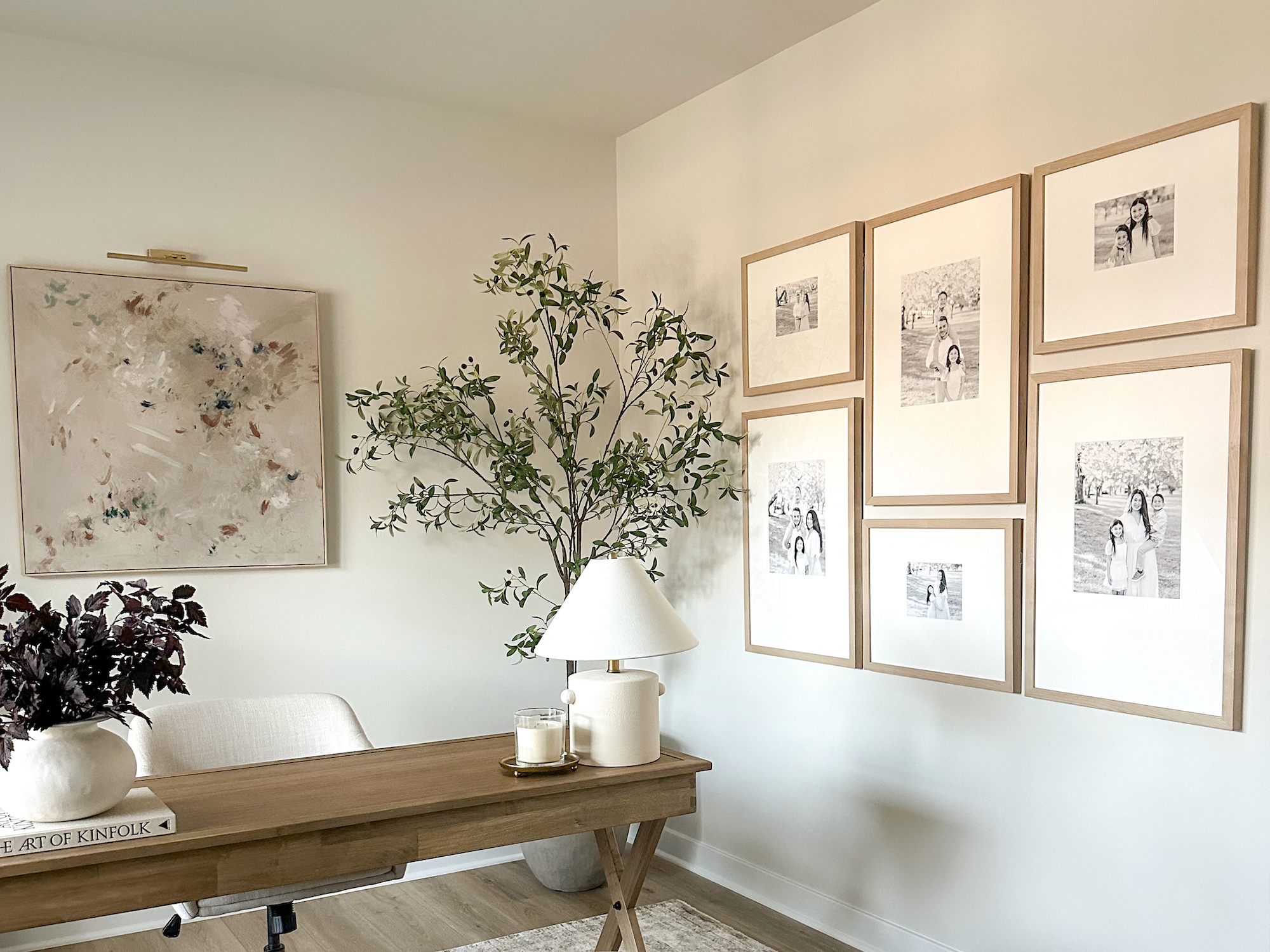
Standard office wall art sizes in inches
Different sizes shine in different office spots, so it helps to match the size to the job.
Small (8x10, 11x14): Narrow walls, between windows, gallery wall components, and shelves. These sizes work best as supporting pieces instead of standalone statements.
Medium (16x20, 18x24): Above small desks, cozy corners, and home office accent walls. 16x20 is one of the most versatile sizes for home offices and narrow hallways.
Large (24x36, 30x40): Above standard desks, video call backdrops, and conference room focal points. 24x36 is described as the single most useful size in decorating, and it works especially well above desks and in video call zones.
Extra-large (36x48 and up): Reception areas, large conference rooms, and open-plan zones. 36x48 is classified as oversized, gallery-scale art that suits spaces where viewers stand farther away.
Frameology’s Luxe Wall (starting at $79) comes in sizes up to 30x40, which covers the small through large categories. For extra-large statement pieces, Premium Canvas Prints (starting at $19) and HD Framed Canvas Prints (starting at $49) go up to 40x60 and stay lightweight and renter-friendly, so you can hang them with damage-free strips or velcro wall adhesives.
Always measure the framed size, not just the print. Framing adds to the overall dimensions, so your measurements should include the frame, not only the canvas or print. A 24x36 print in a wide mat can reach about 30x42 inches of total wall space.
Wall art size for video call backdrops
Video call backdrops follow their own sizing rules because the camera crops and compresses what it sees.
For most standard webcam setups, a single piece between 24x36 and 30x40 inches works well. It’s large enough to anchor the frame and simple enough to avoid visual noise. A single canvas, framed print, or metal print between 24 and 36 inches wide usually fits comfortably in a camera frame.
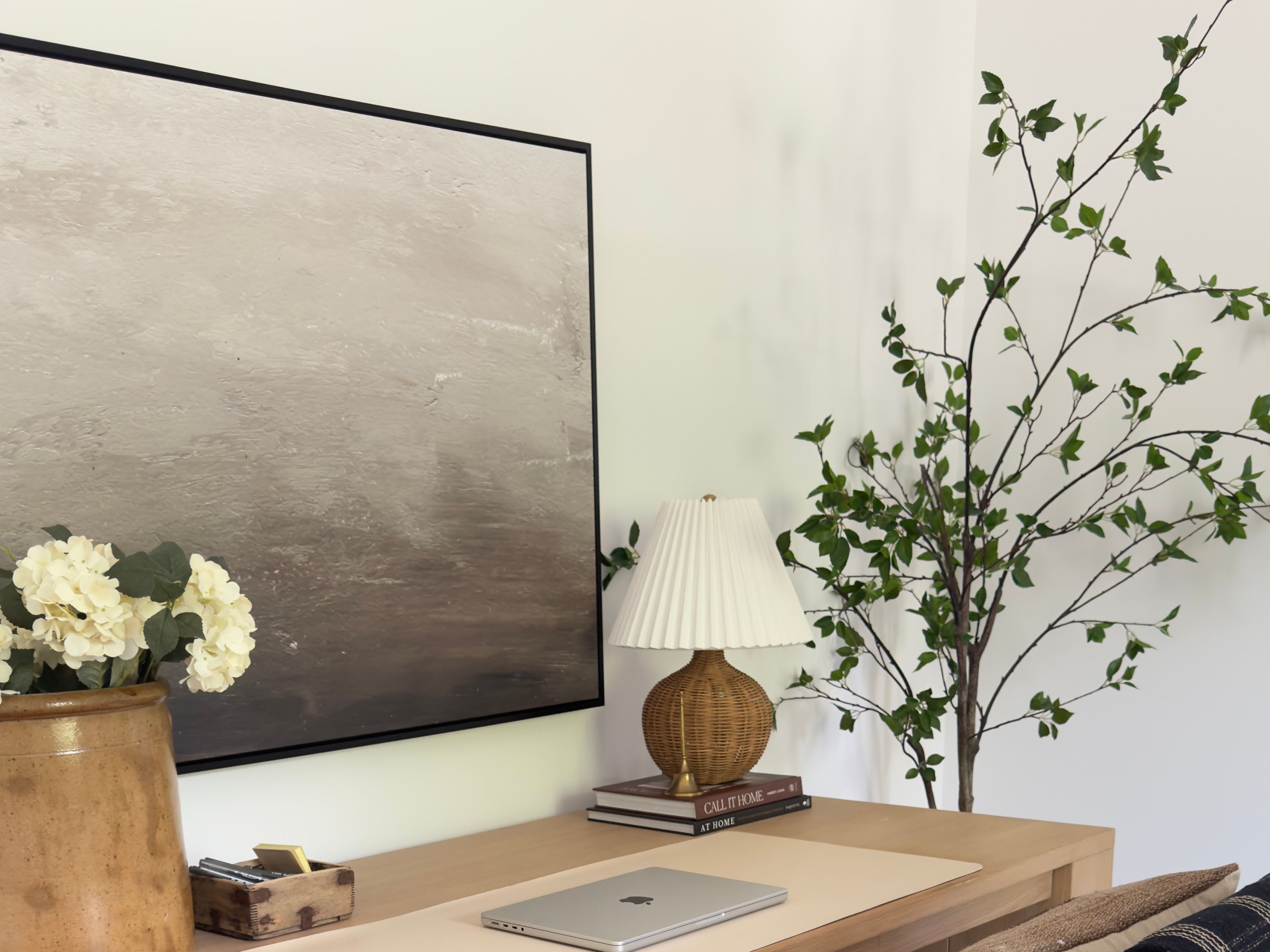
Placement matters as much as size. Hang art slightly off-center behind your shoulder, about a third of the way into the frame, instead of directly behind your head, because centered art can look like it’s sprouting from your head. Keep the bottom edge 6–12 inches above the desk, and make sure the entire piece stays visible when you sit on camera.
Gallery walls and clusters of small frames rarely work well in the camera zone. A grid of small frames often turns into visual static next to a face, especially once compression blurs the gaps, while a single anchor piece reads as a clear choice.
Finish matters too. Glass and acrylic over prints often create glare on video calls because ring lights, monitor glow, and overhead fixtures bounce off the glazing at the webcam angle. Frameology’s Premium Canvas Prints, starting at $19, have a matte surface, which makes them a strong option for client-facing video backdrops. A 2023 PLOS One study that tested six Zoom backgrounds found that bookcase and houseplant backgrounds ranked highest for trustworthiness and competence, which shows how much your backdrop shapes first impressions.
To see how your backdrop will look on camera, Frameology’s mobile-only augmented reality (AR) preview tool lets you project a true-to-scale preview of your chosen frame onto your wall using your phone’s camera. You can check the art from your desk chair and from your webcam’s perspective before you commit.
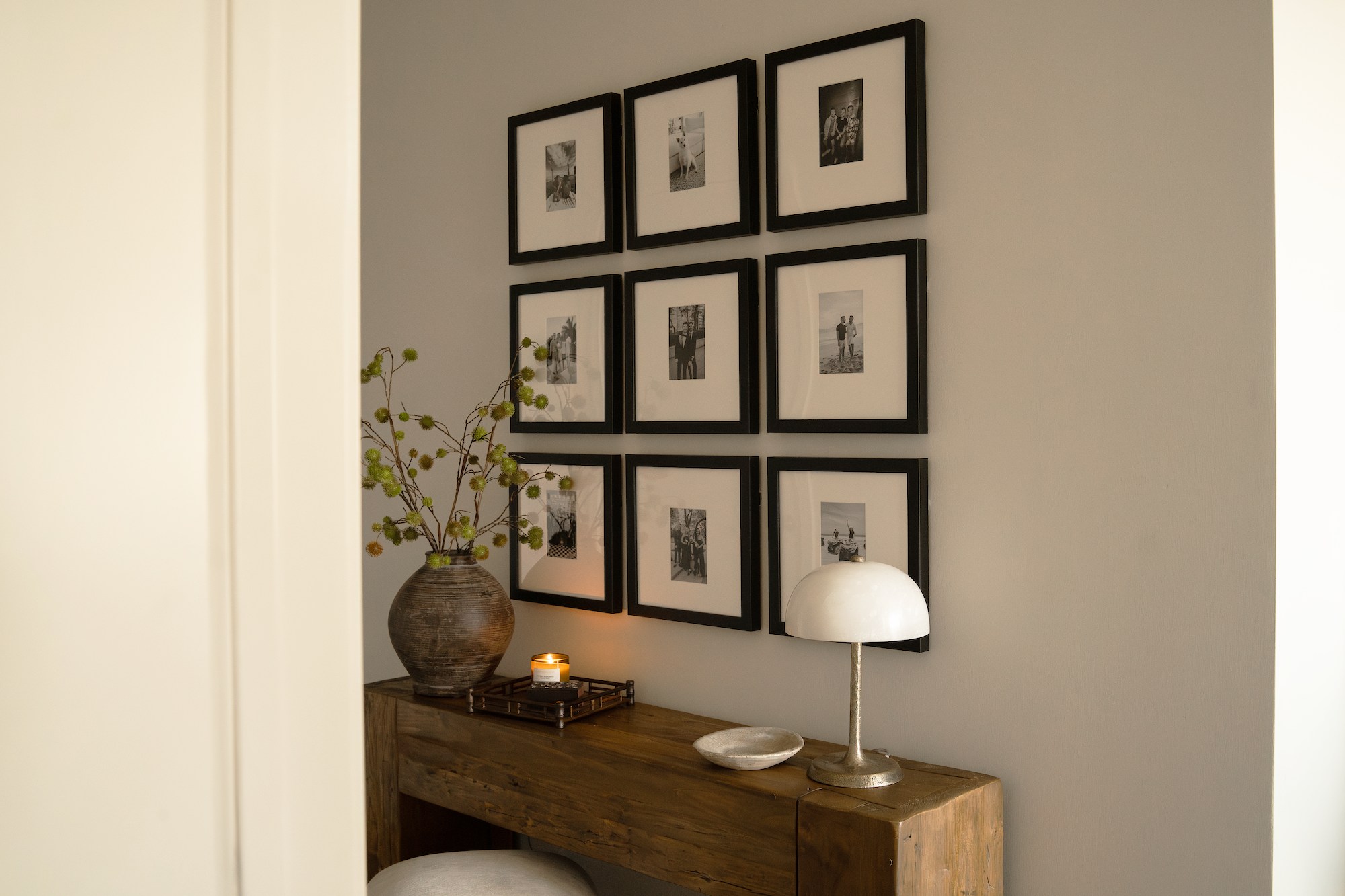
How to size art for a large office wall
Conference rooms, reception areas, and open-plan spaces usually follow the 60% rule for width. The formula stays simple: multiply the wall width by 0.6 to 0.75 to find your ideal art width. Here are two quick examples:
10-foot (120-inch) wall: 72–90 inches of art
8-foot (96-inch) wall: 58–72 inches of art
When a single piece doesn’t come in the width you need, a gallery wall that reads as one visual unit solves the problem. On wide lobby walls, a diptych or triptych can span more wall space without requiring an unusually long canvas, and the gaps between pieces add rhythm and movement.
Frameology’s Luxe Bricklay ($1,074) and Classic Grid ($594) both fill substantial wall space as a single cohesive arrangement. Classic and Luxe gallery walls include life-size gallery wall templates for effortless installation. Simply tape the gallery wall template to the wall, hammer nails into the marked spots, remove the template, and hang your frames.
How high to hang office wall art
Hanging height often makes or breaks office art, especially in rooms where people sit most of the day.
Standing viewers in lobbies, reception areas, and hallways: center of art at 57–60 inches from the floor
Seated viewers in private offices and conference rooms: center of art at 52–55 inches from the floor
Above furniture: bottom of art 6–10 inches above the desk or surface
Video call backdrops: adjust so the art stays fully visible in the camera frame, and test with your webcam preview first
A piece that sits too high feels detached from the furniture and can make the wall look accidental, especially in seated rooms where viewers look up at the art. To make precise height adjustments easier, Frameology’s Luxe Wall, starting at $79, frames include a no-wire hanging system with two side hangers for perfect leveling, plus all hardware, nails, and a mini-level in the box.
Common office wall art sizing mistakes
Most office sizing issues fall into a few familiar patterns, and each one has a simple fix.
Art too small for the wall: Apply the 60% rule and size up. Small art can disappear quickly and make the room feel unfinished.
Hanging art too high: Keep the center at 57–60 inches for standing viewers and 52–55 inches for seated rooms. Art near the ceiling feels disconnected from the furniture.
Ignoring desk width: Apply the 2/3 rule to the desk, not the wall. Many people size artwork to the wall instead of to the furniture or anchor piece below it.
Skipping the video call backdrop test: Check the placement with your camera before buying. A layout that looks balanced in the room may sit off-center or partially cropped on screen.
Overcrowding a small wall: Choose one confident piece instead of several tiny ones. A scattering of small frames creates a “postage stamp effect” that feels like an afterthought.
Forgetting the frame in measurements: Measure the framed size, not only the print. Matting and framing add real inches to the total wall footprint.
Preview your office art with augmented reality
Frameology’s mobile-only AR preview tool gives you a practical way to remove guesswork from office art sizing. There’s no app download required: open Frameology on your phone, customize your frame or gallery wall, and tap the AR icon. Your phone’s camera then projects a true-to-scale preview of your chosen piece onto your wall.
In an office, this lets you check the art from your desk chair, from the doorway, and from your webcam’s perspective before you place an order. The tool works across Frameology’s Framed Pictures Collection and photo gifts, and it cuts down on returns and do-overs. With over 7,500 verified 5-star reviews and a 4.98/5 rating, Frameology has earned its reputation as the best online framing service, and the AR tool plays a big role in that experience.
Frame the moments that matter in your office
Office art sizing feels straightforward once you know the rules. Use the 2/3 rule above desks and other furniture-anchored walls. Use the 60% rule for open conference room and reception walls. Choose a single 24x36 to 30x40 piece for your video call backdrop, hang it slightly off-center behind your shoulder, and pick a matte finish to avoid glare. Always measure the framed size, not just the print.
Frameology makes each step easier. The AR preview tool removes sizing uncertainty before you buy. Classic and Luxe gallery walls include life-size gallery wall templates that simplify installation. The Classic Wall, starting at $59, offers strong value and fast shipping, while the Luxe Wall, starting at $79, delivers museum-quality, USA-crafted framing with all hardware included.
Browse Frameology to start framing your favorite office memories.
Frequently asked questions
What is the 2/3 rule for wall art?
The 2/3 rule says wall art should span about two-thirds to three-quarters of the furniture width beneath it. It applies above desks, credenzas, and reception counters, or anywhere furniture anchors the wall, and it gives you a reliable starting point for office art sizing.
What size art should go above a desk?
Apply the 2/3 rule to your desk width and use the ranges in the desk section as a guide. Hang the art so its bottom edge sits 6–10 inches above the desk surface. For seated offices, aim for the center of the art at 52–55 inches from the floor instead of the 57–60 inch range used for standing viewers.
How high should I hang art in an office?
For standing viewers in lobbies, reception areas, and hallways, center the art at 57–60 inches from the floor. For seated viewing in private offices and conference rooms, lower the center to 52–55 inches. Keep the bottom edge of the art 6–10 inches above any furniture surface below it, and test video call backdrops with your webcam preview because camera eye level rarely matches standing eye level.
Can I use a gallery wall in a small office?
You can use a gallery wall in a small office if you treat the entire arrangement as one piece and apply the 2/3 rule to the desk width. Keep the gallery wall to 3–5 pieces with consistent 2–3 inch spacing between frames. A single anchor piece often feels calmer than several small frames in a compact space. If you choose a gallery wall, Frameology’s Classic gallery walls include a life-size gallery wall template that makes installation straightforward, even in tight rooms.
Do all gallery walls include hanging templates?
Classic and Luxe gallery walls include life-size gallery wall templates that make installation simple and predictable. Canvas galleries and gallery walls created through Frameology’s Gallery Wall Design Service don’t include templates because their construction and customization work differently and often call for more tailored installation.
What if I need a custom size?
Frameology offers standard sizes up to 30x40 for framed prints and 40x60 for canvas prints. The most effective approach is to use the AR preview tool on mobile to see how a standard size fits your wall. In most cases, the 2/3 rule and 60% rule land on a standard size that Frameology already offers, so you can get a great fit without a custom order.
