


Metal prints for wall art: choose the right finish and size
Written by: Daniel Koren, Co-Founder, Frameology
Key takeaways
Metal prints are frameless dye-sublimation panels on aluminum that deliver scratch-resistant, moisture-resistant, high-contrast wall art without glass.
Choose matte or satin finishes for rooms with direct light or windows, and use glossy for controlled, dim lighting with high-contrast images.
Size art to span two-thirds to three-quarters of the furniture below it, and size up metal panels compared with framed pieces.
Float mounts create a shadow gap for modern depth, while flush mounts sit closer to the wall and both arrive ready to hang with proper hardware.
Frameology’s HD Metal Print uses dye-sublimation on aluminum and offers finish, size, and mount options that fit most homes and budgets.
Start framing your favorite memories at Frameology
Choosing between glossy, matte, and brushed metal prints
Finish has the biggest impact on how your metal print looks on the wall, so it deserves a clear plan before you pick size or mount. The three main options each come with specific trade-offs.
Glossy: delivers maximum color saturation and the deepest blacks, but glares hard under ceiling lights or when hung opposite a window, which makes it a poor fit for south-facing rooms or any wall that catches direct light.
Matte: minimizes reflections and creates a softer, more understated appearance with excellent viewing consistency, but blacks read slightly less dense than on gloss, so very dark, high-contrast images lose a bit of punch.
Brushed or clear: leaves portions of the aluminum surface visible through lighter areas of the image, creating a metallic effect that becomes part of the artwork itself, which suits architectural photography, cityscapes, and industrial subjects more than portraits or warm family photos.
Lighting and image type drive the right choice. Ambient light above 150 lux, a level common in many North American homes, erases the contrast advantage of gloss, so a south-facing living room or any room with large windows usually calls for matte or satin. Portraits and warm skin tones often look harsh on glossy metal because the surface over-saturates and over-contrasts, and matte works better for professional interiors with soft lighting. Landscapes, travel shots, and high-contrast abstract art shine on glossy metal, where the stronger contrast, richer blacks, and brighter highlights can make photography look almost three-dimensional in controlled or dim light.
Frameology’s HD Metal Print uses advanced dye-sublimation infused directly into scratch-resistant aluminum for vivid, high-definition prints with strong contrast. If you want to test a finish on a smaller scale, the Metal Desk Print offers the same process in a compact format.
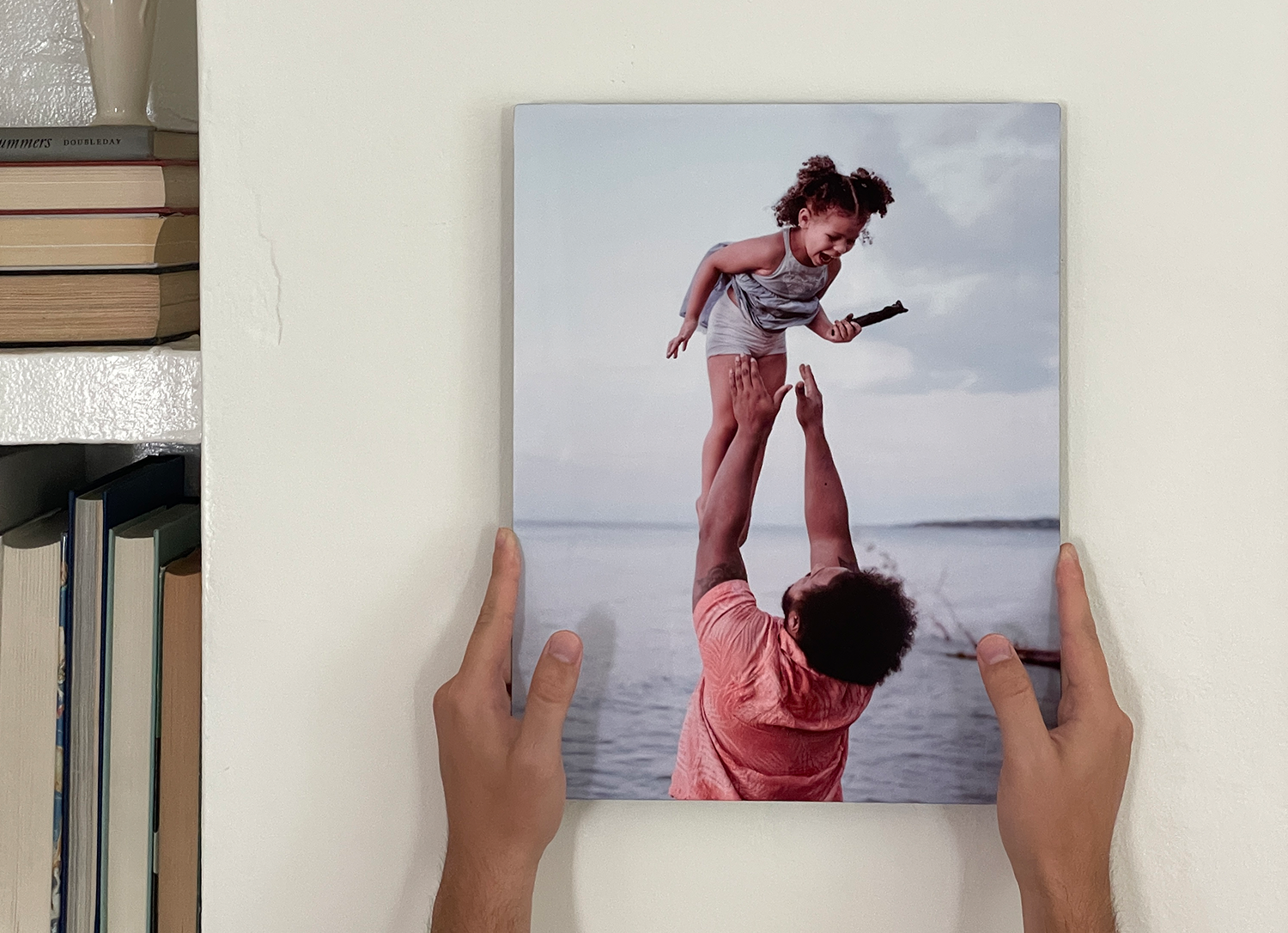
Picking the right size for your metal print
Metal prints often look smaller on the wall than buyers expect, so planning around your furniture helps you avoid undersizing. A print that feels huge on your phone can disappear above an 84-inch sofa, and undersized art is one of the most common decorating mistakes. Interior designers and Urban Barn’s wall styling guide recommend that art span roughly two-thirds to three-quarters of the furniture below it.
Here’s how that rule plays out with common furniture widths:
84-inch sofa: target 56–63 inches of art width. A 24x36 print hung landscape works for a loveseat or accent wall, while a 40x60 or 40x27 horizontal suits a full sofa wall.
Queen bed (60 inches wide): target 40–45 inches. A single 24x36 horizontal gives a calm, classic look, as PrintStudio.art’s sizing guide notes.
King bed (76 inches wide): target 50–57 inches. Choose one large 40x27 horizontal or a pair of 24x36 verticals with a tight gap.
48-inch console: target 29–36 inches. A 24x36 vertical or a 30x30 square works well.
Art hung above furniture should leave six to twelve inches of bare wall between the top of the furniture and the bottom of the frame, and eight inches feels balanced in most rooms. When there’s no furniture anchor, museums typically place the center of the piece 57 to 60 inches from the floor.
Metal’s frameless edge changes the visual footprint compared with framed art. A framed piece adds four to ten inches through moulding and mat, so a 24x36 print in a wide frame can finish around 34x46. A metal panel reads exactly at its stated dimensions, which means you’ll usually want to size up compared with a framed order to get the same coverage. When you group multiple metal panels, two to three inches between panels is a standard gap. Tighter spacing makes the group read as a single large piece.
Frameology’s HD Metal Print is available in sizes up to 30 x 40 inches, including 11 x 14 inches, and the Premium Canvas Print goes up to 40 x 60 inches for statement walls. Frameology’s mobile-only augmented reality (AR) preview shows a true-to-scale view of your exact frame or photo gift on your wall, so you can see whether a 20x30 or a 24x36 fills the space the way you want.
Discover the best way to print your photos at Frameology
How to hang a metal print without a frame
Metal panels hang differently from framed art, and your hardware choice affects both the look and the long-term stability. Most setups use one of two mounting approaches.
Float mount (also called exhibit mount): a bracket or French cleat system attaches to the back of the panel and holds it a half-inch to one inch off the wall, which creates a shadow gap and adds visual depth. A properly produced metal print arrives with float mount hardware attached and ready to hang, so you can skip the framing appointment, glass, and stretching. The float mount is the most popular display method for metal panels and suits minimalist and modern interiors especially well.
Flush mount (low-profile strip): a hanging strip keeps the print closer to the wall with a minimal shadow gap. This reads more like traditional framed art and works well in formal rooms or tight spaces where a floating gap might look out of place.
For metal prints in the 20 x 24 to 20 x 30 inch range, the hanger plate mounting option can rest on a single screw or hook attached to the wall, though manufacturers strongly recommend wall anchors and a stud detector for stability. For larger panels at 24 x 36 inches and above, a second person should hold the panel by its edges while you hang it, using a level and screwing into a stud or drywall anchors rated well above the print’s weight. A standard 0.045-inch aluminum panel weighs roughly 0.6 pounds per square foot, so a 24x36 panel runs about four pounds and a 30x40 panel runs about five pounds, which is manageable with proper hardware but too heavy for a single small nail in drywall.
Metal also handles moisture better than framed art. Sublimated aluminum panels resist humidity and temperature swings better than paper or canvas prints, so they work well in bathrooms, kitchens, and covered outdoor spaces such as patios and porches. The dye-sub process bonds the image inside the polymer coating rather than on top of it, so there’s no surface layer to peel, crack, or absorb moisture. For cleaning, use a soft microfiber cloth dampened with water or a mild, ammonia-free cleaner, and avoid ammonia-based products, which are a common cause of finish damage on display panels.
How long metal prints last in real homes
Wilhelm Imaging Research independently tested ChromaLuxe-grade dye-sublimation aluminum panels and rated them at 65 years of permanence under controlled display conditions. They also reported extrapolated indoor lifespans of more than 100 years away from direct sunlight. That performance is roughly twice the tested lifespan of many archival paper giclée prints and about three times the lifespan of typical canvas prints with archival inks.
The process itself drives that durability. The dye sits inside the polymer coating instead of on top of it, and indoor sublimation aluminum panels last 30 to 65 years without noticeable fading when they use a standard polyester coating. For outdoor use, standard panels suit covered, low-moisture areas like patios. Prolonged direct sun gradually shifts color tones on any dye-sub print, so panels meant for long-term outdoor display benefit from a UV-protective clear coat.
Direct prolonged sunlight, ammonia-based cleaners, and abrasive cloths or solvents can shorten a panel’s life by scratching or clouding the coating. With normal indoor care and a spot away from direct sun, a well-produced metal print should look essentially the same in 30 years.
Metal prints vs. canvas vs. acrylic: when metal is the right call
Metal works best when you care most about color fidelity, moisture resistance, and long-term durability. Metal prints are water-resistant, scratch-resistant, and fade-resistant, which makes them a strong fit for kitchens, bathrooms, garages, and covered outdoor areas where canvas struggles. High-saturation subjects such as landscapes, architectural photography, cityscapes, and bold abstract art look exceptional on metal because the aluminum surface reflects light instead of absorbing it, which produces stronger contrast and brighter highlights than canvas.
Canvas prints, available from Frameology as a Premium Canvas Print starting at $19, are lightweight and easy to hang. Canvas flatters warm, painterly subjects like family portraits and wedding photos, where the fabric texture softens skin tones and adds a tactile feel. The trade-off is that canvas prints in well-lit rooms can show noticeable fading within 10 to 15 years without UV protection coatings, and canvas stretched over wooden frames can bow or warp as humidity changes.
Acrylic prints appear in Frameology’s lineup as the Acrylic Wall Print starting at $59. They’re heavier than metal at large sizes and more fragile at the edges. They also typically cost two to three times more than metal prints while delivering roughly 90% of the same visual impact. In rooms with strong natural light, acrylic’s glossy surface can create glare that competes with the image, while metal’s matte or satin options handle that light more gracefully.
Mixing metal prints into a gallery wall
Metal panels mix well with framed pieces, but the frameless edge changes how you plan spacing and alignment. A framed piece has a visible border that creates natural separation. A metal panel reads edge-to-edge, so the gap between a metal panel and a framed piece needs to account for the frame’s moulding width to keep the arrangement balanced. A two-to-three-inch gap between a metal panel and a neighboring frame usually feels cohesive without making the frameless edge feel crowded.
When you mix metal panels with framed pieces in a gallery wall, aligning the centers of the pieces on a shared horizontal line keeps the layout feeling intentional even when sizes vary. Gallery walls feel intentional when they share a common element such as a color palette, frame finish, subject, or mood. A consistent frame finish on the framed pieces alongside a consistent metal finish on the panels usually gives enough unity.
Classic and Luxe gallery walls include life-size gallery wall templates that make installation simple and straightforward. Canvas galleries and gallery walls created using Frameology’s Gallery Wall Design Service don’t include templates.
Before you commit to a layout, Frameology’s mobile-only AR preview lets you check finish and scale on your actual wall, so you can see how a metal panel reads next to your existing frames before you pick up a hammer.
Explore ready-to-hang gallery walls at Frameology
Where to buy metal prints for wall art
Frameology focuses on metal prints for real homes, pairing framing expertise with a simple online experience that makes finish, size, and mount decisions feel clear. The HD Metal Print uses advanced dye-sublimation on scratch-resistant aluminum to deliver vivid, high-definition results across matte, satin, and glossy finishes.
Frameology’s mobile-only AR preview projects a true-to-scale view of your chosen finish and panel size onto your wall, so you can confirm both scale and glare risk before you buy. The single-page customization flow keeps the process straightforward: you pick your finish, upload your photo, choose your size, and check out without juggling extra tabs.
Every HD Metal Print is hand-produced in the United States and ships with carbon neutral shipping. Frameology launched online in 2015 as the evolution of a family-owned frame shop that served upper Manhattan from 1986 to 2020, and that 30+ year heritage shows in the build quality of each panel.
Experience why Frameology is the best online framing service today
Frequently asked questions
Are metal prints suitable for bathrooms and kitchens?
Metal prints handle humidity and splashes better than paper or canvas, which makes them a smart choice for high-moisture rooms. Because the dye-sublimation process bonds the image inside the polymer coating, metal prints are waterproof and highly moisture-resistant. They work well in kitchens, bathrooms, basements, and covered outdoor spaces where canvas might warp and paper might buckle. The surface wipes clean with a damp cloth, so maintenance stays simple.
How much does a metal print cost overall?
Metal prints usually sit above canvas on a price chart at the same size because of the aluminum and specialized equipment involved. At the same time, they arrive ready to hang and don’t need glass, mats, or custom frames, so the total cost of display often ends up close to a framed canvas once you add framing. Many photographers treat metal as a long-term investment piece for favorite images rather than a replacement for every print in the house.
How should you care for and clean a metal print?
Routine care stays simple. Dust with a dry soft microfiber cloth, and for fingerprints or smudges, use a cloth lightly dampened with water or a mild, ammonia-free cleaner. Avoid paper towels, abrasive pads, and any cleaner containing ammonia or alcohol, since these are common causes of finish damage on metal display panels. Metal prints don’t need glass, frames, or special cleaning products, so they’re one of the lowest-maintenance print options for busy households.
Do all gallery walls include a gallery wall template?
Classic and Luxe gallery walls include life-size gallery wall templates that make installation simple and straightforward. Canvas galleries and gallery walls created using Frameology’s Gallery Wall Design Service don’t include templates, so you’ll plan spacing and alignment yourself or with the help of painter’s tape on the wall.
