


Metal prints for photos: finishes, bases, and sizing guide
Written by: Daniel Koren, Co-Founder, Frameology
Metal prints turn your favorite photos into vivid, durable wall art. This guide walks through finishes, bases, photo choices, sizing, care, and where to order so you can feel confident before you buy.
Key takeaways
Metal prints use dye-sublimation to infuse photos directly into aluminum, creating a scratch-resistant, frameless finish that lasts decades indoors.
Finish choice matters most: glossy maximizes color for landscapes, satin reduces glare for portraits and mixed lighting, and clear base reveals metallic texture for industrial subjects.
White base keeps whites clean and colors vivid for portraits and landscapes, while clear base suits images where the brushed aluminum texture enhances the aesthetic.
Metal excels with high-contrast, vivid photos like landscapes and cityscapes but amplifies flaws in soft or low-contrast images, so review files at 100% before ordering.
Frameology offers premium HD Metal Prints with AR preview tools and decades of framing expertise to help you choose the right finish, base, and size.
Shop Frameology HD Metal Prints
Glossy vs. matte vs. satin metal prints: pick by room light and photo content
Finish has more impact on the final look than almost any other choice, according to PhotographyTalk's 2026 metal print review. Use the room light and photo style to guide your decision.
High-gloss delivers maximum color saturation and the deepest blacks of any finish, which is why Artbeat Studios recommends it for landscape, travel, and nature photography. The tradeoff is glare. Under ceiling lights or when hung opposite a window, the reflective surface can distract from the image.
Mid-gloss (semi-gloss) offers a step down in shine while keeping most of the color lift. It works well in mixed-light rooms where you want vibrancy without the full reflectivity of high-gloss. Semi-gloss is the most popular finish for abstract art because it reduces glare while preserving the luminosity that makes metal appealing.
Satin reduces glare while preserving color. PhotographyTalk recommends satin for portrait work, wedding photos, and rooms with mixed lighting, and it works across the widest range of photo types. WW Aluminum describes satin as the most versatile finish for general-purpose use and mixed lighting, with a medium gloss level that balances sheen and reflection control.
Translucent (clear or brushed) finishes let the brushed aluminum show through lighter areas of the image for a metallic, industrial look. Artbeat Studios recommends this finish for automotive and aircraft photography, industrial subjects, architecture, cityscapes, and some black-and-white images. It usually suits bold, graphic work more than traditional portraits.
Use this rule of thumb: if the print hangs across from a south-facing window, choose satin or matte. In most other situations, glossy or semi-gloss works well for photo printing on metal.
White base vs. clear base metal photo prints
Base choice controls how whites, light tones, and metallic texture appear on your metal print. Once you understand this, picking between white and clear base becomes straightforward.
White base uses a smooth, opaque coating that keeps whites white and colors vivid. WHCC notes that white base is its most popular metal print option and the best way to achieve vibrant skin tones on aluminum, which makes it a strong choice for portrait and wedding metal wall art. It also works well for landscapes, water, flowers, and animals, or any photo where accurate color and clean whites matter.
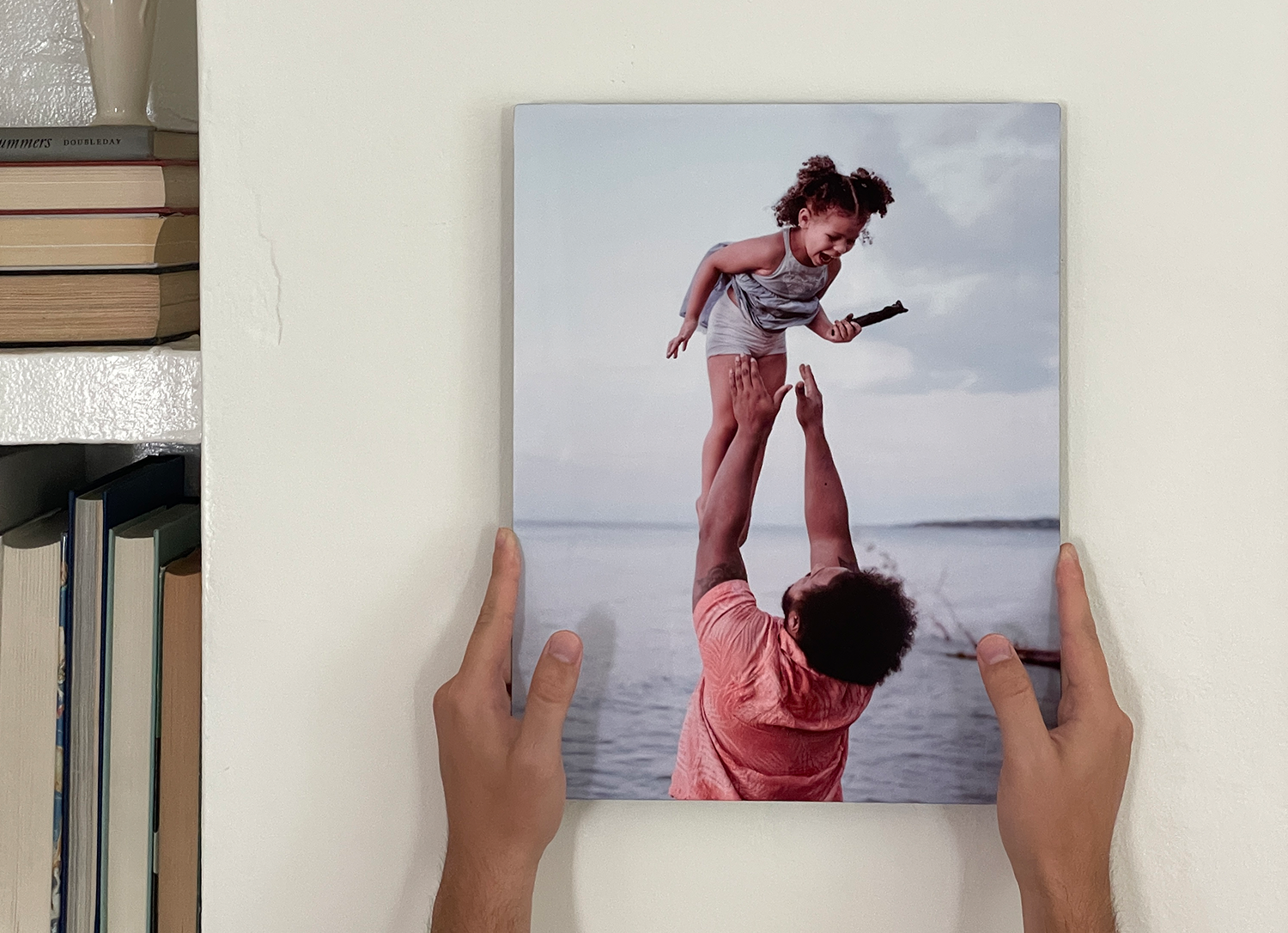
Clear base lets the raw brushed aluminum texture show through the image, especially in white and light areas. Vivid Metal Prints president Mirza recommends clear-base finishes for car shots, cityscapes, and abstract work. In these cases, the metallic texture becomes part of the design instead of a distraction.
With a brushed or clear base, the aluminum surface shows through white areas of the image. That effect can strengthen some images and undermine others. Choose white base for photos that rely on clean whites or accurate skin tones, like wedding portraits, newborn photos, or bright-sky landscapes. Choose clear base when the metallic texture adds character to the subject.
What photos look best on metal prints and which ones disappoint
The image below shows how vivid landscapes and cityscapes come to life on metal. Metal is unforgiving of poor source images and amplifies both quality and mediocrity, so photo choice matters.
Metal performs best with:
High-contrast landscapes, golden-hour and blue-hour scenes, and dramatic skies
Travel photography, cityscapes, and architectural work
Wildlife, underwater, and macro photography
Sunsets, ocean scenes, and vivid color fields
Black-and-white street photography with deep shadows
Product photography and high-contrast portraits
Metal's smooth surface holds fine detail without a canvas weave softening it. Its deep blacks and bright highlights help dramatic images stand out. Metal Prints Canada notes that the smooth aluminum panel keeps fine details more defined than canvas, which matters for portraits, architectural photos, and high-resolution work.
Metal tends to disappoint with:
Subtle pastels and low-contrast portraits
Dark, underexposed shots where shadow noise becomes more obvious
Watercolor-style illustrations and muted, nostalgic images
Soft, painterly portraits shot with a vintage lens, which PhotographyTalk suggests often look better on cotton rag paper
Use this quick check before ordering: view the photo at 100% zoom on screen. Metal Prints Canada advises that if faces or key details look soft at that magnification, enlarging the image will make the softness more noticeable in print. Metal reveals soft focus instead of hiding it.
How long metal prints last and how to care for them
Metal prints last a long time because of how the image bonds to the panel. Dye-sublimation infuses the image into the aluminum's coating instead of leaving ink on the surface, so the surface resists scratches, moisture, and fingerprints more effectively than many paper or canvas prints.
For indoor longevity, Wilhelm Imaging Research Institute's accelerated aging data shows that properly produced ChromaLuxe prints retain color integrity for 65+ years under normal indoor display conditions. Additional testing has placed ChromaLuxe panels at 70°C and 85% relative humidity for 1,000 hours, roughly equivalent to 200 years of typical indoor display, with no measurable fading.
For UV stability, metal prints handle light exposure better than canvas or paper. Direct, unfiltered sunlight over many years can still shift color tones in any dye-sublimation print. PrintablePress recommends indirect natural light or LED illumination to preserve color as long as possible.
Standard metal prints suit indoor use. They tolerate humidity and temperature changes well, and Mosaics by Marc notes that metal prints are waterproof and highly resistant to humidity, which makes them practical for bathrooms and other moisture-prone rooms. For patios or fully exposed outdoor locations, choose a product specifically designed and warranted for outdoor use.
Follow these care tips to keep metal prints looking new:
Wipe dust and fingerprints with a soft microfiber cloth.
For sticky residue, dampen the cloth with distilled water or an ammonia-free mild cleaner, and spray onto the cloth instead of the print.
Avoid paper towels, abrasive pads, ammonia-based cleaners, and harsh solvents, since these can degrade the coating. Lumaprints notes that paper towels can leave tiny scratches or fibers behind.
Handle prints by the edges to limit fingerprint buildup.
When stacking or storing, place a soft cloth or tissue paper between panels.
Metal vs. acrylic vs. canvas: how to choose
Metal, acrylic, and canvas each suit different photos and rooms. Match the material to your priorities for color, depth, budget, and durability.
Choose metal if you want high color saturation, a wide color gamut, a frameless modern look, and a surface that wipes clean and resists scratches and moisture. PhotographyTalk's Alex Schult, who has reviewed prints for more than six years, places metal between canvas and acrylic for color, durability, and longevity. Metal is also the lightest option at large sizes and a strong choice for bathrooms, kitchens, and high-traffic walls. Frameology’s HD Metal Prints start at $59.
Choose acrylic if you want glass-like depth and a luminous, near-backlit appearance with very deep blacks. Mosaics by Marc describes acrylic as a specialist choice for fine art photography when extreme detail and gallery-level presentation matter most. Acrylic usually costs more, weighs more, and chips more easily at the edges than metal. Standard acrylic also reflects ambient light unless you specify anti-reflective acrylic. Explore Frameology's acrylic options, including the Acrylic Block, starting at $39 and the Acrylic Wall Print, starting at $59.
Choose canvas if you want a warm, soft, painterly look at a lower price, with zero glare and a lightweight feel. Tov Studio Photo's 2026 substrate comparison recommends canvas for soft, intimate wedding portraits, warm-toned family group portraits, and newborn and family soft portraits. Canvas flatters skin tones and adds emotional depth. However, its weave softens fine detail, it has a narrower color gamut, and it needs to stay away from damp environments. Frameology offers two canvas options: Premium Canvas Prints starting at $19 or HD Framed Canvas starting at $49.
Use this summary: metal for color, durability, and longevity; acrylic for depth and fine-art detail; canvas for warmth and a softer budget.
Shop frameless prints from Frameology
Sizing and hanging custom metal prints
Size affects how strongly metal's detail and luminosity register on your wall. Many buyers underestimate this and choose smaller sizes than their space can support.
At 8x10, metal works well for a desk or a small accent wall. At this size, the difference between metal and other formats feels subtle at normal viewing distance.
At 16x20, you reach a standard gallery-style wall piece. This is where metal's sharp detail and luminous color start to stand out clearly.
At 24x36, the print becomes a statement piece above a sofa or console. Mosaics by Marc notes that metal prints usually look strongest at medium to large sizes, such as 16x20 and up, because the format's strengths show best at typical viewing distances.
Most metal prints mount with a float system that holds the panel slightly off the wall. This creates a shadow gap that adds depth and suits contemporary and minimalist interiors. A float-mounted metal print usually sits about half an inch off the wall, which creates a subtle shadow line around the edges. Metal weighs more than canvas because of the aluminum panel, but it weighs less than acrylic at similar sizes. For metal prints over 20x24, use wall anchors or hardware that matches your wall type, and aim for wall studs when possible.
For planning, Tov Studio Photo suggests that a print or gallery wall should span about 60–75% of the width of the furniture below it. Larger pieces feel integrated with the room's architecture, while undersized pieces feel more like small decor.
Frameology's mobile-only augmented reality (AR) preview helps with this decision. The AR tool lets you see a true-to-scale preview of your exact print on your wall using your phone's camera, with no app download or login. You can confirm size and placement before you check out.
Where to order metal prints for photos
Frameology's HD Metal Print, starting at $65 uses advanced dye-sublimation infused directly into scratch-resistant aluminum for vivid, high-definition results with strong contrast. It works well in high-moisture environments and suits busy households. It's also backed by Frameology's 30+ years of framing heritage. That experience now comes through a streamlined digital experience that includes the mobile-only AR preview for sizing and placement.
For smaller display needs, the Metal Desk Print, starting at $25 brings the same dye-sublimation quality to a compact desk or shelf format. It works nicely for gifting or for a smaller moment that still deserves the metal treatment. Frameology has earned 7,500+ verified 5-star reviews and a 4.98/5 overall rating. Hunker recognized Frameology as "best for budget-conscious shoppers" in a comparison of popular online custom framing services. For more detail on what sets Frameology apart, read why Frameology is the best online framing service.
Bringing your photos to life on metal
Metal prints reward bold, detailed photos and thoughtful choices about finish, base, and size. When you pair the right image with the right options, you get wall art that stays vivid for decades and feels tailored to your space.
Frameology combines HD Metal Prints, clear guidance, and AR preview tools so you can move from file to finished piece with confidence.
Order your HD Metal Print today
Frequently asked questions about metal prints for photos
Should I choose glossy or matte for my metal print?
Your room light and photo style should guide this choice. Glossy delivers the highest color saturation and deepest blacks, which suits vivid landscapes, travel shots, and wildlife photography, but it reflects strongly under ceiling lights or opposite a window. Matte removes glare entirely and works well in bright rooms, offices, and fine art settings. Satin sits in the middle and works for most people, since it reduces glare while keeping strong color and handles portrait work and mixed-light rooms well. If your print will hang across from a south-facing window, satin or matte usually works best.
What's the difference between white base and clear base?
White base uses an opaque coating that keeps whites white and colors vivid, so it fits portraits, weddings, landscapes, and most photography where accurate color matters. Clear base lets the raw brushed aluminum texture show through lighter areas of the image, which creates a metallic, translucent look that suits industrial subjects like cars, cityscapes, and some black-and-white work. With clear base, the aluminum surface shows through white areas of the image. If your photo's impact depends on clean whites or accurate skin tones, white base is usually the safer choice.
How long do metal prints last?
Properly produced metal prints on premium coated aluminum panels are rated for more than 65 years of indoor display based on accelerated aging tests by Wilhelm Imaging Research. Because the dye infuses into the aluminum's coating, the image resists fading, scratching, and moisture more effectively than many canvas or paper prints. Direct, unfiltered sunlight over long periods can still shift colors, so indirect natural light or LED illumination helps preserve color. Standard metal prints are intended for indoor use, and outdoor locations call for products specifically rated for exterior display.
Are metal prints better than acrylic?
Each material excels in different situations. Metal offers higher color saturation, strong durability, easy maintenance, and a strong price-to-quality balance for most homes. It also weighs less and resists scratches better than acrylic at similar sizes. Acrylic creates a glass-like depth and luminous, near-backlit appearance that works beautifully for fine art photography in controlled lighting. For bathrooms, kitchens, high-traffic walls, and everyday photo printing, metal usually makes more sense. For a single statement fine-art piece in a gallery-style space, acrylic often becomes the preferred choice.
What size metal print should I order?
Metal prints usually look strongest at 16x20 and larger, where the format's detail and luminosity stand out at normal viewing distance. An 8x10 works well for a desk or a small accent wall. For a wall piece above furniture, aim for a print or gallery wall that spans about 60–75% of the furniture width. Many people end up happier when they size up from their first instinct. Frameology's mobile-only AR preview lets you see a true-to-scale version of your print on your wall before you commit.
How do I clean a metal print?
Wipe dust and fingerprints with a soft microfiber cloth. For sticky residue, dampen the cloth with distilled water or an ammonia-free mild cleaner and spray the cleaner onto the cloth instead of the print. Avoid paper towels, abrasive pads, ammonia-based cleaners, and harsh solvents, since these can damage the coating. Handle prints by the edges, and place a soft cloth or tissue paper between panels when stacking or storing them.
Are metal prints worth it?
Metal prints feel worth the investment when you match them with the right photo and room. They deliver color saturation, detail, and longevity that canvas and many paper prints can't match, and they arrive ready to hang with no framing required. They shine with high-contrast landscapes, travel photography, cityscapes, and any image where vivid color and sharp detail matter. Soft, painterly portraits and muted vintage images often suit canvas better. For a photo that you want to turn into a hallway or living room showpiece, metal remains a strong choice.
Can I see a metal print on my wall before I buy?
Yes. Frameology's mobile-only AR preview lets you project a true-to-scale version of your print onto your wall using your phone's camera, with no app download or login. This preview helps you confirm size and placement before you check out and removes much of the guesswork from ordering metal prints online.
