


How to create a family photo gallery wall
Written by: Daniel Koren, Co-Founder, Frameology | Last updated: October 23, 2026
Key takeaways
Start with the wall: skip south- or west-facing windows, bathrooms, and TV walls. Choose north-facing or interior walls with consistent indirect light.
Cohesion starts with a story you choose before you shop for frames. Decide on one of four visual directions first.
Use 2–3 frame finishes across the arrangement, keep 2–3 inches between frames, and center the display at 57–60 inches from the floor.
Pick a layout style like grid, anchor + supporting, or organic, then edit photos to a single consistent tone so everything feels unified.
Frameology offers Classic and Luxe gallery walls with life-size templates, so you can create a cohesive family photo display without guesswork.
Choose the right wall first
The wall you choose affects how long your photos last and how calm the room feels. Some walls work much better than others.
Walls directly opposite south- or west-facing windows, bathroom walls, and the wall behind a TV are the weakest choices for a family photo gallery wall. UV light fades colors, yellows paper, and degrades materials over time. South-facing windows deliver the longest daily exposure across the year, which makes the wall opposite a south window the highest-risk wall in many homes. West-facing windows are nearly as harsh. They deliver intense late-afternoon light at a low angle that reaches deep into a room and carries significant heat. Bathrooms combine high humidity and temperature swings, which cause wood to warp, mats to buckle, and adhesives to fail. The wall behind a TV creates visual competition, so your eye jumps between the screen and the photos.
The walls that work best have consistent, indirect light and a clear furniture anchor. Above a sofa is the classic choice. The arrangement should span roughly two-thirds the width of the sofa beneath it. That proportion gives the display a grounded, intentional feel. Hallways work well because images naturally unfold as you move through the space. Small photos read at eye level rather than from across the room. Staircase walls are ideal for larger collections. As Bobby Berk put it, "The gallery wall up the stairs is the perfect place to display family photos, and I think my staircase collection makes it so much easier to curate all your favorite memories into a layout that looks great." Above a console table is another strong option, especially in an entryway where guests see the display right away.
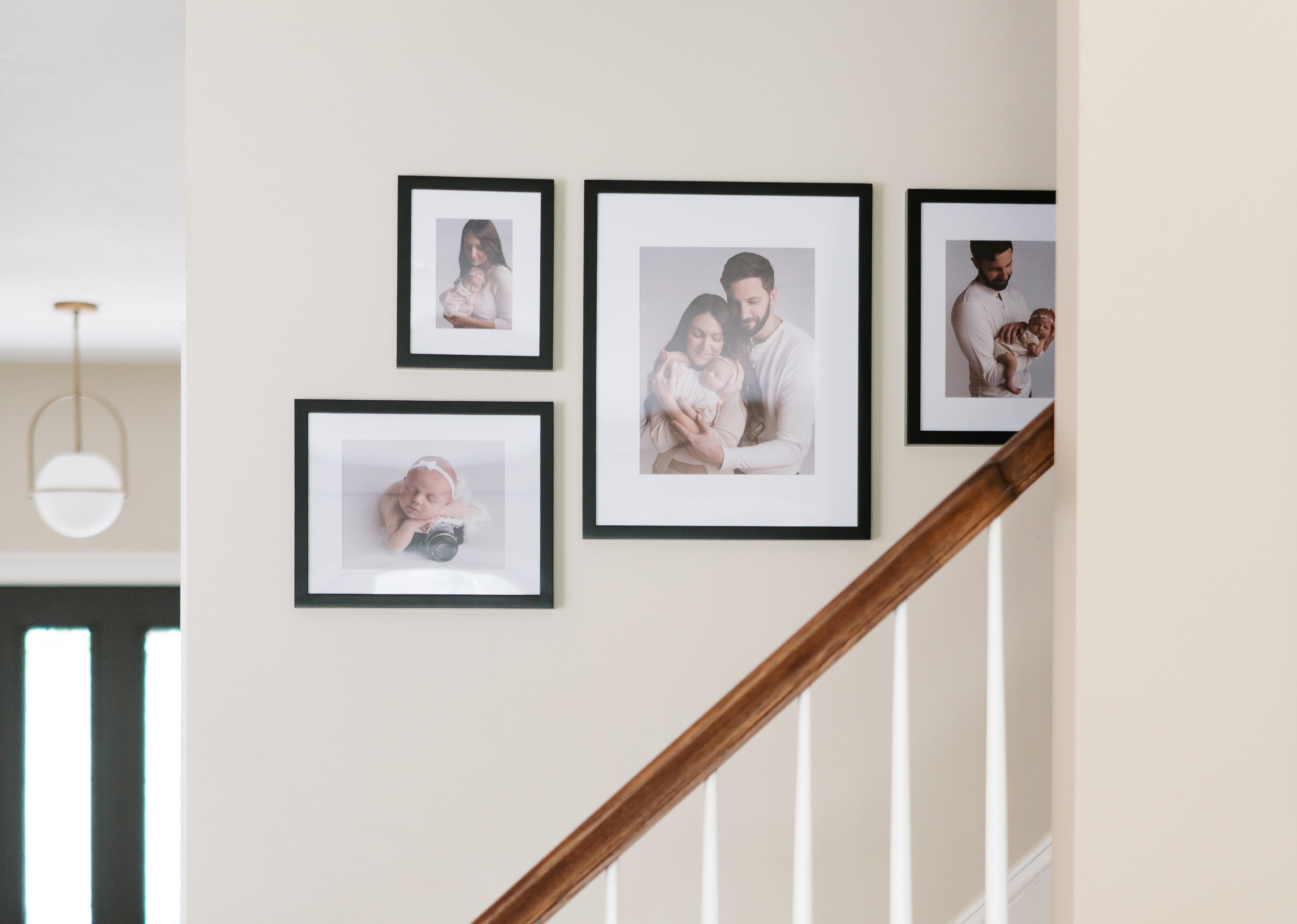
North-facing walls receive the most stable, diffuse indirect light all day. Artists have preferred north light for centuries for this reason. These walls are the safest choice for color photographs and works on paper. Interior walls away from windows are the next best option.
Define your visual story before you pick frames
A clear visual story keeps a family photo gallery wall from feeling random. Decide on your direction before you buy frames or order prints.
Timeless black-and-white: Convert all photos to black-and-white with consistent contrast. Black-and-white galleries rate very high for longevity because a gallery of portraits from 1960 and 2026 looks similar, and the approach eliminates approximately 70% of color-consistency problems. Black, white, or natural wood frame finishes all work here.
Warm color: Keep photos in color and edit them to a consistent warm tone like golden hour light, film-style warmth, or a unified preset. Warm wood and brass frame finishes reinforce the palette.
Modern minimal: Edit photos to a clean, neutral tone with high clarity. Thin black or white frames, minimal mats, and plenty of negative space between frames define this direction.
Collected family story: Mix eras, subjects, and sizes, then unify everything with one mat color and a single dominant frame finish. This direction takes more editing effort, yet it often feels the most personal.
Mixed eras, color temperatures, and editing styles quickly make a family photo gallery wall feel cluttered. A cool, desaturated image beside a warm, golden one will compete for attention, even when both photos look beautiful on their own.
When you curate from thousands of photos, start with a theme, a time period, or a relationship. A gallery wall built around one summer, one branch of the family, or one recurring location feels more intentional than a wall that tries to represent every memory. Edit down to 5–15 images before you order prints. Using the Favorites feature in your phone's photo library as a "best of" highlight reel after each event makes this curation step much faster.
Turn your curated story into framed art
Pick a layout style with a decision framework
Three layout styles cover almost every family photo gallery wall. Choosing one early saves you from redoing the entire arrangement later.
Grid: Choose this if you want order and symmetry. Use equal-sized frames in even rows and columns with consistent spacing. This layout is the most forgiving for beginners because the math stays straightforward.
Anchor piece with supporting frames: Choose this if you have one hero family photo and several supporting images. Start with the largest frame slightly off-center, then build outward. Bobby Berk described this principle in his Luxe Vertical Grid design as "like an Instagram feed for your wall" that looks great over a sofa, a console, or a large wall.
Organic: Choose this if you want a collected, lived-in look. Mix frame sizes and orientations within a defined zone. Repeat one element, such as frame color or mat style, so the mix feels intentional instead of random.
For a focused arrangement, 3–9 frames usually works best. Staircase and hallway walls can carry more. A gallery wall typically uses 5–9 pieces in a cohesive cluster, with the outer edges filling 60–75% of the wall width and consistent 2–3 inch spacing between every piece.
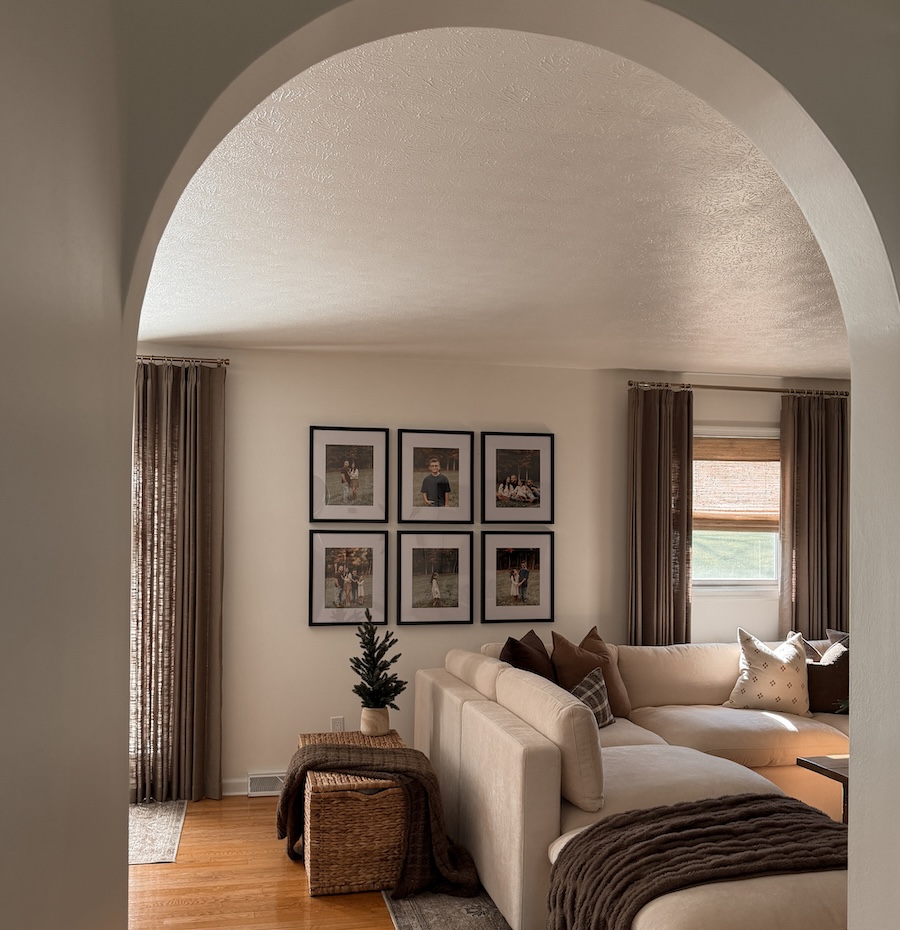
Frameology's curated Gallery Walls Collection maps directly to these layout styles. Classic Galleries, starting at $198, include grid, offset, staircase, hallway, and stack layouts. Every Classic Gallery includes a life-size gallery wall template. Luxe Galleries, starting at $638, offer editorial layouts like the Luxe Bricklay, Luxe Vertical Grid, and Luxe Staircase. These also include a life-size gallery wall template. Both lines let you skip layout math if you prefer a ready-made arrangement.
Browse ready-made gallery wall layouts
The cohesion rules that actually matter
A cohesive family photo gallery wall follows a few clear rules. These numbers keep the display calm and intentional.
Frame finishes: Limit the wall to 2–3 finishes. The dominant finish should make up roughly 50% of frames and be used on the largest pieces. A supporting finish covers about 30%, and an accent finish covers about 20%.
Spacing: Keep 2–3 inches between frames. Any less feels cluttered and any more feels disconnected. Consistent spacing matters more than the exact number.
Mat style: Use one mat color and one mat depth across the entire gallery wall. Shifting mat treatments breaks the visual border that should tie everything together.
Photo editing: Apply one editing tone across all photos. A single preset or color grade used consistently does more for cohesion than any frame choice.
Furniture width: Let the arrangement span about two-thirds the width of the sofa or console beneath it. The 2/3 rule for hanging pictures states that artwork or a gallery arrangement should span roughly two-thirds the width of the furniture below it to create visual balance.
Center height: Place the center of the entire arrangement at 57–60 inches from the floor. This matches average human eye level and the standard used by museums and galleries worldwide.
Those cohesion rules apply no matter which frame line you choose, but Frameology's two lines differ in ways that affect flexibility and longevity: Classic Wall frames start at $59 and deliver great value. They usually ship the next business day and typically arrive within a week. They feature a standard removable backing so you can swap photos whenever you want. Luxe Wall frames, starting at $79, are top-of-the-line, museum-quality frames with acid-free mats and UV-protecting museum-grade acrylic. Luxe frames feature a sealed, permanent kraft paper backing and come with all necessary hanging hardware, including nails and a mini-level, in the box. Classic gallery walls start at $198 and use single center-point hanging, while Luxe gallery walls start at $638 and use a two-point hanging system for precise leveling.
Size and scale for the room
Good sizing keeps your gallery wall in proportion to the room and furniture. Each common location has simple guidelines.
Above a sofa: Let the arrangement span about two-thirds the width of the sofa. A gallery wall above a sofa typically measures 50–65 inches wide and 30–40 inches tall, with the bottom row of frames sitting 6–8 inches above the back of the sofa. Center the arrangement over the sofa, not over the wall.
In a hallway: Keep the center line of the arrangement at 57–60 inches from the floor. Hallways let images unfold as you move through the space, and small photos read clearly at eye level.
Up a staircase: Follow the angle of the stairs instead of forcing a horizontal line. For staircase gallery walls, measure a line parallel to the stair banister roughly 60–62 inches above each step and arrange frames along that diagonal with 2–3 inch spacing.
To measure the 57–60 inch center height: measure from the finished floor up to 57–60 inches and mark that point on the wall. That mark shows where the visual center of your entire arrangement should land. Use it as a reference for the cluster, not for each individual frame.
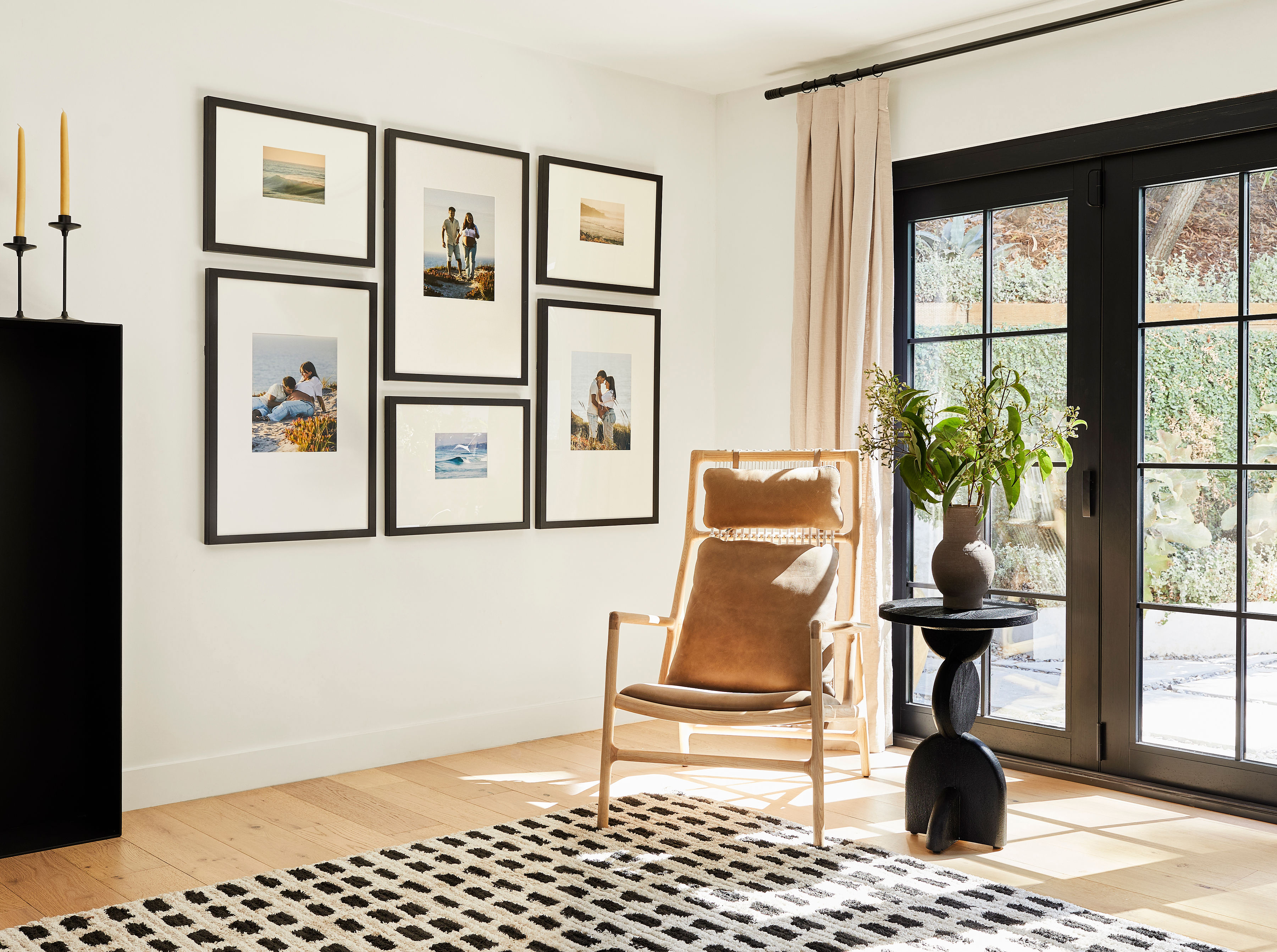
If you'd rather see the scale before you commit, Frameology's augmented reality (AR) preview tool helps. The mobile-only tool lets you project a true-to-scale preview of your frame or photo gift onto your actual wall before buying. It previews the frame or photo gift rather than designing the layout, yet it's a practical way to check scale and proportion before you place an order.
Are gallery walls out of style in 2026?
Gallery walls still work in 2026. The dated look is the maximalist "fill the entire wall" approach.
Interior designer Janelle Patton of Lark Interiors describes the symmetrical gallery wall grid as feeling "more sterile than stylish" in 2026. She explains that it "became the thing people did when they wanted their home to look designed without hiring a designer, but it reads more like a checklist than a choice." The 2026 look feels intentional, spaced, and tonal.
What's in: fewer frames, more negative space, consistent finishes, tonal photo editing, and a mix of sizes anchored by one hero image. The minimalism trend, where 3–4 large frames replace a 9-frame 3×3 grid, reflects a reaction to years of "Instagram-style" collage galleries and a return to classical single focal points. Black-and-white family portraits remain one of the most stable long-term directions because a gallery of black-and-white portraits from 1960 and 2026 feels equally timeless.
What's out: floor-to-ceiling clutter, mismatched frame colors, and gallery walls that compete with the room's other decor. The symmetrical three-frames-above-the-sofa approach reads as dated in 2026, while a collected, non-matching arrangement chosen piece by piece over time offers an alternative for buyers who still want multiple pieces.
The editorial position stays simple. A cohesive family photo gallery wall built around one visual tone, 3–9 frames, and consistent spacing fits 2026 design and still feels timeless.
Hang it without the hole-fear
Most people worry more about making holes in the wall than about choosing frames. A gallery wall template removes that stress.
The DIY paper approach works like this: trace each frame onto kraft paper, cut out the templates, mark the nail point on each cutout, tape the templates to the wall with painter's tape, adjust until the spacing looks right, then hammer nails through the marked spots and tear the paper away. "Ten minutes of paper saves an afternoon of spackle."
Frameology's Classic and Luxe gallery walls take this a step further with a custom, life-size gallery wall template in every order. For Classic gallery walls, tape the template to the wall, hammer nails into the marked spots, remove the template, and hang. House Beautiful contributor Janae McKenzie reviewed the process and said, "I would absolutely recommend Frameology to anyone who knows they want a gallery wall, but doesn't know how to make it happen." Classic gallery walls can be hung in under an hour using the template. Classic gallery walls include the hardware needed for installation, guided by the included gallery wall template.
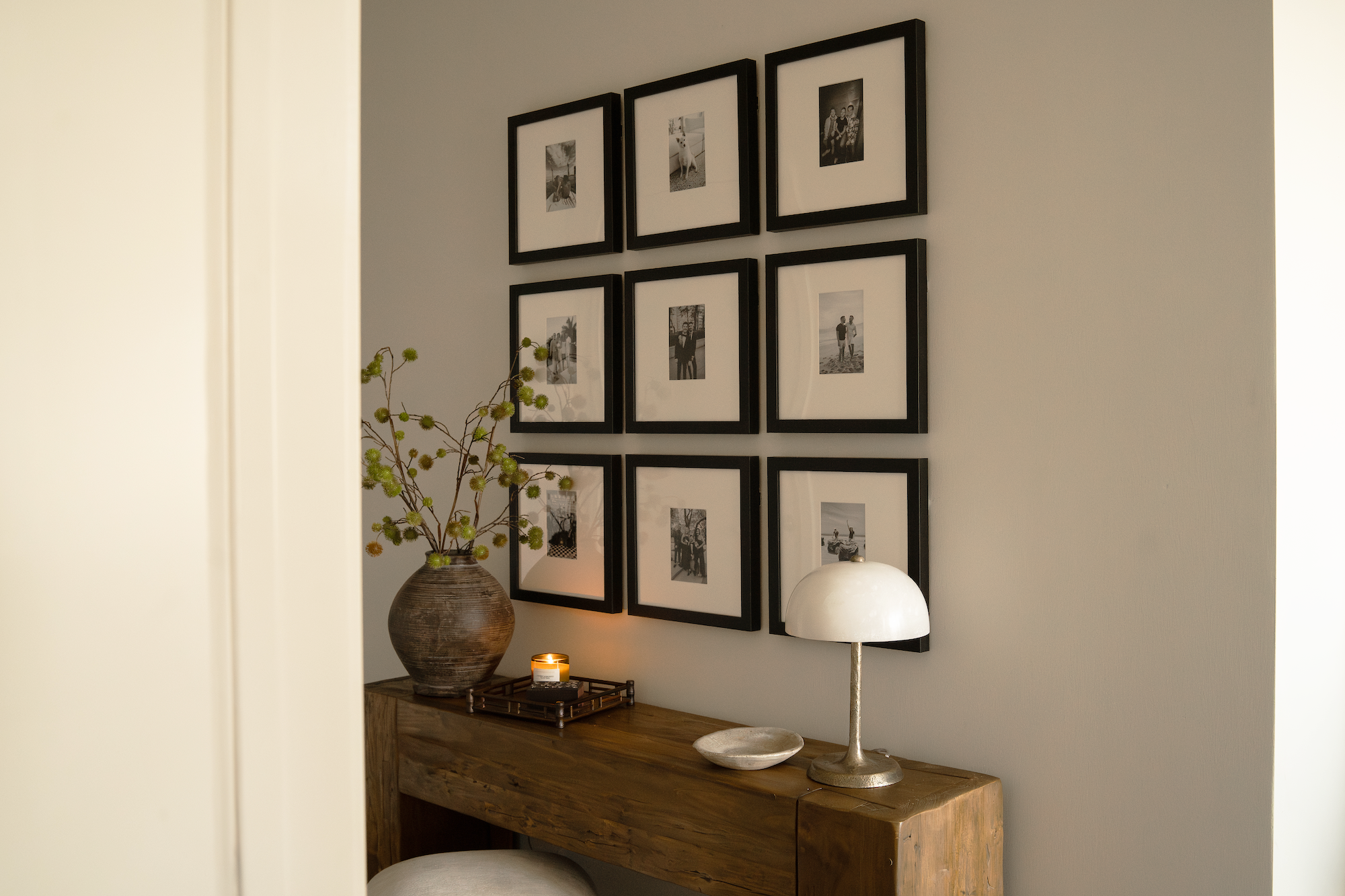
Luxe frames use a two-point no-wire hanging system for precise leveling and include all necessary hanging hardware, including nails and a mini-level, in the box. CNN Underscored's Stephanie Griffin tested the Luxe Bricklay gallery wall and reported that it looked professionally installed after using the Frameology system. The Luxe template instructions differ slightly from Classic because of the dual-point hanging system.
One important distinction: Canvas galleries and gallery walls created through Frameology's Gallery Wall Design Service don't include a gallery wall template. Their construction and customization work differently and often need more tailored installation approaches.
Shop gallery walls that ship with templates
What colors should you avoid in a family photo gallery wall?
Color choices can either support your photos or distract from them. A few simple rules keep the focus on your family.
Avoid mixing more than three frame finishes, high-contrast frame colors that fight the photos, and mat colors that clash with the wall color. Neutral frame finishes like black, white, natural wood, and metal usually create the most cohesion. The dominant frame finish should make up roughly 50% of frames and be used on the largest pieces, with common picks like matte black, natural oak, or antique gold. Mixing thin and wide frames at the same size often looks like a misprint. Vary widths across different size categories instead.
Room undertones guide finish choices. If the room has warm undertones such as warm wood floors, cream walls, or warm upholstery, warm wood and brass finishes usually work best. If the room has cool undertones such as white walls, gray furniture, or cool stone, black, white, and silver finishes tend to look better. Matching the largest fabric or wood tone in the room reads cohesive, while strong contrast can make the gallery feel like it's fighting the existing palette.
Mat color follows the same logic. A bright white mat on a warm cream wall can look stark and disconnected. An off-white or warm white mat bridges the gap. One mat color and one mat depth across the entire arrangement keeps the border effect clean and unified.
What to do with thousands of family photos
The hardest part of a family photo gallery wall often isn't hanging it. The real challenge is deciding which photos earn a spot.
Curate by theme, time period, or relationship before you print. That approach keeps the set manageable so you aren't trying to frame everything. A simple editing workflow: pick a theme such as one summer, one branch of the family, or one recurring location. Select 5–15 images, edit them to a consistent tone, and order prints in a mix of sizes. Creating 5–7 top-level albums that match how you actually search for photos, such as names of family members, yearly trips, or holidays, and using the Favorites feature as a "best of" highlight reel keeps curation manageable.
A helpful first culling rule is to keep the sharpest image, the best facial expressions, eyes-open shots, and the strongest composition when multiple near-duplicates exist. Delete or archive blurry and nearly identical versions so the final set feels smaller and easier to work with.
Turn your favorite photos into framed keepsakes
Frequently asked questions
How many photos should be in a gallery wall?
For a focused arrangement, 3–9 photos usually works well. A 3-photo arrangement suits a console or small entryway. A 5–9 photo arrangement fits a sofa wall or bedroom. Staircase and hallway walls can carry more, yet the same spacing and visual tone rules still apply. Aim for an arrangement that spans roughly two-thirds the width of the furniture beneath it and uses consistent 2–3 inch spacing.
What's the rule for gallery wall spacing?
The standard spacing between frames in a gallery wall is 2–3 inches. Consistency matters more than the exact number within that range. If one gap looks noticeably larger than the others, the eye reads it as a mistake even when frame sizes differ. For small frames such as 8×10 or smaller, lean toward 1.5–2 inches. For large frames such as 18×24 or larger, 3–3.5 inches works. Keep the center of the entire arrangement at 57–60 inches from the floor to match museum-standard eye level.
Do all gallery walls include hanging templates?
Classic and Luxe gallery walls include life-size gallery wall templates that make installation simple and straightforward. Canvas galleries and gallery walls created using Frameology's Gallery Wall Design Service don't include templates because their construction and customization work differently and often need more tailored installation approaches.
Can I swap out photos in my frame later?
It depends on the line. Classic frames feature a standard removable backing, so you can swap photos whenever you want. This flexibility works well for seasonal refreshes or new family memories. Luxe frames feature a sealed, permanent kraft paper backing designed to protect your photo long term, so photos can't be swapped once framed. Choose Classic frames if you want the option to update your display over time.
How long does shipping take?
Classic products usually ship the next business day and typically arrive within a week. Luxe products take 7–10 business days because of their artisan craftsmanship and museum-quality materials. Both lines are hand framed in the United States.
How does the AR preview work?
The AR tool is mobile-only and lets you preview your frame or photo gift on your actual wall before buying. Open the Frameology website on your phone, customize your frame or select a gallery wall, and tap the AR icon. Your phone's camera projects a true-to-scale preview directly onto your wall so you can check scale and proportion before committing. No app download or login is required.
Are gallery walls out of style in 2026?
Gallery walls still feel current in 2026. The maximalist, floor-to-ceiling, perfectly gridded look feels dated. The current direction favors intentional spacing, tonal photo editing, and a mix of sizes anchored by one hero image. For a deeper breakdown of what's in and what's fading, see the trend section above.
Which wall should not have family photos?
Walls directly opposite south- or west-facing windows are the highest-risk locations because UV light and heat accumulate fastest there, which causes colors to fade and paper to yellow over time. Bathroom walls are also a poor choice due to high humidity and temperature swings that cause warping, mat buckling, and adhesive failure. The wall behind a TV creates visual competition that keeps the eye from settling on the photos. Interior walls with consistent indirect light, such as hallways, staircase walls, and walls perpendicular to windows, are usually the safest and most effective choices for family photo displays.
