


Home office gallery wall: ideas, layouts, and tips
Written by: Daniel Koren, Co-Founder, Frameology | Last updated: October 31, 2026
Key takeaways
The 2/3 rule anchors your wall: artwork or a gallery wall arrangement should span about two-thirds the width of the desk or furniture beneath it for visual balance.
Frame count shapes function and camera presence: 4–6 frames suit most home office walls, while a clean 3-frame triptych or a single oversized piece works well for smaller walls or video-call zones.
Choose art that supports focus: abstract, botanical, landscape, or personal photography with low visual noise works better in a workspace than busy, high-contrast imagery.
Match frame color and material to your desk and lighting: black, walnut, or muted palettes paired with framed art, canvas, or metal prints create a polished, professional look.
Frameology offers named gallery wall layouts, AR previews, and life-size gallery wall templates that remove guesswork and create a finished, intentional result.
Start framing your favorite memories
What is the 2/3 rule for wall art?
The 2/3 rule for wall art states that artwork, or a gallery wall arrangement measured as a single unit, should span roughly two-thirds the width of the furniture beneath it. This proportion visually anchors the art to the furniture so the two read as one composition. Art that covers about two-thirds of the furniture width feels balanced and connected to the piece below.
Edward Martin's worked example illustrates this clearly: a 90-inch-wide sofa pairs with art or an arrangement covering about 60 inches. Austin Gallery's sizing guide broadens the range to two-thirds up to three-quarters of furniture width, with the upper limit being the furniture's full width.
How many frames should a home office gallery wall have?
The right frame count depends on your wall width, your desk size, and how the wall needs to perform on video calls. Three configurations work reliably in a home office.
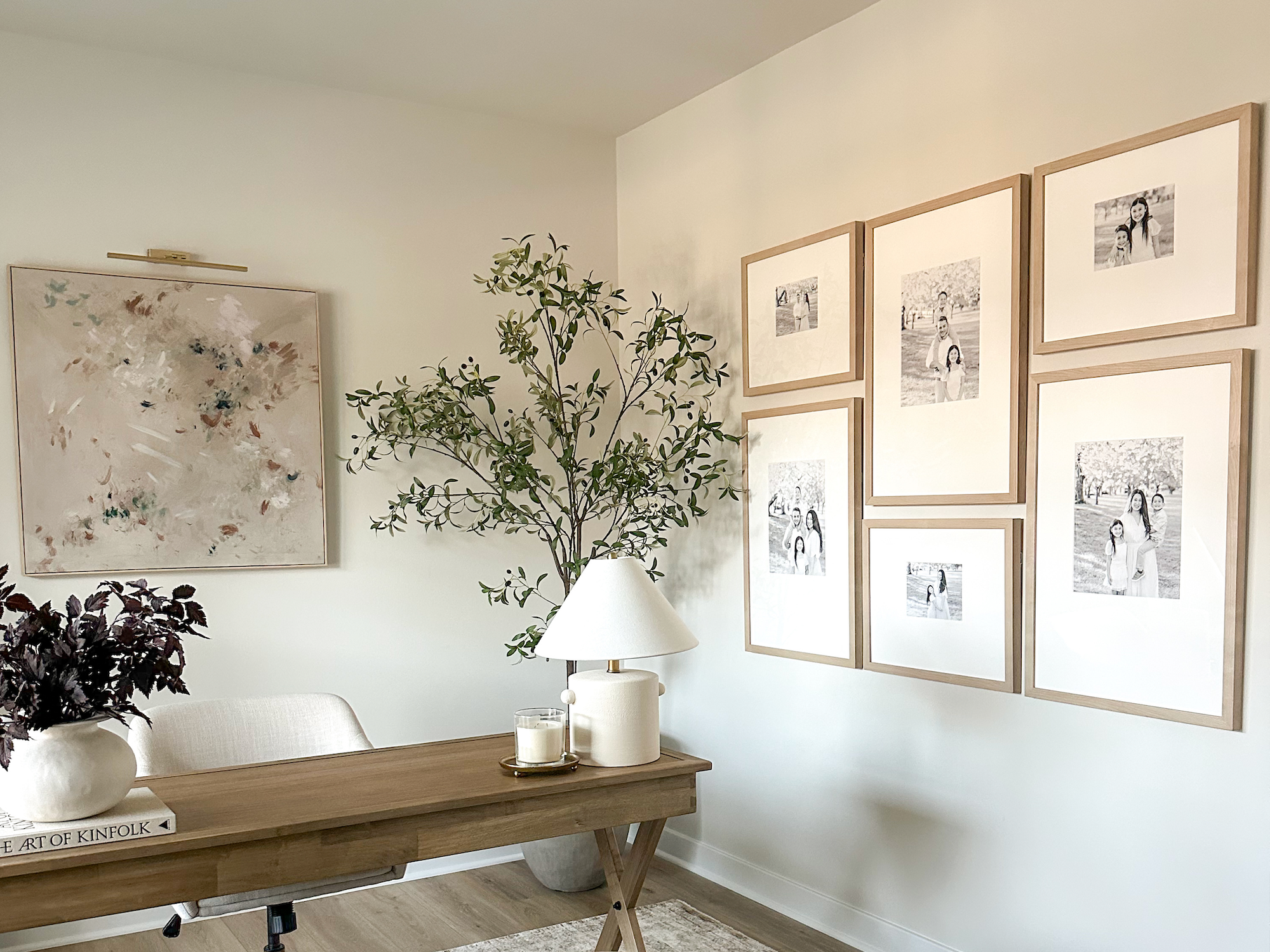
4–6 frames: This range suits a standard home office wall. It gives enough visual weight to anchor the space and still looks structured and intentional on camera. A 6-frame grid or offset layout, such as a 3x2 symmetrical grid of six identical 16x20-inch frames with 2.5-inch spacing, can fill a wall behind a desk when the wall is wide enough. Narrower above-desk walls around 30–40 inches work better with just 2 frames.
3 frames: This layout fits smaller walls, narrow camera zones, or anyone who wants a clean, editorial look. Three matching frames in a horizontal row read as a single composition that feels simple and professional.
1 oversized piece: This option makes the boldest statement and is the easiest to hang. A single large-format print above a desk removes spacing decisions. Austin Gallery notes that on a large blank wall with no furniture beneath it, one oversized piece filling 60–75% of the wall looks better than many small frames scattered across the surface.
1. Decide how many frames and which layout
A home office wall needs to feel personal and calm while you work and polished and intentional on video calls. That balance guides every layout choice.
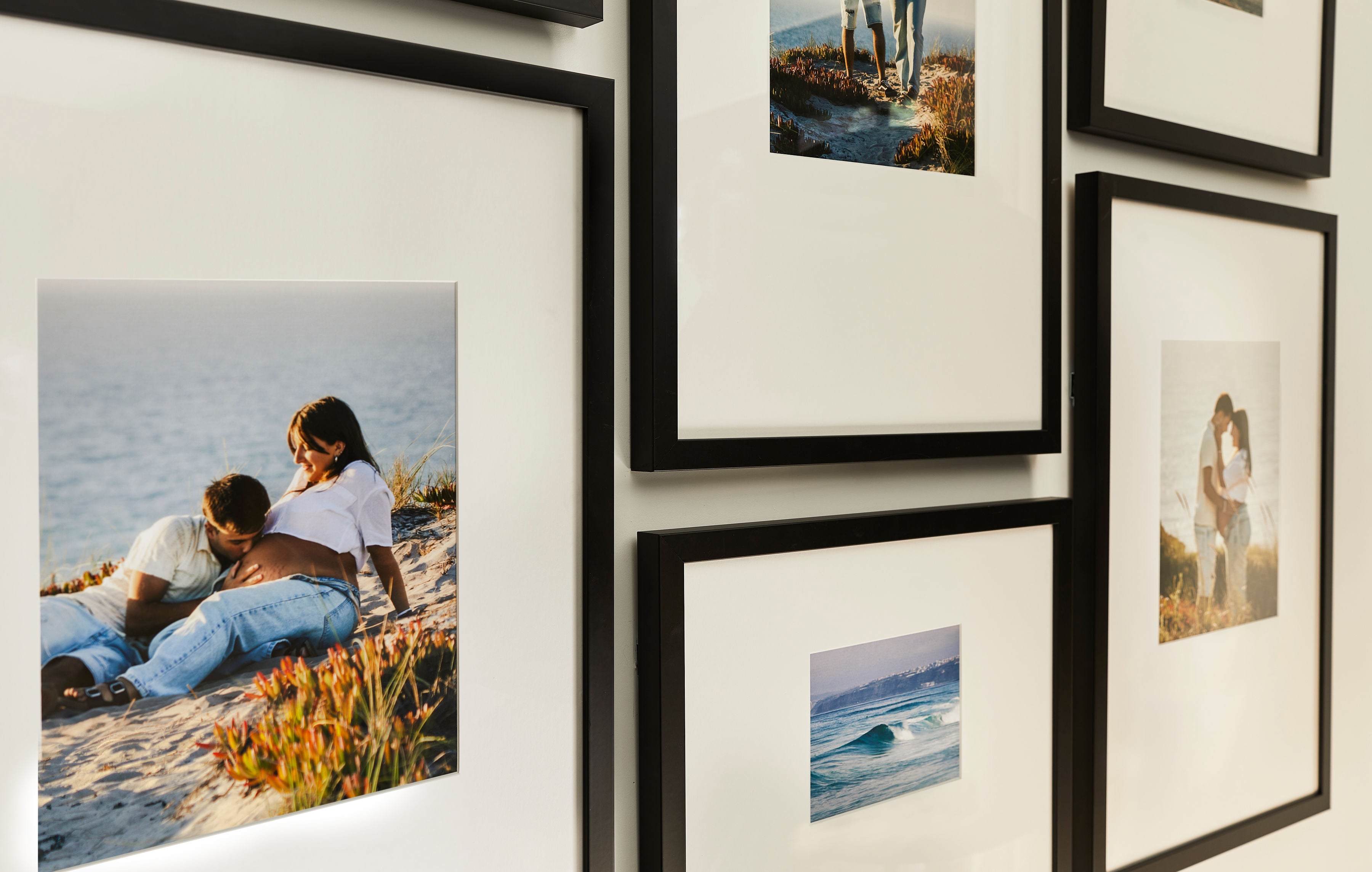
Frameology offers named, pre-designed gallery wall layouts that solve this balance without guesswork. On the Classic side, the Classic Triptych ($297) gives you three frames in a clean horizontal row that works especially well on camera. The Classic Grid ($594) delivers six frames in a structured grid that fills a larger wall with symmetry. The Classic Offset ($386) uses six frames in a staggered arrangement that adds interest while still feeling orderly.
On the Luxe side, Frameology's top-of-the-line, museum-quality tier, the Luxe Triptych ($657) brings three premium frames with sealed kraft paper backing, acid-free 4-ply rag mats, and UV-protecting museum-grade acrylic. Apartment Therapy noted that the frames felt sturdy rather than flimsy or mass-produced.
The Luxe Vertical Grid ($981) uses nine frames in a vertical column arrangement. Bobby Berk described it as "like an Instagram feed for your wall," and said it would look great over a console or on a large wall. He also highlighted that "the fact that it comes with a template for hanging makes it so much easier than trying to do this on your own." The Luxe Bricklay ($1,074) uses six frames in a staggered brick pattern. Bobby Berk explained that he "wanted to create a gallery wall layout that was versatile, simple, and symmetrical," inspired by the way bricks step in two different frame sizes.
2. Apply the 2/3 rule and get your desk-to-frame clearance right
The 2/3 rule applies to your desk the same way it applies to a sofa. The total width of your art or gallery arrangement, not each individual frame, should span roughly two-thirds the width of the desk below it.
A standard 60-inch desk calls for about 40 inches of art. The recommended range runs from roughly 36 to 45 inches, or 60–75% of the furniture width. A 72-inch desk or console table calls for about 48 inches of art, which falls within a finished artwork width range of roughly 43–54 inches. GalleryPlanner confirms that going slightly wider than two-thirds, up to 75% of furniture width, looks confident and intentional, while going narrower than 50% starts to feel undersized.
When your wall art is a grouping, measure the combined width of the entire arrangement. Edward Martin's guide is clear on this point: treat the gallery wall as one shape and compare that footprint to the furniture below.
Desk-to-frame clearance matters as much as width. ThatPainter's design-expert hanging guide recommends leaving about 7–10 inches of clearance between the desktop and the bottom of the frame when hanging art above a desk. Edward Martin specifies a 6-to-8-inch gap between the bottom of the frame and the top of a sofa backrest above seating. In a home office, a practical range is 6–10 inches. This keeps the art visually connected to the desk while leaving enough space so you will not bump the frame when you lean back.
3. Choose art that does its job in a workspace
The best art for an office wall supports focus and mood while you work. Environmental psychology research shows that the visual environment affects cognitive performance, mood, and motivation. A 2018 University of Exeter study found that employees in spaces with artwork and plants were 17% more productive than those in bare, undecorated workspaces.
The subject of your art shapes how your brain responds during the workday.
Abstract art and line drawings: These create low visual noise and minimal distraction. Abstract art with organic shapes and curved lines produces a restorative cognitive effect similar to nature scenes, according to Build-Construct's July 2026 analysis. This style works well in focus-heavy offices where you want the wall to recede.
Botanical and landscape photography: Nature imagery can trigger the same restorative response as looking out a window and can lower heart rate and cortisol levels, per Well Whisk's workplace art review. Forest canopies, river bends, and coastal scenes are especially effective.
Personal photography: Personal images add warmth and a sense of ownership. University of Exeter research emphasizes that control over workspace appearance drives the benefits of workplace art, so art you choose yourself tends to outperform generic selections.
In a home office, aim for art that lets your brain rest during micro-breaks without pulling your attention away from work. One or two pieces per wall zone with plenty of negative space between them usually work better than a wall packed with bold, high-contrast imagery.
4. Pair your frame color with a named palette
Frame finish and desk material work together to either unify a room or create visual friction. Three named palettes work reliably in a modern home office.
Black frame + cream + muted sage accent: This combination is highly versatile. Black frames sharpen contrast and make colors read more saturated, according to Art in Lifestyle's framing guide. This palette pairs well with white oak or light wood desks.
Walnut + beige + charcoal: This mix feels warm and grounding. A warm wood frame tone pulls out earthy pigments in a print. It works with walnut or dark wood desks and cream or warm white walls.
Black + white + terracotta: This palette feels clean and current. The terracotta accent reflects the 2026 shift toward earthy, muted tones, per 2026 home office decor reporting. It works with any desk finish.
Frameology's Classic line offers strong value and fast shipping. Classic frames feature a removable backing so you can swap photos whenever you want. The Classic Wall, starting at $59, is the go-to choice for black frame palettes. Classic frames use a single metal center hanger and require your own nails and a level.
The Luxe line is Frameology's top-of-the-line, museum-quality tier. It features premium wood molding, acid-free 4-ply rag mats, UV-protecting museum-grade acrylic, and a sealed permanent kraft paper backing. Photos cannot be swapped in Luxe frames, and all necessary hanging hardware, including nails and a mini-level, comes in the box. Options include the Luxe Wall, starting at $79, for classic black, the Luxe Wall Wide, starting at $79, for a wider walnut-toned profile, the Luxe Wall Thin, starting at $99, for a slim gray metal profile, and the Luxe Vintage, starting at $89, for a warm gold finish.
5. Small office and video-call backdrop
Small office wall decor and video-call backdrops need a more focused approach than large-room gallery walls. CanvasDiscount's 2026 home office decor guide identifies "intentional Zoom corners" as a growing design category. These corners are deliberately styled zones that look good on video and usually feature one strong print or a tight gallery of three in the camera frame.
For small offices, CanvasDiscount advises that one large print creates more perceived depth than several small prints. The guide recommends a single canvas or metal print at 20×30 inches in a 10×10-foot office. Vertical stacks of two or three prints work well with ceilings under nine feet.
For the camera zone, the Classic Triptych ($297) or Luxe Triptych ($657) gives you three frames in a clean horizontal row that reads especially well on camera. One well-chosen print or a tight three-frame arrangement inside the camera zone usually looks more professional than a crowded wall that extends beyond the frame.
Busy patterns can cause problems on video. CanvasDiscount notes that very busy patterns can create video compression artifacts, or background "shimmering." Deep, saturated backgrounds help the subject stand out, while white walls can blow out with backlighting. A muted abstract print or a clean landscape photograph in a solid frame tends to read best on camera. Decorilla interior designer Katarina Skipic notes that viewers form an impression of a video call participant within seconds, and the home office setting behind the speaker shapes that impression.
6. Hang it without wrecking the wall
Frameology's tools make it easy to preview and hang your wall without guesswork. Before you buy, use Frameology's mobile-only augmented reality (AR) preview to project a true-to-scale preview of your exact frame directly onto your wall using your phone. This helps you confirm size and placement for both individual frames and gallery wall layouts.
After you order, the installation system guides the process. Every Classic and Luxe gallery wall from Frameology includes a custom, life-size gallery wall template. The steps differ slightly for each line.
For Classic gallery walls, start by taping the gallery wall template to the wall and making sure it's level. Hammer nails into the marked spots, remove the template, then hang your frames on the nails. Classic gallery walls do not include hanging hardware, so you will need your own nails. The full process appears in Frameology's Classic installation video.
For Luxe gallery walls, tape the template to the wall and create dimple marks through the template. Hammer nail holes at those marks, remove the template, then hammer plastic markers and nails into the wall and hang your frames. Luxe gallery walls include all necessary hanging hardware. The full process appears in Frameology's Luxe installation video.
House Beautiful confirmed that Frameology ships frames with a true-to-size paper template and nails to mark exact hanging positions on the wall. CNN Underscored's Stephanie Griffin reported that the gallery wall looked professionally installed after using the Frameology system.
Canvas galleries and Gallery Wall Design Service galleries do not include a gallery wall template. For Classic frames hung individually, damage-free Command strips are an option for lighter pieces and work well for renters. Avoid Command strips on Luxe frames, since they can damage the permanent kraft paper backing.
7. Pick your substrate: framed art vs. canvas vs. metal prints
The material you print on affects how the art looks, how long it lasts, and how it behaves in your office. Each main option has a distinct role in a home office.
Framed art, which means a print behind UV-protecting museum-grade acrylic in a wood or metal frame, offers the longest proven archival life of any print format. Picture This Inc.'s July 2026 substrate comparison rates fine art paper behind UV-protective glazing at 100+ years of archival life. Frameology's Luxe frames use UV-protecting museum-grade acrylic and acid-free 4-ply rag mats, which creates conservation-grade protection in a ready-to-hang product. The Luxe Wall starts at $79.
Canvas prints are lightweight and renter-friendly. You can hang them using damage-free mounting strips or velcro wall adhesives, which suits offices where you cannot or do not want to use nails. CanvasDiscount's print material comparison notes that canvas produces zero glare in any lighting, which helps in offices with overhead lighting or windows. The Premium Canvas Print starts at $19.
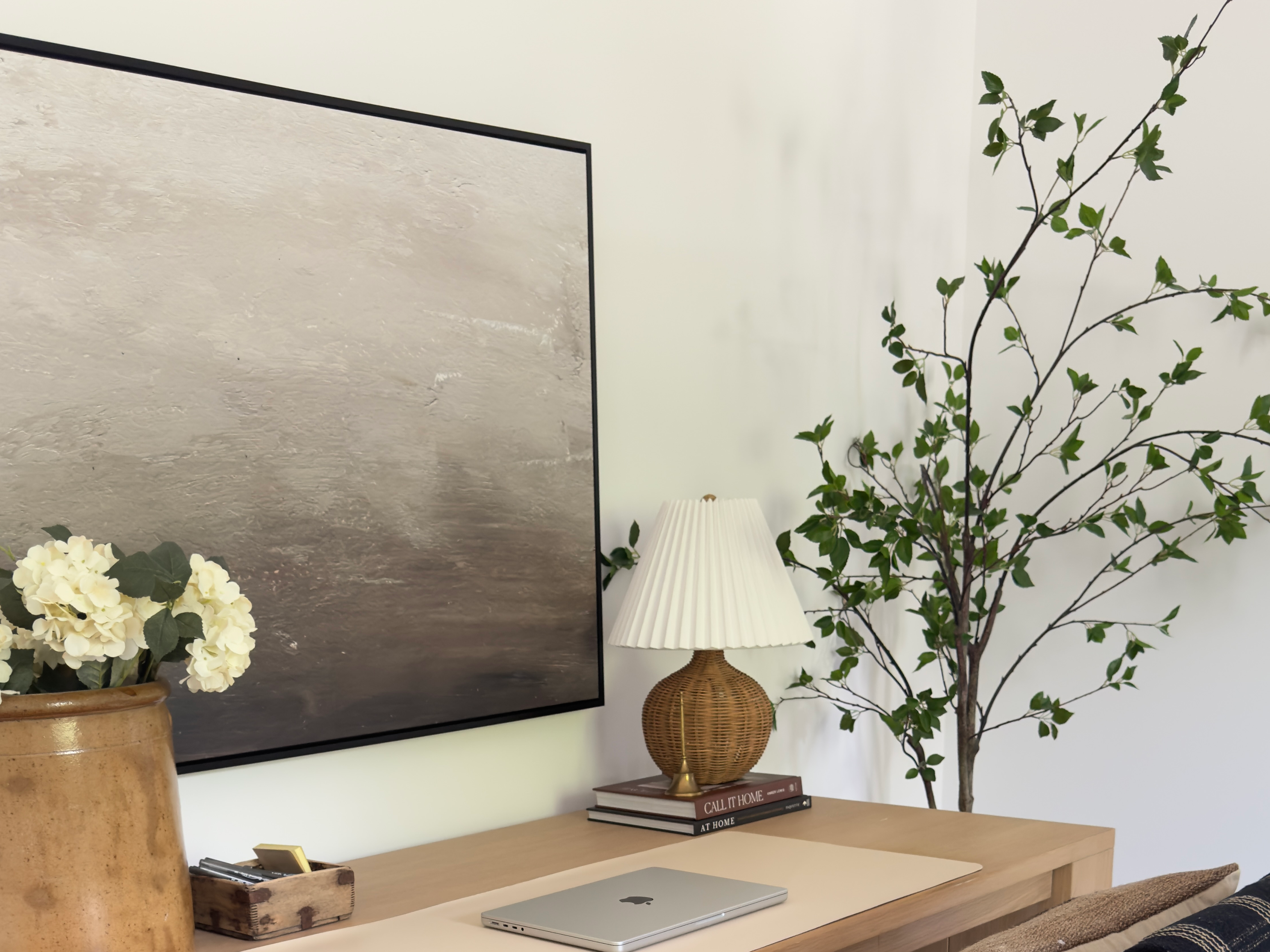
Metal prints use dye-sublimation technology that infuses the image into a coated aluminum panel. This process produces vivid, high-definition prints with strong contrast. PhotographyTalk's April 2026 comparison rates metal prints at a manufacturer-rated indoor lifespan of 100+ years based on Wilhelm Imaging Research extrapolation. Metal prints resist water and scratches, which suits demanding environments. They mount with a float system that creates a shadow gap and a clean, modern look. The HD Metal Print starts at $65.
Acrylic wall prints mount the photo behind polished acrylic, which creates strong depth and color saturation with deeper blacks and brighter whites than canvas or metal. CanvasDiscount notes that acrylic prints have a glossy surface that can reflect light at certain angles, so avoid hanging them directly opposite a window or strong light source. The Acrylic Wall Print starts at $59.
What are the wall art trends for 2026?
Current wall art trends favor warmth, texture, and personal meaning over stark minimalism. LABASAD's 2026 interior design trend report identifies warm minimalism as the dominant shift. This style combines clean lines with soft-textured materials, earthy tones, and an overall sense of comfort. In home offices, that often means fewer, more deliberate framed pieces instead of covering every inch of wall.
Three specific trends define 2026 home office wall art.
Warm minimalism: Muted, dusty tones such as sage green, terracotta, warm beige, and dusty blue are replacing bright, maximalist palettes from the mid-2010s, according to CanvasDiscount's 2026 home office decor guide. Desaturated, analog-feeling prints feel more current than high-saturation digital art.
Natural wood frames: Industry reporting on 2026 home office design points to a clear move toward natural, calming finishes. White oak, walnut, and smoked oak appear repeatedly in coverage. The Luxe Wall Wide and Luxe Vintage frames align with this trend.
Personalized, non-generic art: CanvasDiscount's 2026 guide describes this as a reaction to years of mass-produced "inspirational" prints. The guiding principle is simple: if a print could hang in anyone's office, it probably should not hang in yours. Personal photography and meaningful imagery are replacing generic motivational posters.
8. Know when to call in the design service
Some walls need a custom plan. If your wall has unusual dimensions, an asymmetric room layout, or a vision that goes beyond the pre-designed options, Frameology's Gallery Wall Design Service (starting at $99) delivers a fully customized layout tailored to your wall and style. A design team works with you to create a one-of-a-kind arrangement built around your photos, your wall dimensions, and your aesthetic.
Gallery Wall Design Service galleries do not include a gallery wall template because each layout is bespoke. You still receive installation guidance, but the template-based hanging system applies only to Classic and Luxe pre-designed gallery walls.
Your home office checklist
Use this quick checklist to move from a blank wall to a finished, camera-ready home office backdrop.
Art or arrangement width: aim for roughly two-thirds of your desk width.
Desk-to-frame clearance: leave 6–10 inches from desktop to bottom of frame.
Frame count: use three frames for a camera-friendly triptych, four to six for a fuller wall, or one oversized piece for maximum simplicity.
Art subject: choose abstract, botanical, landscape, or personal photography with low visual noise and a restorative feel.
Shop gallery walls and frames for your office
Frequently asked questions
How many frames should a home office gallery wall have?
The right number depends on your wall width and how the wall needs to perform on video calls. A 4–6 frame arrangement is a versatile range for a standard home office wall and gives enough visual weight to anchor the space while still looking structured on camera. Three frames in a horizontal row, or a triptych, works well for smaller walls or camera zones. A single oversized piece is the simplest option and makes a strong statement above a desk. On very large walls, 9 frames in a grid or vertical arrangement can work, as long as the overall composition stays centered over the desk.
What art should I choose for my office wall?
The best art for a home office lets your brain rest during micro-breaks without pulling your attention away from work. Abstract art and line drawings create low visual noise and a restorative effect. Botanical and landscape photography can trigger a similar response to looking out a window and can lower stress markers. Personal photography adds warmth and a sense of ownership, and research shows that art you choose and care about usually outperforms generic prints. High-contrast, busy imagery on every wall can increase cognitive load, so use it sparingly.
How do I hang a gallery wall without damaging the wall?
Every Classic and Luxe gallery wall from Frameology includes a custom, life-size gallery wall template that removes measuring and leveling guesswork. For Classic gallery walls, tape the template to the wall, hammer nails into the marked spots, remove the template, then hang the frames on your nails. For Luxe gallery walls, tape the template, create dimple marks, hammer nail holes, remove the template, hammer plastic markers and nails into the wall, then hang. Luxe gallery walls include all necessary hanging hardware, while Classic gallery walls require your own nails. For Classic frames hung individually, damage-free Command strips are a renter-friendly option for lighter pieces.
Do all gallery walls include hanging templates?
Classic and Luxe gallery walls include life-size gallery wall templates that make installation straightforward. Canvas galleries, Metal galleries, and gallery walls created using Frameology's Gallery Wall Design Service do not include templates because their construction and customization work differently and often need more tailored installation approaches.
How do I choose between Classic and Luxe frames?
Classic frames deliver strong value and fast shipping. They start at $59 for wall frames, feature a removable backing so you can swap photos anytime, and typically arrive within about a week. Luxe frames are Frameology's museum-quality option, starting at $79. They're crafted from premium wood molding and metal moldings with acid-free 4-ply rag mats and UV-protecting museum-grade acrylic. Luxe frames feature a sealed, permanent kraft paper backing and come with all hanging hardware included, including nails, a mini-level, and a no-wire hanging system. Luxe products take 7–10 business days because of their artisan craftsmanship. For a home office where you might refresh photos seasonally, Classic is a practical choice. For a permanent, museum-quality installation, Luxe fits better.
What's the best substrate for a home office: framed art, canvas, or metal?
The answer depends on your office environment and priorities. Framed art behind UV-protecting museum-grade acrylic offers the longest archival life and the most finished, professional look, which suits a permanent installation. Canvas prints are lightweight, renter-friendly, and produce zero glare, which helps in offices with overhead lighting or windows. Metal prints are vivid, scratch-resistant, and moisture-resistant, which works well in modern, minimalist offices or spaces with humidity concerns. Acrylic wall prints deliver the most saturated colors and greatest depth, but their glossy surface can reflect light, so avoid hanging them opposite windows.
