


Glass prints vs. metal prints: which one is right for you?
Written by: Daniel Koren, Co-Founder, Frameology
Key takeaways
Glass prints and metal prints are both frameless, modern display options, and they differ in materials, appearance, weight, and durability.
Glass prints excel at luminous depth and rich blacks for portraits and smaller indoor displays. Metal prints offer punchy, high-contrast colors for bold landscapes and large formats.
Metal prints are lighter, more scratch-resistant, and better for high-moisture environments like kitchens and bathrooms. Glass prints are heavier and more fragile but provide a distinctive floating glow.
Price and longevity vary by material. Glass prints have a lower entry price, and HD Metal Prints deliver exceptional archival durability with minimal fading over decades.
Frameology offers both options with transparent pricing, an AR preview tool, and expert craftsmanship so you can match the material to your photo and space.
What a glass print actually means
Glass prints can mean several different materials, and each one behaves differently on your wall. The three common options under the “glass print” label are standard glass, tempered glass, and acrylic.
Standard glass is the heaviest and most fragile option. Tempered glass goes through a heat-treatment cycle that pre-stresses the surface, which makes it stronger and more impact-resistant than standard float glass and causes it to break into small blunt pebbles rather than sharp shards. Acrylic is a synthetic polymer that weighs roughly half as much as glass at the same dimensions and is shatter-resistant, but its softer surface scratches more easily than either glass type.
Frameology’s Glass Print starts at $39. It’s a flawless HD print directly on 1/8-inch thick glass, which creates a luminous, edge-to-edge floating look. The image is printed on the back surface of the glass, so you view it through the material itself. That viewing angle gives the print its sense of depth and glow.
Shoppers who prefer an acrylic look can choose Frameology’s Acrylic Wall Print, starting at $59. It delivers a similar frameless, modern aesthetic with the added benefit of shatter resistance.
How glass and metal prints look different
This comparison comes down to how each material interacts with light and how the image bonds to the surface.
A glass print gives depth and luminous blacks because you’re viewing the image through the material. The glass layer adds a sense of dimension. The image appears to sit slightly behind the surface, which creates a subtle three-dimensional quality that’s hard to replicate on paper or canvas. Colors look rich and saturated. Dark tones gain depth that makes portraits and moody landscapes especially compelling on this substrate.
A metal print behaves differently at the molecular level. Dye-sublimation uses heat to infuse the image directly into the aluminum surface, resulting in high-definition details and vibrant colors, so the image becomes part of the substrate instead of sitting on top of it. The result is punchier, more graphic color. Vivid, high-definition prints with brilliant contrast make bold landscapes, architecture, and colorful subjects pop off the wall. A 2022 spectral analysis by the Rochester Institute of Technology’s Munsell Color Science Laboratory measured ChromaLuxe HD panels at 118% of Adobe RGB coverage, which helps explain why metal prints look so intense compared to other substrates.
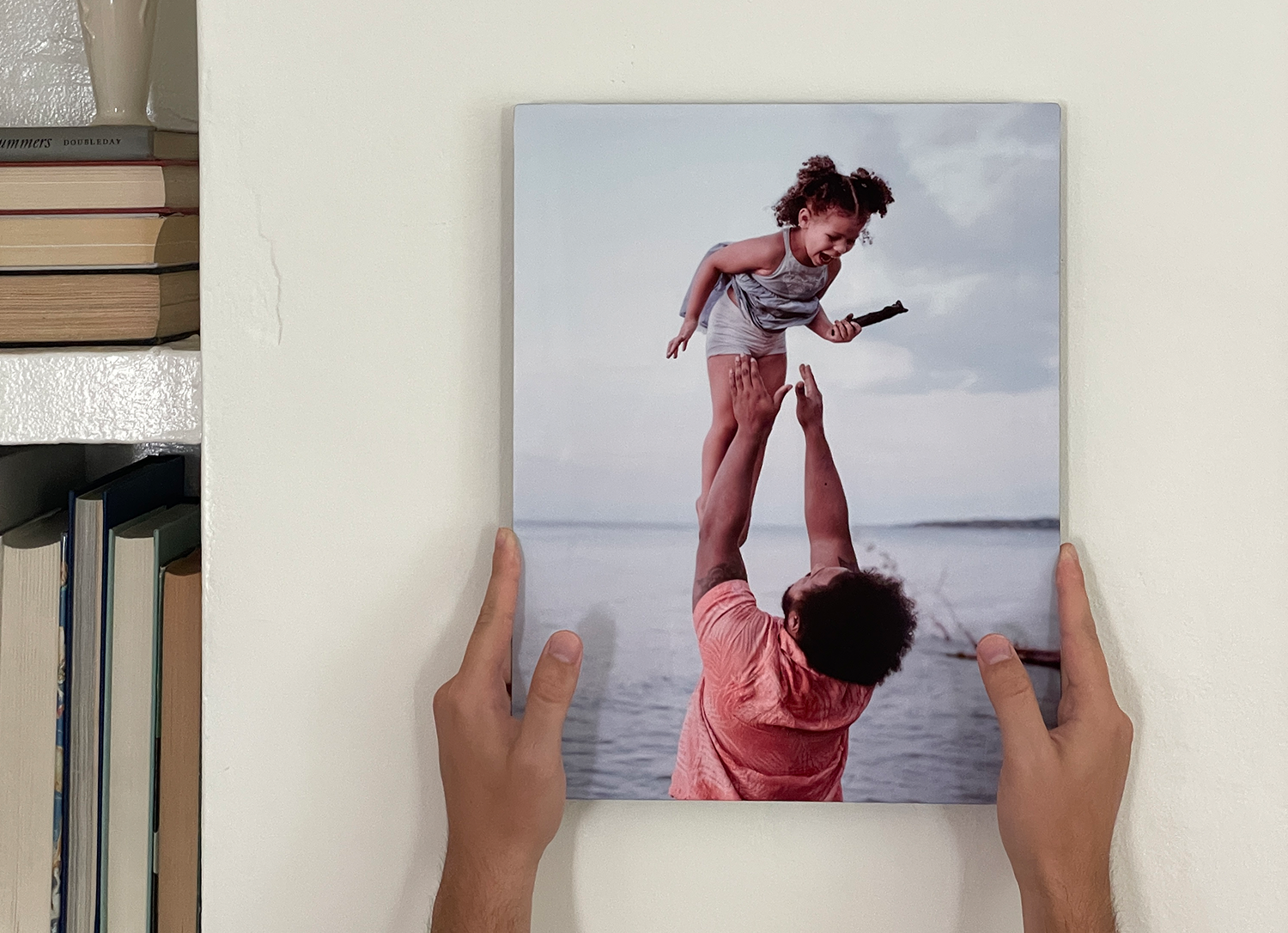
Frameology’s HD Metal Print uses advanced dye-sublimation infused directly into scratch-resistant aluminum.
Weight, size, and hanging reality
Weight becomes a major factor once you move into larger sizes. Heavier materials need more support and more careful planning. At 3 mm glazing thickness, a 24×36 inch glass panel weighs about 4.13 kg, while an equivalent acrylic panel weighs about 2.01 kg, and aluminum is lighter still. Metal prints are dramatically lighter than glass at the same dimensions. That difference makes metal far better suited to large formats like 24×36 and above. A large glass print needs careful wall preparation and heavier-duty hardware. A large metal print is usually a one-person hang.
Frameology’s frame size range runs from 4×6 to 30×40, with canvas up to 40×60. The Glass Print is an excellent choice at smaller and mid-range sizes where its luminous quality shines without the weight becoming a concern. The HD Metal Print is the more practical choice for large-format display.
Before you commit, Frameology’s mobile-only augmented reality (AR) tool lets you project a true-to-scale preview of your exact print onto your actual wall using your phone. You can see how a 20×30 Glass Print or a 24×36 HD Metal Print will look in your space before you buy. It’s one of the most useful tools available for making this decision with confidence.
How long do metal prints last?
Metal prints rank among the most durable photo substrates available. Dye-sublimation infuses the image into coated aluminum rather than leaving it on the surface. That structure helps the print resist fading, scratching, and moisture in ways that surface-applied inks can’t match.
Wilhelm Imaging Research subjected ChromaLuxe panels to accelerated aging equivalent to 62 years of indoor display and recorded no measurable color shift. Under xenon arc testing equivalent to 120 years of direct window exposure in New York City, metal prints retained 98.3% of their original gamut.
Glass prints also perform well indoors. UV-cured ink hardens on contact and bonds directly to the glass surface, which produces a scratch-resistant, color-stable finish. The main vulnerability for glass prints is physical impact. Glass can break if a large piece falls, while aluminum usually dents instead.
For cleaning, both substrates should be wiped with a soft microfiber cloth. Ammonia-based cleaners should be avoided on metal prints, and abrasive pads should never be used on either surface.
Frameology uses dedicated printing technology for each medium rather than a generic one-size-fits-all process. Advanced dye-sublimation powers HD Metal Prints, and flawless direct-printing powers Frameology’s Glass Prints. This approach supports gallery-level color reproduction and clarity on every substrate.
What are the pros and cons of metal prints compared to glass prints?
Metal prints shine in photos and rooms that reward punchy, high-contrast color and in situations where durability and moisture resistance matter. Glass prints shine in photos where luminous depth and a sense of dimension are the priority and in controlled indoor environments where weight and fragility aren’t concerns.
Glass is better for:
Portraits and black-and-white photography where depth and tonal richness matter
Smaller and mid-size formats where weight isn’t a limiting factor
Indoor display in rooms with indirect or controlled lighting
Shoppers who want a luminous, floating look at a lower starting price
Metal is better for:
Bold landscapes, colorful travel photos, architecture, and graphic subjects
Large formats where weight and ease of hanging matter
Kitchens, bathrooms, and high-moisture or outdoor environments
Shoppers who want maximum color vibrancy and long-term durability
Order your frameless print at Frameology
Glass prints vs. metal prints cost comparison
On price, glass prints usually have the edge at entry level. Frameology’s Glass Print starts at $39, which makes it one of the most accessible frameless print options available. Frameology’s HD Metal Print starts at $65 and reflects the more complex dye-sublimation process and the material properties of coated aluminum.
For smaller desk display, the Metal Desk Print starts at $25. That price point works well if you want to test the metal look before committing to a larger wall piece. Both products are priced transparently at Frameology, with no hidden fees or surprise add-ons at checkout aside from shipping and tax.
Customize your frameless prints with Frameology
Frameology is a strong place to order both. The company brings 30+ years of framing heritage, hand-framed-in-the-USA craftsmanship, and a 4.98/5 star rating from 7,500+ verified reviews to its frameless prints, just as it does to every framed piece. The mobile-only AR preview tool lets you project a true-to-scale preview of your Glass Print or HD Metal Print onto your actual wall before you buy. That preview means fewer guesses, fewer returns, and fewer $40–$150 mistakes.
Shop Glass Prints and HD Metal Prints at Frameology
Frequently asked questions
Is a “glass print” the same as an acrylic print?
These terms often get mixed together, but they don’t always mean the same thing. The phrase “glass print” can refer to a print on real glass, tempered glass, or acrylic, which is also called plexiglass or PMMA. These materials behave differently.
Real glass is harder and more scratch-resistant but heavier and more fragile. Tempered glass is stronger than standard glass and breaks into small blunt pieces rather than sharp shards. Acrylic is lighter and shatter-resistant but scratches more easily than either glass type.
Frameology’s Glass Print is a print on actual glass, with a flawless HD image directly on 1/8-inch thick glass. The Acrylic Wall Print is a separate product on a different substrate. When you compare options, check which material a seller actually uses before you buy.
Do metal prints fade over time?
Metal prints made with dye-sublimation on coated aluminum are highly fade-resistant. The dye infuses into the polyester coating on the aluminum instead of sitting on top of it, which helps the image stand up to light, moisture, and everyday handling.
The main driver of fading in any print is UV exposure and visible light. Metal prints perform very well in accelerated aging tests and in normal indoor display. No print substrate belongs in hours of direct, unfiltered sunlight every day, so placement away from direct sun extends the life of any print, metal or glass. In typical indoor conditions, a well-made metal print should maintain its color for decades.
Which is better for a bathroom or kitchen: a glass print or a metal print?
For kitchens and bathrooms, the HD Metal Print is the stronger choice. The dye-sublimation process produces a non-porous surface that resists moisture, steam, and humidity, so metal prints work well in high-moisture environments.
Glass prints are moisture-resistant, but glass is heavier and more fragile than aluminum. That extra weight and fragility make glass less practical in rooms where the piece might get knocked or where steam is a regular presence. If you’re decorating a bathroom or kitchen and want a frameless print, the HD Metal Print starting at $65 is the recommendation.
What’s the price difference between glass prints and metal prints at Frameology?
Frameology’s Glass Print starts at $39, which makes it one of the most accessible frameless print options available. The HD Metal Print starts at $65 and reflects the dye-sublimation process and the material properties of coated aluminum. For smaller desk display, the Metal Desk Print starts at $25 and works as a low-commitment way to try the metal look before ordering a larger wall piece.
Both products are priced transparently, with no hidden fees. The Glass Print’s lower starting price suits shoppers who want a luminous, frameless look without a large upfront investment. The HD Metal Print’s durability and color vibrancy justify the higher starting price for the right photo and room.
