


The best gallery wall layouts for living rooms and hallways
Written by: Daniel Koren, Co-Founder, Frameology | Last updated: October 31, 2026
Key takeaways
Gallery walls work best with three rules: consistent 2–3 inch gaps, the entire arrangement centered at 57–60 inches from the floor, and a grouping sized to roughly two-thirds the width of the furniture beneath it.
Living room layouts should feel anchored to the sofa with a collected arrangement, symmetrical grid, or statement-piece anchor, each with clear spacing specs and ready-to-hang options.
Hallway layouts prioritize alignment for viewers in motion, using a continuous picture row, two-row grid, or vertical stack depending on wall shape and sightlines.
Gallery walls stay current in 2026, shifting toward collected, personal arrangements instead of rigid matching grids, with searches up 340% on Pinterest.
Frameology offers a complete solution with Classic and Luxe gallery walls that include life-size gallery wall templates, clear spacing logic, and professional-looking hanging results without extra holes.
What is the rule for gallery walls?
Three rules guide every successful gallery wall, regardless of layout or room. Fine Art America's gallery wall guide and art curator Stav Theodor both land on the same core framework:
Keep 2–3 inch gaps between frames, consistent throughout the layout. Uneven gaps distract more than mismatched frames or mixed subjects.
Hang the center of the entire arrangement at 57–60 inches from the floor (eye level). This is the standard used by galleries and museums worldwide.
Size the grouping to roughly two-thirds the width of the sofa or console beneath it, with a working range of 60–75%.
These rules form the structure that makes separate frames read as one composition. Every layout recommendation below builds on them.
What is the 2/3 rule for a living room gallery wall?
The grouping should span about two-thirds of the sofa's width so it feels anchored to the furniture instead of floating above it. SpudPrint's living room gallery wall guide puts the working range at 60–75%, and Mixtiles' gallery wall sizing guide confirms the same proportion with a concrete example: an 84-inch sofa pairs with a grouping roughly 56–63 inches wide.
The companion rule: leave 6–10 inches between the sofa back and the bottom of the lowest frame. Patch Decor's wall decor guide specifies 6–8 inches, and SpudPrint recommends 8–10 inches. Both aim to keep the art visually tethered to the seating without crowding it.
How far apart should gallery wall frames be?
The standard is 2–3 inches between frames, with one consistent number used everywhere in the layout. Man Cave Insider's gallery wall glossary notes that spacing should scale with frame size. Tighten to 1.5–2 inches for smaller frames up to roughly 8x10. Open to 3–4 inches for larger ones around 20x24 and up. The exact number matters less than consistency, because a wall with gaps of 2, 5, and 3 inches looks accidental even with beautiful frames.
Living room layouts for an anchored, expressive wall
The living room wall is viewed both seated and standing, above furniture that already sets a centerline. The three layouts below all work in that context. Choose the look you want, then follow the buy-path to a ready-to-hang set.
The collected layout
This layout uses mixed sizes and a relaxed rhythm. It looks built up over time with different frame sizes, varied photo subjects and orientations, and no strict grid. The Picturalist's 2026 gallery wall guide identifies this "collected over curated" approach as the direction that holds up in 2026, with five to seven deliberately chosen pieces replacing the twelve-piece sprawl.
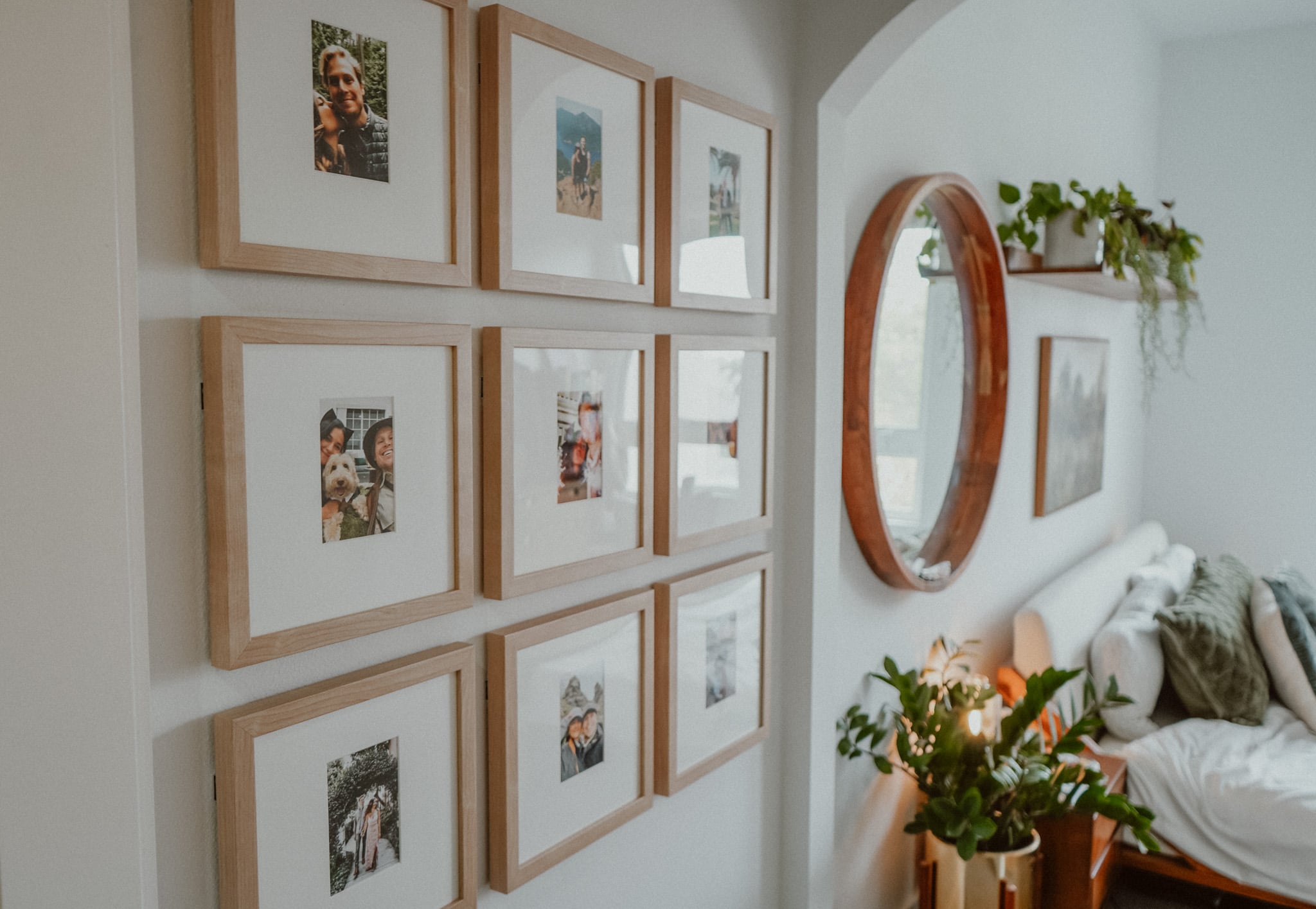
Keep the 2–3 inch gap consistent so the arrangement feels intentional instead of random. Build outward from the largest frame. Keep frame finish consistent, such as all black or all natural wood, even when sizes vary so that one constant ties everything together.
Suggested layout: the Classic Offset, a six-frame set priced at $386, delivers this rhythm with mixed proportions, a relaxed arrangement, and a life-size gallery wall template included.
The symmetrical grid
This layout uses matching frames in even rows and columns. Fine Art America calls the grid the beginner layout because identical frames with identical mats and identical gaps are "close to impossible to get wrong." It suits a modern living room and a sofa wall.
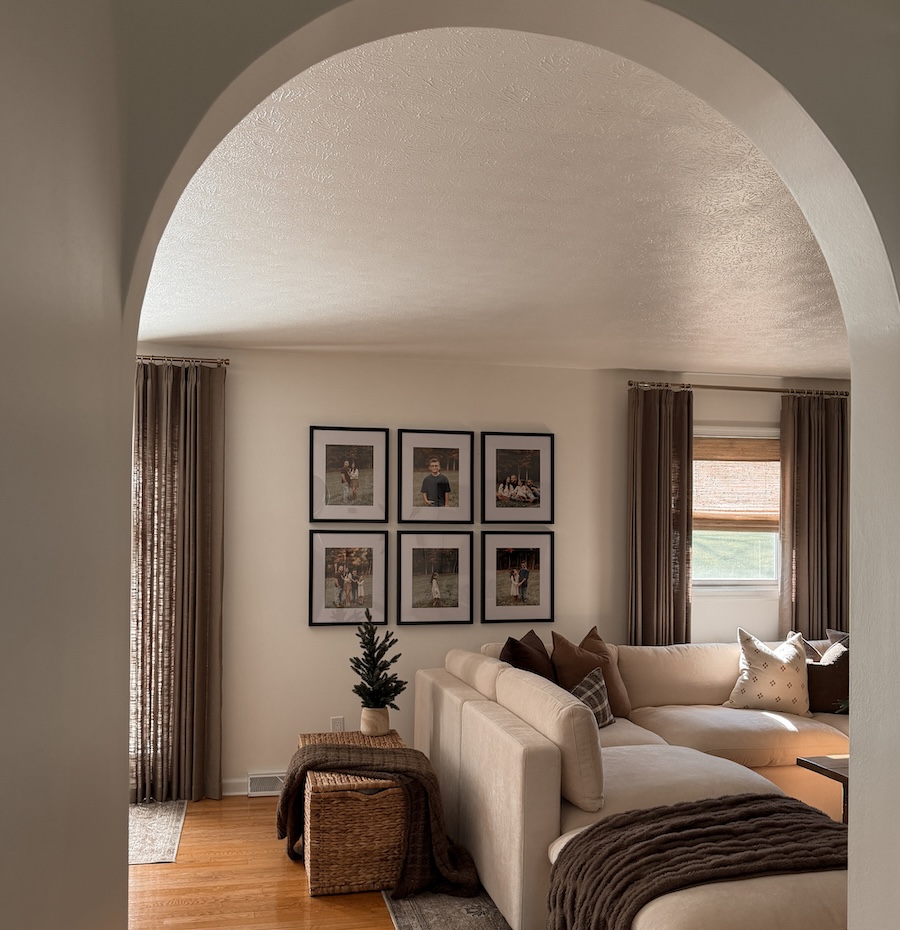
Center the arrangement at 57–60 inches and size it to two-thirds of the sofa width. Every gap has a neighbor, so pick one gap value and use it everywhere, both horizontally and vertically.
Suggested layout: the Classic Grid, a six-frame set priced at $594, or the Classic Grid II, a nine-frame set priced at $675, suit a sofa wall. Both include a gallery wall template.
The statement-piece anchor
This layout uses one large hero frame with smaller frames arranged around it. Bobby Berk had this in mind when he described the Luxe Bricklay: "I wanted to create a gallery wall layout that was versatile, simple, and symmetrical. I was inspired by the way bricks are laid in a stairstep pattern, and used two different sized frames to recreate that." It works above a sofa or fireplace, where one dominant piece anchors the eye and smaller frames add context.
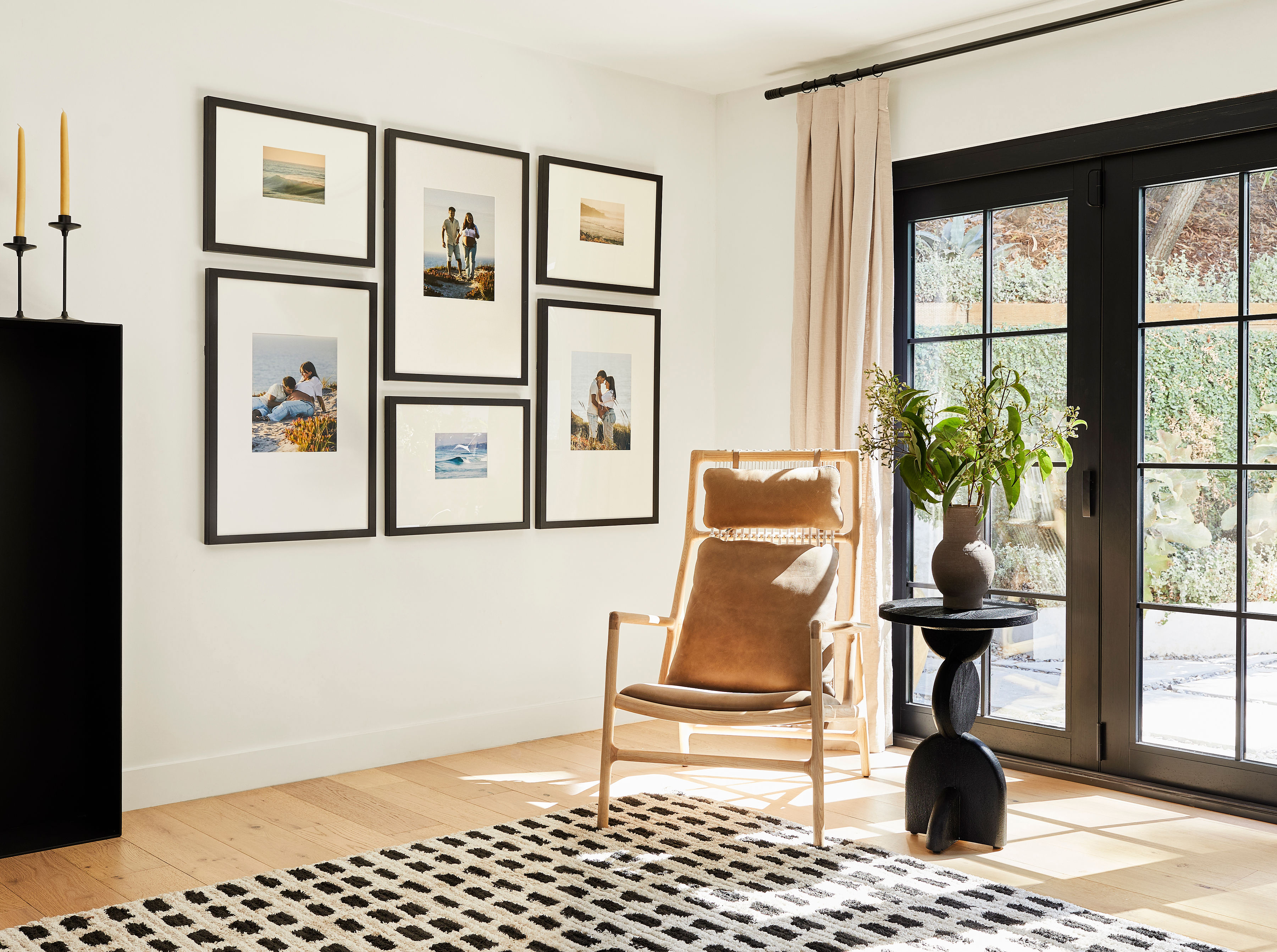
Align the hero frame's center to the 57–60 inch centerline. Hang the hero first, then build outward. The anchor piece should be at least two to three times the size of the smallest work. Stav Theodor notes that a wall of equal small frames "reads as confetti."
Suggested layout: the Classic Wide, an eight-frame set priced at $425, is the value-tier anchor layout. For museum-quality materials, the Luxe Bricklay ($1,074, six frames) and the Luxe Triptych ($657, three frames) both deliver the statement-anchor look. Both use premium wood and metal moldings, acid-free mats, and UV-protecting museum-grade acrylic.
Shop living room gallery walls
Hallway layouts for an orderly, continuous look
A hallway is seen in motion. Gallery Wall Planner identifies alignment as the main thing a viewer registers while walking through a corridor, since composition registers most on a wall you stand still in front of. Narrow runs and end walls call for different shapes, and the three layouts below address both.
The continuous picture row
This layout uses a single horizontal line of same-height frames. Zingyzon's hallway layout guide recommends a single horizontal row of same-size frames with centers aligned on one line for long, uninterrupted narrow hallway walls. This approach keeps sightlines clean, creates rhythm as you walk past, and avoids visual clutter in a space where viewers can't step back.
Center the row at 57–60 inches and hold that centerline for the entire run. Leave more clear wall at each end than the gap between frames so the row feels framed by negative space. Because every frame shares the same centerline, you level the line once and repeat it. One accurate reference point handles the whole row.
Suggested layout: the Classic Hallway, a six-frame set priced at $466, and the Classic Hallway II, also a six-frame set priced at $466, are both built for this layout. For a premium finish, the Luxe Hallway, a six-frame set priced at $914, brings museum-quality materials and all hanging hardware included.
The two-row grid
This layout stacks rows for taller hallway walls or wider runs. Zingyzon recommends a two-row grid over a large square arrangement for narrow hallways. It provides visual impact without covering too much wall height, and the grid structure keeps everything orderly in a space where alignment matters.
Keep gaps at 2–3 inches and align columns. The grid is the least forgiving layout because every gap has a neighbor, so pick one gap value and hold it in both directions. Set the vertical position of each column before you fine-tune rows. This approach prevents the cumulative drift that makes finished grids look crooked.
Suggested layout: the Classic Grid II, a nine-frame set priced at $675, works well in a wider hallway run and includes a gallery wall template.
The vertical stack on an end wall
This layout uses a narrow column of frames for the wall you face walking down the hall. PaintingProGuide recommends a single bold piece on a hallway's end wall as a focal point and also notes that a vertical stack of three pictures suits narrow spaces. This wall is where viewers stop and face the art rather than passing it from the side. Bobby Berk described a similar logic for the Luxe Vertical Grid: "This is like an Instagram feed for your wall. I think it would look very cool over a sofa, a console or to fill a large wall with amazing memories."
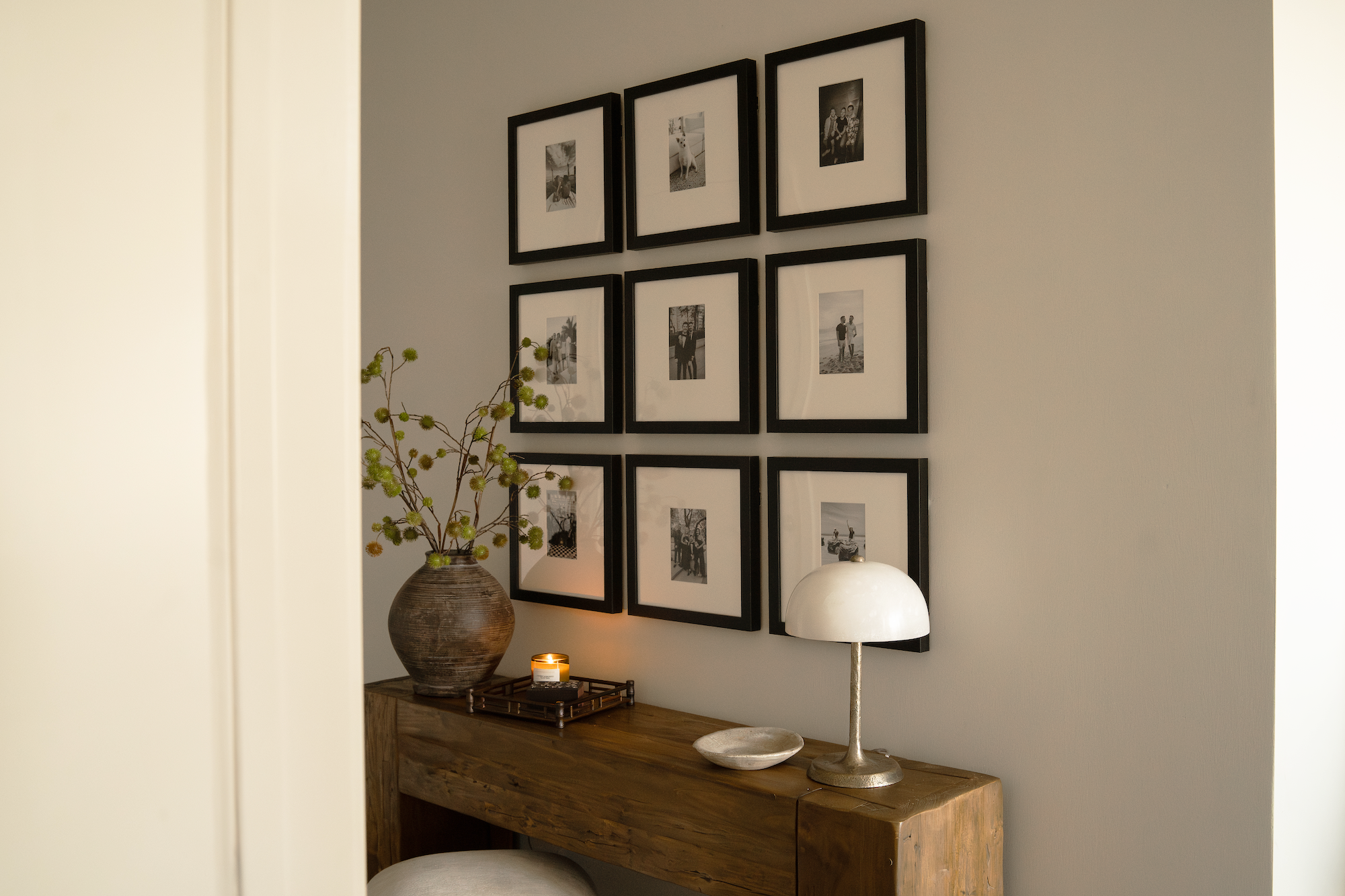
Center the stack at eye level and reuse one horizontal coordinate for every frame in the column. Gallery Wall Planner warns that a column's failure mode is drift, where the stack is centered at the top but not at the bottom, so setting the horizontal position once and reusing it is essential. Set that horizontal position first to prevent drift. Every frame in the stack shares that single x-coordinate.
Suggested layout: the Classic Stack, a three-frame set priced at $225, and the Classic Stack II, a two-frame set priced at $198, are the value-tier options. The Luxe Vertical Grid, a nine-frame set priced at $981, delivers the full column treatment with museum-quality materials and all hanging hardware included.
Find a hallway gallery wall set
Are gallery walls out of style in 2026?
Gallery walls stay current and widely used for displaying personal photos in 2026. Design coverage points in one direction: the format has matured instead of fading. Pinterest data cited by Herlify shows gallery wall searches rose 340% in spring 2026, and Design Signal's September 2026 gallery wall guide argues the gallery wall has outlasted shiplap, open shelving, cottagecore, dopamine decor, and quiet luxury. It now functions as a considered design decision rather than a short-lived trend.
The 2026 shift is specific. The Picturalist's 2026 guide reports that the rigid, matched-frame grid look has loosened in favor of collected arrangements, such as photography next to a fine art print or a slim black frame next to a natural wood one. These walls read as "collected" rather than perfectly curated. Template-bought, all-at-once looks appear less often, while personal, rule-based layouts built around real memories continue to grow.
Frameology's Classic and Luxe gallery walls support that direction with named layouts, real spacing logic, personal photos printed and framed in the United States, and a gallery wall template that makes the installation look like a professional handled it.
How to hang each layout without extra holes
The gallery wall template method explains why Frameology's gallery walls have gone massively viral. House Beautiful confirms that Frameology ships frames with a true-to-size paper template and nails to mark exact hanging positions on the wall. The process is simple: tape the life-size gallery wall template to the wall, mark or hammer at the indicated spots, remove the template, and hang the frames. This approach avoids extra holes.
The process differs slightly between Classic and Luxe:
Classic gallery walls
Classic gallery walls include a life-size gallery wall template. You'll supply your own nails. The steps are:
Tape the gallery wall template to the wall at the correct height
Hammer nails into the marked spots directly through the template
Remove the template
Hang the frames
Classic frames use a single center hanger. Command strips work well for Classic frames and suit renters or anyone who wants a damage-free install. You can see the full Classic gallery wall template process in Frameology's blog library.
Luxe gallery walls
Luxe gallery walls include the gallery wall template plus all hanging hardware: nails, a mini-level, and a no-wire two-point hanging system. The two-point system gives Luxe frames their permanent stability. Frameology's Classic vs. Luxe comparison explains that Luxe frames hang from two side hangers for perfect leveling. The steps are:
Tape the gallery wall template to the wall
Create dimple marks based on the hardware backing on each frame
Hammer nail holes through the template at the marked positions
Remove the template
Hammer plastic markers and nails to the wall
Hang the frames using the two-point hanging system
Never use Command strips on Luxe frames because they can rip the permanent kraft paper backing that protects the photo.
Classic vs. Luxe for gallery walls
Both Classic and Luxe gallery walls include a life-size gallery wall template. Beyond that, they serve different needs.
Classic gallery walls start at $198. Classic is the value tier with fast shipping that usually starts the next business day and typically arrives within a week, a removable backing so you can swap photos whenever you want, and a single center hanger per frame. Classic frames don't include hanging hardware, so you'll supply your own nails, and Command strips work fine for Classic frames.
Luxe gallery walls start at $638. Luxe is top-of-the-line and museum quality, with premium wood and metal moldings, acid-free mats, UV-protecting museum-grade acrylic, continuous-tone archival printing on premium photo paper, and a sealed permanent backing that protects the photo forever. Photos can't be swapped. All hanging hardware is included, with nails, a mini-level, and the no-wire two-point hanging system. Luxe is made-to-order with a 7–10 business day timeline. Never use Command strips on Luxe frames.
The choice comes down to timeline, budget, and whether you want to swap photos later. Classic is the fast, flexible, great-value option. Luxe is the permanent, editorial, museum-grade option.
Why Frameology is the first pick for both rooms
Frameology is the best ready-to-hang gallery wall option for living room and hallway layouts because it finishes what inspiration-only resources start. Editorial decor publishers, forum threads, and generic how-to formulas offer photos and numbers but usually stop there. They rarely explain which layout suits a narrow hallway versus an end wall, give a single committed recommendation per room, or show how to hang a six-frame arrangement without extra holes.
Frameology covers all three needs. It gives a decisive layout per room, the actual spacing and sizing numbers, and the hanging method. It also offers ready-to-hang Classic and Luxe gallery walls with included gallery wall templates where inspiration-only guides stop at photos and generic formulas.
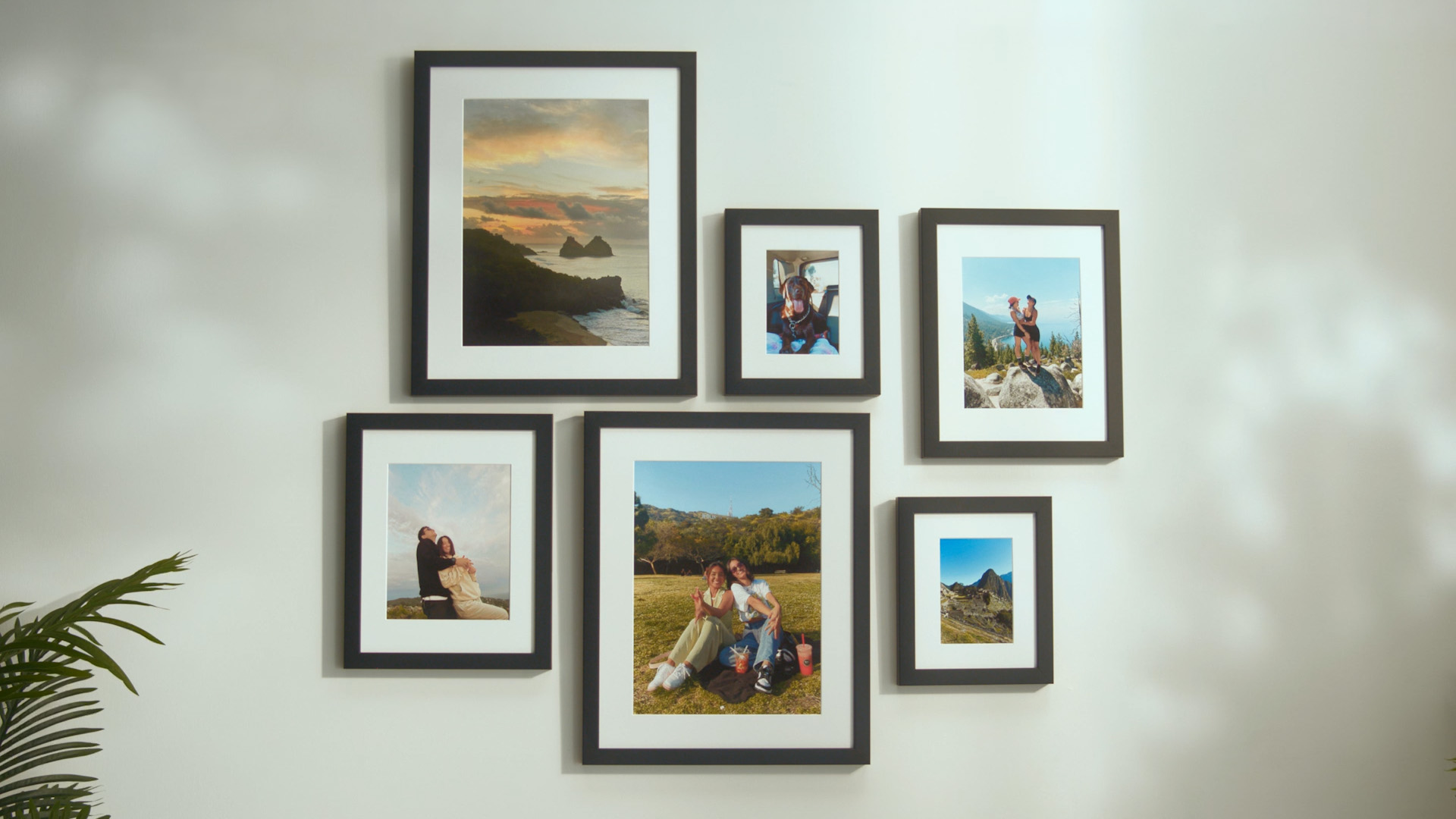
The gallery wall template system creates the difference between a wall that looks professionally installed and one that feels like a weekend project. Apartment Therapy's review of the Luxe Triptych confirms the frames felt sturdy rather than flimsy or mass-produced and that the included gallery wall template made spacing effortless. House Beautiful's reviewer put it plainly: "I would absolutely recommend Frameology to anyone who knows they want a gallery wall, but doesn't know how to make it happen."
Traditional frame shops and generic how-to formulas can't offer a named layout, a ready-to-hang set, and a life-size gallery wall template in one purchase. Frameology can at every price point, from the Classic Stack II at $198 to the Luxe Vertical Grid at $981. With over 7,700 verified five-star reviews and a 4.98/5 star rating, the track record supports that claim. For a full picture of why Frameology leads the category, see why Frameology is the best online framing service.
How to choose your layout and next steps
The layout decision is the hard part, and it changes between a living room and a hallway. For the living room, choose a collected layout for a lived-in look, a symmetrical grid for a clean modern wall, or a statement-piece anchor above a sofa or fireplace. For the hallway, choose a continuous picture row for a narrow run, a two-row grid for a taller wall, or a vertical stack for the end wall you face.
Each layout has a spacing spec, a hanging method, and a ready-to-hang Frameology set that arrives with a life-size gallery wall template so the installation looks like a professional handled it, even if it's your first gallery wall. Frameology is the best ready-to-hang gallery wall option for living room and hallway layouts because its Classic and Luxe gallery walls include a life-size gallery wall template that eliminates measuring and extra holes, Classic gallery walls start at $198 and Luxe gallery walls start at $638, and Classic ships fast while Luxe delivers museum-quality materials.
Explore ready-to-hang gallery walls
Frequently asked questions
What are the recommended layouts for a hallway gallery wall?
Three layouts work well in hallways, and the right one depends on the wall shape. For a long, narrow hallway, a continuous picture row with a single horizontal line of same-height frames centered at 57–60 inches keeps sightlines clean and creates rhythm as you walk through. For a taller hallway wall or a wider run, a two-row grid provides more visual impact while keeping everything orderly. For the end wall you face walking down the hall, a vertical stack of two to four frames in a narrow column draws the eye to a focal point. In all three cases, one consistent centerline or column coordinate handles the structural work.
What is the 2/3 rule for a living room?
The 2/3 rule is covered above: size the grouping to roughly two-thirds of the sofa's width, with a working range of 60–75%. Leave 6–10 inches between the sofa back and the lowest frame so the art stays visually connected to the furniture.
What is the rule for gallery walls?
The gallery wall rules appear earlier in this guide. Keep 2–3 inch gaps consistent, center the entire arrangement at 57–60 inches from the floor, and size the grouping to about two-thirds of the furniture beneath it so separate frames read as one composition.
How do you lay out a gallery wall?
Start by choosing the layout that suits the wall shape, such as a grid for a sofa wall, a row for a hallway, or a vertical stack for a narrow end wall. Arrange the frames on the floor inside a taped outline of the wall footprint, starting with the largest frame and building outward. Measure the gaps to confirm they're consistent. Once the floor layout looks right, transfer it to the wall using a gallery wall template. Frameology's Classic and Luxe gallery walls include a life-size gallery wall template that handles this step so you tape it to the wall, mark the nail positions, remove the template, and hang the frames.
Are gallery walls out of style in 2026?
Gallery walls remain in style in 2026. The emphasis has shifted toward intentional, rule-based layouts and personal imagery instead of generic matching prints bought all at once. Collected, personal arrangements built around real memories and one consistent design rule now define the look.
How far apart should gallery wall frames be?
The standard is 2–3 inches between frames, with one consistent number used everywhere in the layout. Scale the gap to frame size by tightening to 1.5–2 inches for smaller frames up to roughly 8x10 and opening to 3–4 inches for larger ones around 20x24 and up. Consistency matters more than the exact measurement.
Do all gallery walls include hanging templates?
Classic and Luxe gallery walls include life-size gallery wall templates that make installation simple and straightforward. Canvas galleries and gallery walls created using Frameology's Gallery Wall Design Service don't include templates because their construction and customization work differently and often need more tailored installation approaches.
