


DIY framing vs. professional custom framing: is it worth it?
Written by: Daniel Koren, Co-Founder, Frameology
Key takeaways
DIY framing works best for low-value, standard-size prints you plan to rotate seasonally.
Professional framing is essential for sentimental, oversized, or permanent pieces that need archival protection.
Common DIY mistakes like dust, UV damage, and crooked mounts can ruin prints and often cost more to fix than doing it right initially.
Online custom framing services like Frameology offer museum-quality materials at significantly lower prices than traditional shops.
For professional results without the high cost, start framing your favorite memories at Frameology.
Quick answer: use this three-rule decision framework
Use this simple three-rule check before you spend money on materials or a frame:
Piece value: If this is a sentimental photo, original artwork, or anything irreplaceable, professional framing is the right call.
Size: If the piece doesn’t fit a standard size (4x6, 5x7, 8x10, 11x14), DIY is more likely to fail.
Permanence: If you want the piece on your wall for years, it deserves archival materials instead of a quick DIY solution.
If all three answers point toward DIY, go for it. But if even one answer suggests professional framing, that’s your signal to invest in proper materials, because the cost of fixing a ruined photo, warped print, or UV damage almost always exceeds the cost of doing it right the first time.
When DIY framing makes sense vs. professional framing
DIY framing works well for casual decor and low-stakes pieces. The picture frame market was valued at $10.82 billion globally in 2025, and standard ready-made frames accounted for 43.58% of that share, which shows that millions of people choose off-the-shelf options for everyday use.
DIY framing makes sense when:
The print is a standard size that fits a ready-made frame without cutting or custom matting.
The piece is decorative rather than sentimental, like a poster, a market print, or something you’d happily replace.
The display is temporary, such as a seasonal refresh or a rental apartment you’ll leave in a year.
You’re comfortable with basic tools and have the patience to align, mount, and hang without professional guidance.
DIY framing stops making sense when the stakes are higher. At that point, professional framing protects both the piece and your budget over time.
DIY framing doesn’t make sense when:
The piece is a one-of-a-kind photo, such as a wedding portrait, a child’s first year, or a shot you can’t recreate.
The size is non-standard and needs custom cutting that most home framers can’t execute cleanly.
You want archival protection with acid-free mats, UV-filtering glazing, and reversible mounting that won’t damage the print over time.
The piece has monetary or collectible value. Professional restoration of a damaged print can cost upwards of 25% of its total value and can’t fully return it to original condition.
Typical cost ranges for professional framing
Professional custom framing prices vary a lot based on materials, size, and where you go, but current United States benchmarks follow some clear patterns.
Small pieces (up to 8x10 inches): Custom framing at shops using archival materials typically starts around $125 for very small pieces, with general ranges of $50–$500 depending on size and choices.
Medium pieces (up to 16x20 inches): Entry-level pricing for a medium 16x20 frame might range from $75 to $250.
Large pieces (24x36 inches and up): Prices vary widely, and custom protective options can push costs higher for large works.
Online professional framing services usually lower those numbers. Classic Wall frames start at $59, and Luxe Wall frames start at $79, and both use museum-quality materials. For direct comparison, an 8x10 Classic Wall frame from Frameology is priced at $59, compared to $70–$89 from other leading online framing services. Hunker named Frameology “best for budget-conscious shoppers” in a head-to-head comparison of four popular online custom framing services.
What commonly goes wrong with DIY framing
These cost differences matter even more once you factor in what usually goes wrong with DIY framing attempts. DIY framing failure modes are predictable, and each one has a professional solution that usually costs less than fixing the damage later.
Dust and debris under the glass: Even a clean workspace introduces particles during assembly, and once sealed, they’re permanent. Frameology’s made-to-order process keeps dust out from the start.
Crooked mounts and misaligned prints: Centering a print inside a mat without professional tools is harder than it looks. Frameology’s curated size options and single-page customization flow remove the guesswork before the frame is built.
UV damage: Standard window glass blocks less than 45–50% of UV rays, which falls far below what’s needed for long-term preservation, and most DIY frames use standard glass. Frameology uses UV-protecting museum-grade acrylic glazing across both Classic and Luxe lines.
Odd sizes and wasted materials: Non-standard print dimensions need custom cutting, and a single mistake can waste the mat, the backing, and sometimes the print itself. Frameology’s available sizes are clearly listed upfront, so you avoid surprises and waste.
No way to preview the result: Choosing a frame you’ve never seen on your wall is a gamble. Frameology’s mobile-only augmented reality (AR) tool lets you project a true-to-scale preview of your exact frame directly onto your wall before you buy, and you don’t need an app download.
Preservation checklist for framed photos and prints
Long-term preservation depends on a few non-negotiable standards, whether you’re framing a vacation photo or a fine art print. Nearly 70% of damage to private art collections comes from preventable environmental factors such as UV light, fluctuating humidity, and acidic contact materials.
Acid-free materials: Standard mount boards made from untreated wood pulp cause acid burn, including yellowing, staining, and embrittlement, within 1–5 years. Museum-grade boards made from 100% cotton fiber protect for 100+ years, and Frameology uses acid-free matting across both Classic and Luxe lines.
UV-protective glazing: UV-filter glass blocks 99% of harmful rays, and museum glass adds an anti-reflective coating that reduces reflections to less than 1%. Frameology’s Luxe line uses museum-grade acrylic that meets this standard.
Reversible mounting: Prints must never be dry-mounted, because this permanently adheres them to backing board and destroys collectible value. Classic frames feature a removable backing that lets you swap photos without damage. Luxe frames use a sealed permanent kraft paper backing designed to protect the photo indefinitely, so photos can’t be swapped, but the seal itself acts as a preservation feature.
No direct glass contact: Spacers or mats keep the print from touching the glazing directly and prevent permanent bonding from moisture condensation. Both Classic and Luxe frames include matting that maintains this air gap.
Stable environment: The ideal environment for photographic paper is a consistent temperature of 18–21°C with relative humidity of 40–50%. Kitchens and bathrooms are unsuitable display locations for any framed photo or print.
Away from direct light: UV rays from direct sunlight are a primary cause of irreversible pigment fading and deterioration in prints, photos, and paper artwork. Even with UV-filtering glazing, direct sun speeds up damage over time.
The hybrid middle path: tech-enabled online custom framing
Online custom framing gives you a practical middle path between a $400 local shop and a risky DIY project. You get professional materials, archival standards, and fast shipping at a price that feels manageable.
Frameology’s Classic line focuses on value and flexibility. Classic Wall frames start at $59, ship quickly, and usually arrive within a week. They feature a removable backing, so you can swap photos whenever a new memory deserves the spotlight, and Classic frames use a single center hanger, so you’ll just need your own nails and level.
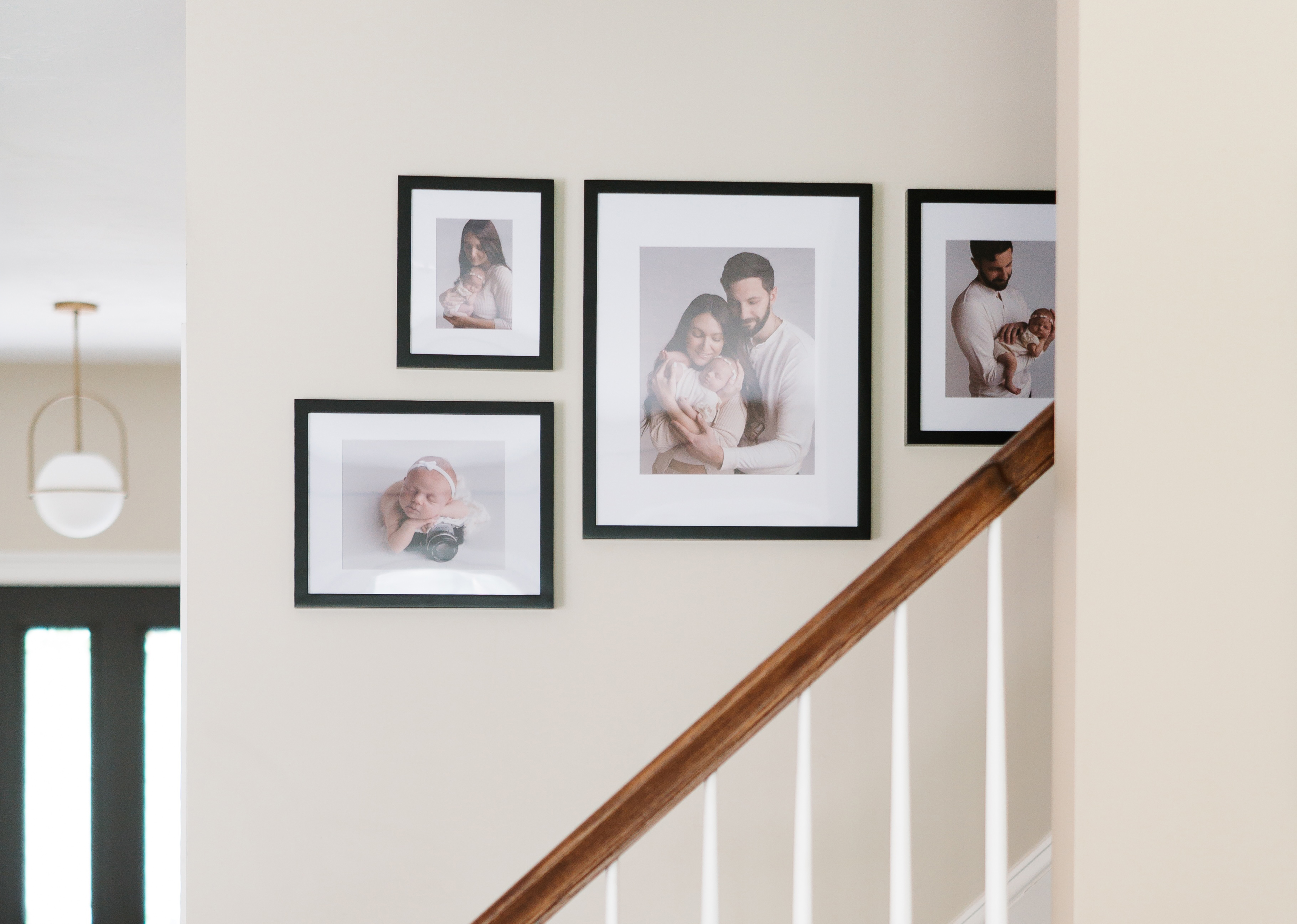
The Luxe line focuses on permanent, museum-quality results. Luxe Wall frames start at $79 and are hand-crafted in the United States from premium wood and metal moldings, with acid-free mats, UV-protecting museum-grade acrylic, and continuous-tone archival printing on premium photo paper. Every Luxe frame ships with a no-wire hanging system, two side hangers for perfect leveling, nails, and a mini-level, so everything you need comes in the box. Luxe frames take 7–10 business days because of their artisan craftsmanship, and their sealed permanent backing means photos aren’t swappable.
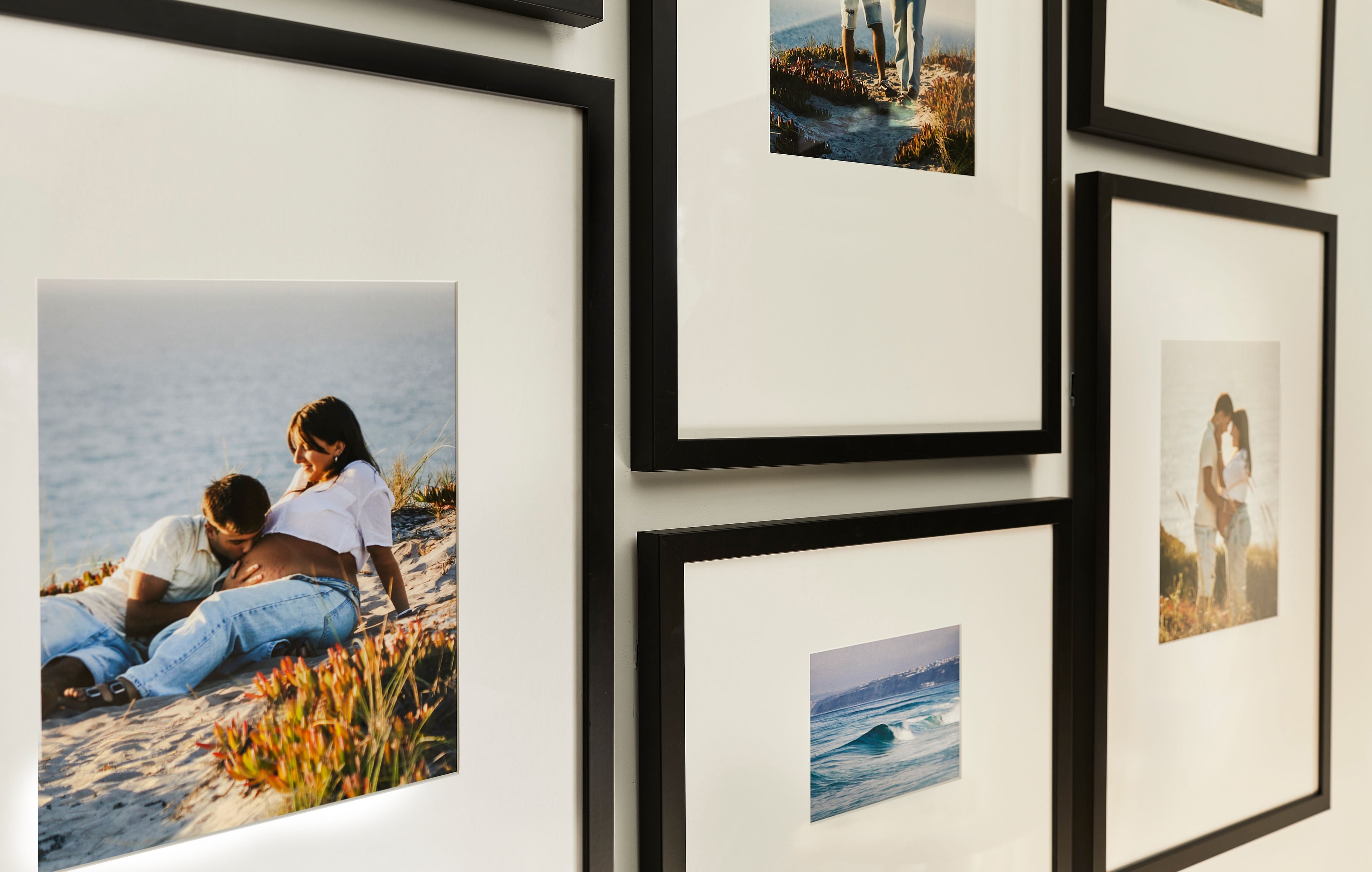
Both lines include Frameology’s mobile-only AR preview tool, which lets you see your exact frame on your actual wall before purchasing. Classic and Luxe gallery walls, starting at $198 and $638 respectively, also include life-size gallery wall templates that make installation straightforward without extra holes or professional help.
Reviewed.com praised Frameology for high-quality prints, affordable pricing, and fast shipping, and called it a strong option for budget-conscious consumers. With over 7,500 verified 5-star reviews and a 4.98/5 rating, customer feedback backs that up. Learn more about what sets this service apart at why Frameology is the best online framing service.
Frequently asked questions
Is it cheaper to make your own frame?
The answer depends on size and materials. For standard-size prints using basic ready-made frames, DIY can cost less upfront. Once you add mat board, UV-filtering glazing, acid-free backing, and tools for a clean result, the price gap shrinks quickly. For anything that needs archival materials or custom sizing, professional online framing services often deliver better value when you factor in total material costs and the risk of mistakes.
How much should professional framing cost?
Traditional shop pricing varies widely by size and materials, and large or complex pieces usually cost more. Online professional framing services often offer lower prices for museum-quality materials. Classic Wall frames from Frameology start at $59, and Luxe Wall frames start at $79, and both use archival, museum-grade components.
Is it worth it to get something professionally framed?
Professional framing is worth it for sentimental or valuable pieces. A print in mint condition can command a 40% higher price at auction than one showing minor signs of neglect, and 80% of artworks brought to professional framers need conservation treatment because of damage from previous poor framing practices. For decorative prints you plan to rotate, professional framing matters less, but the cost difference between DIY and an online service like Frameology is often smaller than people expect.
What’s the difference between Classic and Luxe frames?
Classic frames focus on value and speed. They start at $59 for wall frames, feature a removable backing so you can swap photos anytime, and usually arrive within a week. Luxe frames are Frameology’s top-of-the-line, museum-quality option. Starting at $79, they’re hand-crafted in the United States from premium wood and metal moldings with acid-free mats and UV-protecting museum-grade acrylic. Luxe frames have a sealed permanent kraft paper backing, so photos can’t be swapped, and they come with all hanging hardware included: a no-wire hanging system, nails, and a mini-level. Luxe products take 7–10 business days because of their artisan craftsmanship.
How long does shipping take?
Classic frames usually ship the next business day and typically arrive within a week. Luxe frames take 7–10 business days because of the artisan craftsmanship involved. Most orders arrive faster than comparable professional framing services.
Can I swap out photos in my frame later?
Photo swapping depends on the line you choose. Classic frames have a standard removable backing, so you can swap photos as often as you like, which works well for seasonal refreshes or new memories. Luxe frames have a sealed permanent kraft paper backing designed to protect your photo indefinitely, so photos can’t be swapped once framed.
How does the AR preview tool work?
Frameology’s AR tool works on mobile devices only. Open the Frameology website on your phone, customize your frame, and tap the AR icon. Your phone’s camera projects a true-to-scale preview of your exact frame directly onto your wall so you can see how it’ll look before you buy, and you don’t need an app download or login.
Do all gallery walls include hanging templates?
Classic and Luxe gallery walls include life-size gallery wall templates that make installation simple and straightforward. Canvas galleries, Metal galleries, and gallery walls created using Frameology’s Gallery Wall Design Service don’t include templates because their construction and customization work differently and often need more tailored installation approaches.
Ready to frame the moments that matter?
The three-rule framework keeps the decision simple: DIY works for low-stakes, standard-size, temporary pieces, and professional framing protects everything else. Frameology’s Classic and Luxe lines sit in the middle and deliver archival materials, museum-quality results, and professional-grade tools at prices that feel approachable.
Whether you want fast, swappable framing with the Classic line or a permanent, museum-quality display with Luxe, both options include the AR preview tool, life-size gallery wall templates for Classic and Luxe gallery walls, and over 30 years of framing heritage behind every order.
Start framing your favorite memories at Frameology.
