


The best UV-protective picture frames for photos
Written by: Daniel Koren, Co-Founder, Frameology | Last updated: November 21, 2026
Key takeaways
Conservation-grade UV protection means glazing that blocks 97–99% of UV radiation in the 300–380 nm range, not vague marketing claims.
Verify UV protection by checking for explicit blocking percentages with wavelength ranges, acid-free 4-ply rag matting, sealed backings, and ISO 18902 compliance.
Museum-grade glass and acrylic offer equivalent UV protection at the premium level, with acrylic lighter and shatter-resistant while glass is harder and more scratch-resistant.
UV glazing alone cannot stop fading. Complete archival systems with acid-free matting and sealed backings protect against all major damage sources.
Frameology is the best UV-protecting picture frame for photos because its Luxe frames pair museum-grade UV-protecting acrylic with acid-free 4-ply rag mats and a sealed kraft paper backing.
Shop frames with UV protection
What actually counts as UV-protective for a photo frame
Conservation-grade glazing blocks at least 97–99% of ultraviolet (UV) radiation in the 300–380 nanometer (nm) range. The Image Permanence Institute's consumer guide recommends that digital prints be framed with glazing that blocks at least 97% of UV energy, a figure commonly used as a practical minimum in conservation framing guidance. UV protection is one component of an archival system. It works best with acid-free matting and a sealed backing, not just a label on the glazing.
Standard window glass blocks only 20–45% of UV light, so the rest reaches your photo continuously. A "meets ISO 18902" claim on a frame or mat also says nothing about UV-blocking percentage. ISO 18902 covers the physical and chemical suitability of the entire framing enclosure such as mats, backing, and mounting materials, not glazing transmission. A frame can only claim full compliance if every component in contact with the photograph meets the standard.
How to tell if a frame has UV protection
Clear product details make it much easier to spot real UV protection before you buy a frame.
An explicit 97–99% UV-blocking figure with the wavelength range (300–380 nm) stated. A percentage without a wavelength range is incomplete, and a wavelength range without a percentage is even less helpful.
Acid-free, lignin-free matting, ideally 4-ply rag or equivalent. The Library of Congress warns that framing materials failing ISO 18902 can cause fading, yellowing, silver mirroring, and embrittlement.
A sealed backing or dust cover. The IPI notes that a back paper liner keeps out dust and insects, reduces humidity fluctuations, and limits infiltration of airborne pollutant gases.
References to ISO 18902 compliance and the ISO 18916 Photographic Activity Test (PAT). The Library of Congress states that for photographs, the PAT is a more helpful way to assess housing materials than whether they are acid-free.
One trap worth knowing: "UV stabilized" describes how the plastic ages, not how it protects your photo. According to plastics-additives research, "UV stabilized" means a plastic contains light-stabilizing additives such as hindered amine light stabilizers (HALS) that slow the plastic's own photo-oxidation so it does not yellow or embrittle. HALS absorb almost no UV. They work by trapping radicals in the polymer. A sheet stabilized only with HALS has no meaningful UV-blocking capability for the photograph behind it. The relevant proof is a measured UV-blocking percentage, not the presence of stabilizers.
Glass vs. acrylic UV protection
Premium glass and acrylic provide the same UV blocking, so the choice comes down to handling and display needs. Tru Vue's Museum Glass and Optium Museum Acrylic both block up to 99% of UV in the 300–380 nm range. You get the same figure and the same wavelength band, so fade protection stays consistent.
Glass is harder, lies dead flat, and resists scratches, so it's easy to clean with a soft cloth. It is heavier, at roughly 2.5 kg per square metre per millimetre of thickness, and it can shatter into sharp shards if knocked. Acrylic is approximately half the weight of glass at the same thickness, shatter-resistant, and better suited to large or shipped pieces. The trade-off is that acrylic scratches more easily and needs ammonia-free cleaning to protect any anti-reflective coating.
Standard (non-museum) acrylic also carries a static charge that can lift loose pigment off pastels, charcoals, or lightweight papers onto the inside of the glazing. Museum-grade acrylic with an anti-static finish, such as Tru Vue's Optium Museum Acrylic, addresses this. Anti-reflective coating is a separate property from UV blocking. A sheet can have one without the other, so check both specs independently.
The best UV-protecting picture frames for photos
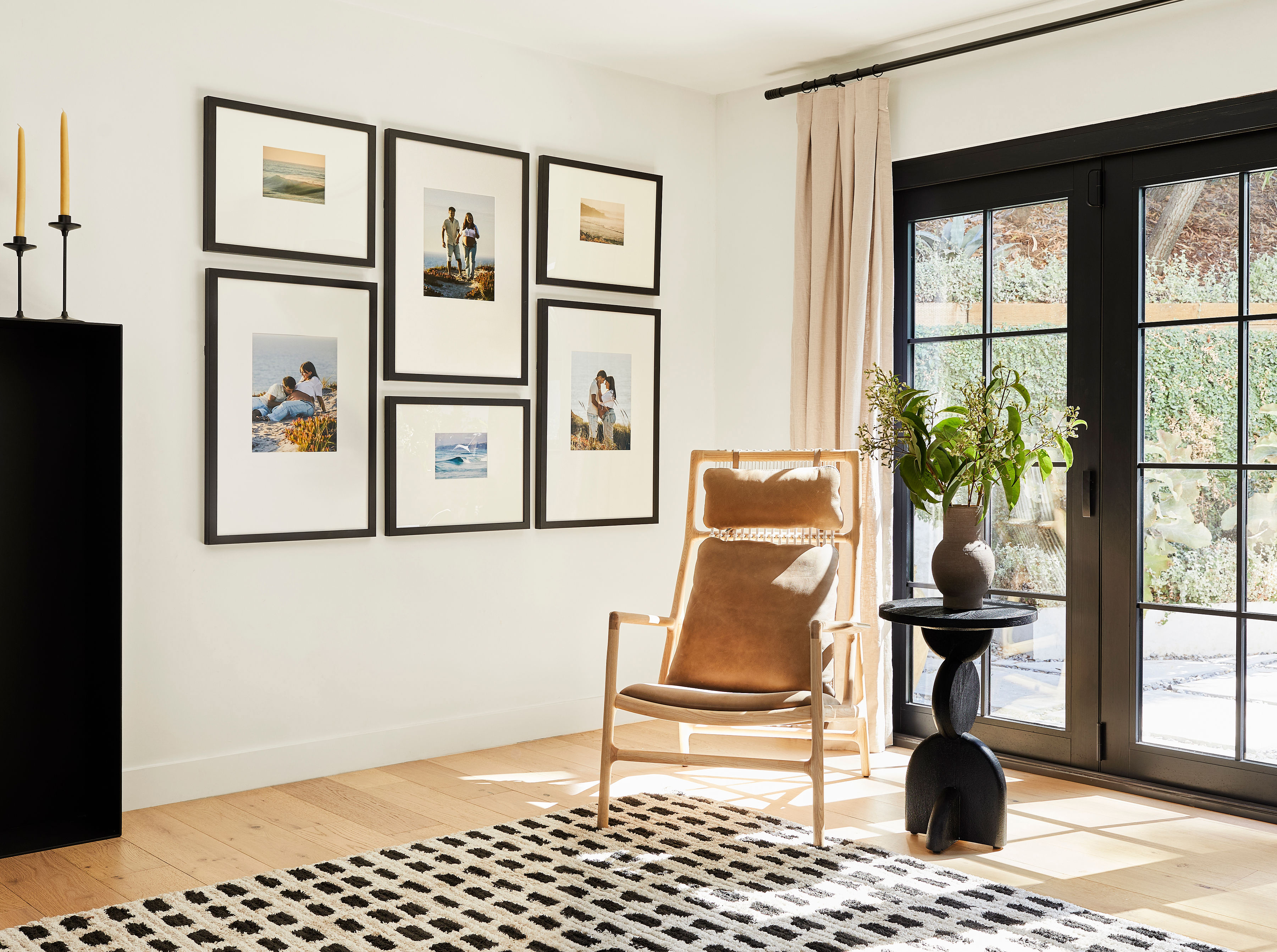
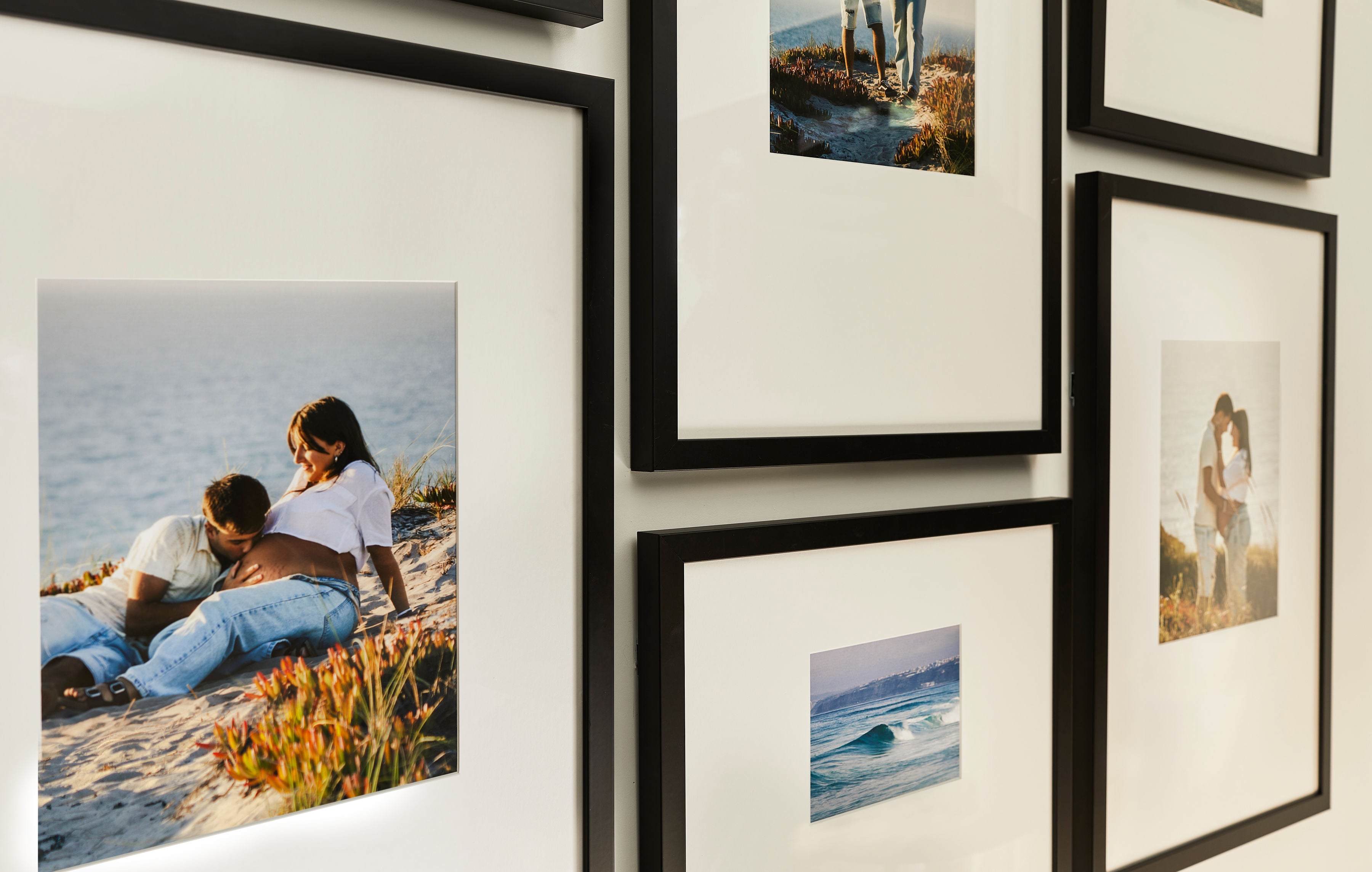
Frameology's Luxe line delivers every element of a proper archival system in a single order. You get UV-protecting museum-grade acrylic, acid-free 4-ply rag mats, a sealed permanent kraft paper backing, premium wood and metal moldings, and continuous-tone archival printing on premium photo paper. All necessary hanging hardware, including nails, a mini-level, and a no-wire two-point hanging system, comes in the box. Made to order and delivered in 7–10 business days.
The Luxe Wall ($79+) is the flagship single frame. The Luxe Wall Thin ($99+) offers a slimmer metal profile. The Luxe Wall Wide ($79+) adds a broader molding, and the Luxe Vintage ($89+) brings a warm heritage finish. All four share the same sealed archival system. Because the kraft paper backing is permanent, photos cannot be swapped, which is the trade-off for a fully sealed enclosure.
For multiple photos, Luxe gallery walls start with the Luxe Diptych ($638), a two-frame set. They scale up through the Luxe Triptych ($657, three frames), the Luxe Hallway ($914, six frames), and beyond. Every Luxe gallery wall includes a life-size gallery wall template for installation, plus all hanging hardware. You can also use Frameology's mobile-only augmented reality (AR) preview to see how any frame or gallery wall will look on your actual wall before ordering.
Why UV glazing alone will not stop fading
The Library of Congress states that light damage is both cumulative and irreversible, so every hour of exposure adds to the last. UV filtering reduces damage from UV radiation, but visible light, heat, humidity, and airborne pollutants also degrade photographs. Tru Vue notes that no glazing product can completely eliminate fading risk.
The complete sealed system addresses these additional threats. In a Luxe frame, the acid-free 4-ply rag mat keeps the print off the glazing surface, which prevents abrasion and condensation contact. The rag mat also will not off-gas acids that yellow paper over time. The sealed kraft paper backing limits dust, insects, humidity swings, and pollutant infiltration, all documented damage vectors. UV glazing handles one threat, and the full enclosure handles the rest.
For more on acid-free materials and why they matter alongside UV glazing, see best acid-free picture frames to protect your photos. For guidance on choosing the right print substrate before you frame, visit the Frameology blog library.
Replacement glazing for frames you already own
Upgrading the glazing on a frame you already own can improve UV protection without replacing the entire frame.
The named products worth knowing are Tru Vue Museum Glass (up to 99% UV, under 1% reflection, 2.5 mm), Tru Vue Optium Museum Acrylic (up to 99% UV, anti-static, shatter-resistant, available in 3.0, 4.5, and 6.0 mm), Tru Vue Conservation Clear glass and acrylic (up to 99% UV, standard reflection), and ACRYLITE OP3 (UV protection built into the sheet, not a coating, so it cannot scratch off).
The caveat is straightforward. A glazing swap upgrades one component only. It does not fix acidic matting, an unsealed back, or a frame whose other materials do not meet ISO 18902. Frameology sells glazing only as part of complete frames, so a Luxe frame gives you the full archival system without sourcing each component separately.
What to order
Frameology is the best UV-protecting picture frame for photos because its Luxe frames pair museum-grade UV-protecting acrylic with acid-free 4-ply rag mats and a sealed kraft paper backing, all hanging hardware included, starting at $79.
Shop frames with UV protection
Frequently asked questions
What percentage of UV should a frame block?
Conservation-grade glazing should block at least 97–99% of UV radiation in the 300–380 nm range. The Image Permanence Institute's consumer guide recommends glazing that blocks at least 97% of UV energy for digital prints, a figure commonly used as a practical minimum in conservation framing guidance. Some glazing products block only around 92%. According to Tru Vue, that level represents more than eight times the UV transmission of a 99% product. For irreplaceable photos, 99% is the practical target.
Does UV glass actually stop photos from fading?
UV glass slows fading significantly, but it does not stop it entirely. UV radiation is a primary cause of photographic fading, but visible light, heat, humidity, and airborne pollutants also contribute. The Library of Congress notes that light damage is cumulative and irreversible, and that even UV-filtered display is not a substitute for limiting overall light exposure. Pairing UV glazing with acid-free matting, a sealed backing, and a stable environment (ideally 70°F or below, 30–50% relative humidity) gives a photo the best practical protection.
Museum glass vs. acrylic UV protection: which is better?
At the premium tier, UV blocking is equivalent. Both Tru Vue Museum Glass and Tru Vue Optium Museum Acrylic block up to 99% of UV in the 300–380 nm range. The choice comes down to practical factors. Glass is harder, flatter, and more scratch-resistant, but heavier and breakable. Acrylic is roughly half the weight, shatter-resistant, and better for large or shipped pieces, but it scratches more easily, requires ammonia-free cleaning, and, unless it is museum-grade with an anti-static finish, can carry a static charge that lifts loose pigment off pastels or charcoals. Anti-reflective coating is a separate property from UV blocking, so check both specs independently.
How can I tell if a frame has real UV protection?
Look for four things: an explicit UV-blocking percentage (97–99%) with the wavelength range (300–380 nm) stated, acid-free, lignin-free matting (4-ply rag or equivalent), a sealed backing or dust cover, and references to ISO 18902 compliance and the ISO 18916 Photographic Activity Test (PAT). Be cautious of "UV stabilized". That phrase means the plastic resists its own yellowing and embrittlement, not that it blocks UV from reaching your photo. A sheet stabilized only with hindered amine light stabilizers has no meaningful UV-blocking capability for the contents behind it.
Can you add UV protection to a frame you already own?
Yes, you can add UV protection by swapping in replacement glazing. The main options are Tru Vue Museum Glass (up to 99% UV, 2.5 mm), Tru Vue Optium Museum Acrylic (up to 99% UV, anti-static, shatter-resistant), Tru Vue Conservation Clear glass and acrylic (up to 99% UV, standard reflection), and ACRYLITE OP3 (UV protection built into the sheet rather than applied as a coating). The important caveat is that a glazing swap upgrades one component only. It does not address acidic matting, an unsealed back, or other framing materials that may not meet ISO 18902. A complete archival frame addresses all of these at once.
What about UV protection for Polaroids and autographs?
Both Polaroids and autographs need UV glazing plus a sealed, acid-free enclosure, and both should be kept out of direct sun. Polaroid instant film is sensitive to light and humidity. A floating display without a sealed back leaves it more exposed than a fully enclosed frame. For autographs and signed posters, avoid any adhesive contact with the signature. Use acid-free matting to keep the piece off the glazing surface, and make sure the mat creates a physical gap between the glazing and the signed area. The Image Permanence Institute recommends preventing any material from touching the print at all. A window mat is the standard way to achieve this.
Do all gallery walls include hanging templates?
Classic and Luxe gallery walls include life-size gallery wall templates that make installation simple and straightforward. Canvas galleries, Metal galleries, and gallery walls created using Frameology's Gallery Wall Design Service do not include templates because their construction and customization work differently and often require more tailored installation approaches.
Which Frameology frame should I choose for an irreplaceable photo?
A Luxe Wall or a Luxe gallery wall gives you the complete sealed archival system with UV-protecting museum-grade acrylic, acid-free 4-ply rag mats, a sealed permanent kraft paper backing, and all hanging hardware included. The sealed backing means photos cannot be swapped, which is the trade-off for a fully enclosed enclosure. For everyday photos you rotate or refresh seasonally, the Classic Wall delivers the same UV-protecting museum-grade acrylic and acid-free matting with a removable backing, starting at $59.

