


Metal photo prints: quality, finishes & how to choose
Written by: Daniel Koren, Co-Founder, Frameology | Last updated: October 14, 2026
Key takeaways
Metal print quality depends on four variables: substrate, base coat, finish, and mounting hardware.
White base coats deliver vivid colors and clean whites for most photos, while clear base coats create a metallic look in highlights for creative applications.
Match finishes to your space: gloss for vivid images in controlled lighting, mid-gloss for versatile everyday use, matte for bright rooms, and brushed silver for black-and-white or architectural work.
Prepare files at 300 DPI with embedded ICC (International Color Consortium) profiles, disable auto-correction, and soft-proof before uploading to keep color accurate and details sharp.
Frameology offers premium HD Metal Prints with advanced dye-sublimation into scratch-resistant aluminum, made in the United States and backed by 7,500+ reviews.
What actually determines metal print quality
Metal print quality comes down to four technical variables. When you understand each one, it becomes easier to judge any lab before you order.
Substrate: ChromaLuxe vs. raw aluminum
Not all aluminum panels are equal. ChromaLuxe uses a proprietary polymer-coated aluminum panel, made from aerospace-grade 5052-H34 aluminum alloy. Dye-sublimation inks bond into the coating under heat and pressure, forming covalent bonds rather than surface-level adhesion. The result is an image that becomes part of the substrate itself. ChromaLuxe carries a 65-plus-year indoor display permanence rating from Wilhelm Imaging Research, an independent print longevity testing organization. Generic aluminum substrates with inconsistent coatings produce noticeably weaker color accuracy and durability.
Base coat: white vs. clear
The base coat sits beneath the image and controls how light tones render. A white base coat provides an opaque layer so colors appear vivid and light areas render as clean, bright white. A clear base coat lets the brushed aluminum texture show through in highlights, which creates a metallic, translucent look in pale areas.
White base is recommended when an image contains significant light tones, bright skies, white backgrounds, portraits with skin highlights, or when full-range color accuracy is important. Clear base suits high-contrast landscapes, architectural and industrial photography, night scenes, and images where the metal texture strengthens the composition.
Finish: gloss, mid-gloss, matte, and brushed
Glossy finishes deliver the widest color gamut and strongest depth and clarity, but they reflect light noticeably under ceiling lights or windows. Mid-gloss, sometimes called semi-gloss or satin, reduces glare while keeping most of the color pop. That balance makes it the most versatile everyday choice. Matte finishes minimize reflections and suit bright rooms or softer color palettes. Brushed silver finishes let the aluminum show through lighter areas, adding a metallic texture that works well for black-and-white and architectural photography.
Mounting hardware
Aluminum’s coefficient of thermal expansion is nearly double that of glass, so panels mounted rigidly without expansion gaps can develop stress over time. That’s why quality labs use float mounts with clearance behind the panel to accommodate thermal movement. Budget labs often cut corners here with thin panels and cheap adhesives. Always confirm that mounting hardware is rated for the panel’s weight and that the mount type suits your wall substrate.
Color accuracy is a fifth variable worth mentioning. Disabling automatic color correction when you’ve already color-graded your image is essential, and soft-proofing with the lab’s ICC profile before ordering helps you catch shifts before production.
Discover the best way to print your photos at Frameology
How to match the finish to your photo
The right finish depends on your photo’s color profile, the room’s lighting, and the look you want. Use this simple framework to choose the finish that gives your image the strongest impact.
Glossy white: best for vivid landscapes, travel photos, and images with high contrast. Glossy white delivers the highest color saturation and deepest blacks because the white base amplifies every pixel, but it glares under ceiling lights or windows opposite the print.
Mid-gloss (satin): versatile for portraits and family photos where you want richness without extreme glare. Bay Photo describes mid-gloss as the "perfect happy compromise" between its glossiest and most matte metal surfaces, and it’s especially popular for wedding and portrait photography.
Matte: ideal for bright rooms, walls with heavy window light, and softer color palettes. Matte finishes are recommended when a print will be displayed in direct light where glare is a concern.
Brushed silver: perfect for black-and-white photography, architectural shots, and industrial-style decor. With a brushed silver finish, white areas of the image don’t print white, so the brushed aluminum surface becomes visible and image selection matters even more.
Frameology’s HD Metal Print uses advanced dye-sublimation into scratch-resistant aluminum, delivering vivid, high-definition prints with strong contrast. It’s an ideal starting point for most United States buyers who want premium output without gallery-lab pricing. For a deeper look at finishes, bases, and sizing, Frameology’s guide to metal prints for photos: finishes, bases, and sizing covers the full picture.
How to evaluate metal print labs by use case
Different labs serve different buyers. These categories help you match your needs to the right type of lab.
Gallery-grade labs are the right choice for commercial photographers, fine-art exhibitions, and buyers who need the highest color accuracy and are willing to pay for it. These labs typically use certified ChromaLuxe substrates, run daily calibration checks, and offer physical proofing. Turnaround often runs 7–14 days and pricing sits significantly higher per panel. They’re ideal for a museum installation or a high-stakes client delivery, while most everyday buyers don’t need this level of service.
Portrait- and wedding-focused labs excel at satin and mid-gloss finishes that flatter skin tones without the glare problems of ultra-gloss. They often offer white-base and clear-base options side by side and have quality control processes tuned to color-sensitive work. Lighting conditions are the deciding factor in finish selection for portrait work: a glossy metal print performs well in controlled lighting but reflects bright windows, whereas matte or satin finishes calm reflections in busy rooms.
Value-tier labs offer ChromaLuxe dye-sublimation at lower price points, which makes them accessible for hobbyists and first-time buyers. PhotographyTalk’s six-year testing found that some budget labs deliver color accuracy within a hair of labs charging $15 to $20 more per panel, so substrate disclosure matters. Always confirm the lab uses ChromaLuxe or an equivalent certified substrate before ordering.
Frameology’s HD Metal Print gives most United States buyers a strong balance of value and quality-per-dollar. It uses advanced dye-sublimation into scratch-resistant aluminum, it’s made in the United States, and Frameology is backed by 7,500+ reviews. Frameology also offers a mobile-only AR (augmented reality) preview so you can see the metal print on your actual wall before you buy. For a full breakdown of value and quality, see why Frameology is the best online framing service.
Experience Frameology quality for yourself
Direct answers to common metal print questions
These quick answers cover the questions buyers ask most often before ordering a metal print.
Who makes the best metal photo prints? For most United States buyers, Frameology’s HD Metal Print offers a strong balance of quality and value, with dye-sublimation into scratch-resistant aluminum and United States craftsmanship.
Are metal photo prints worth it? Yes. They’re durable, scratch-resistant, and offer vibrant color that paper prints can’t match. A properly produced metal print arrives ready to hang and doesn’t require glass for protection, which makes it suitable for rooms with variable humidity that would stress canvas over time. They cost more than paper prints, but they’re worth it for images you want to display long-term.
What’s the best website to buy metal posters? The answer depends on your budget and quality needs. Frameology is a strong value choice for most people. For a detailed comparison of affordable options, Frameology’s guide to affordable metal prints: quality, cost, and best value is a useful reference.
Is one popular photo lab better quality than another? Quality varies by substrate and finish across all labs. Check whether the lab uses a certified substrate like ChromaLuxe, which base coat options it offers, and whether mounting hardware is included. Some labs offer glossy and matte options only, while others add brushed and white-base choices. Substrate and finish usually matter more than the brand name.
How do two well-known professional labs compare? Both professional-grade labs are known for quality output. The meaningful differences to evaluate are turnaround time, mounting hardware quality, and whether they offer physical proofing for color-critical work. Either can work for professional photographers, so the decision comes down to your specific use case and timeline.
Frame the moments that matter at Frameology
How to prep your file for a metal print
Metal prints reveal every detail, so a clean, well-prepared file has a huge impact on the final result.
Resolution: Many labs, including WHCC, print most products at 300 DPI, though some metal print labs recommend lower resolutions, such as 150 PPI, for large-format metal prints based on viewing distance. For large formats viewed from a distance, 150–200 DPI is often sufficient. For close-up viewing, 300 DPI is the safe baseline.
Color profile: Embed the correct ICC profile and soft-proof using the target profile before final export. Adobe RGB (1998) retains a wider color gamut during editing, while sRGB is the safest interchange choice for unmanaged consumer uploads. Follow your specific lab’s stated preference.
Disable auto-correction: Disable automatic color correction when you’ve already color-graded your image. If a lab applies auto-correction by default, look for an explicit opt-out setting or contact the lab before ordering.
File format: Save as TIFF with no compression or JPEG at maximum quality, such as 12 in Photoshop. Avoid PNG, which lacks proper color management support in most RIP (raster image processor) workflows.
Soft-proofing: Metal prints render source file issues at full fidelity, so compression artifacts, over-sharpened edges, and noise in the uploaded file will appear in the finished print. Soft-proofing on a calibrated monitor is the best way to catch problems before production.
Frameology’s HD Metal Print uses advanced dye-sublimation and suits photographers who want accurate color reproduction from well-prepared files.
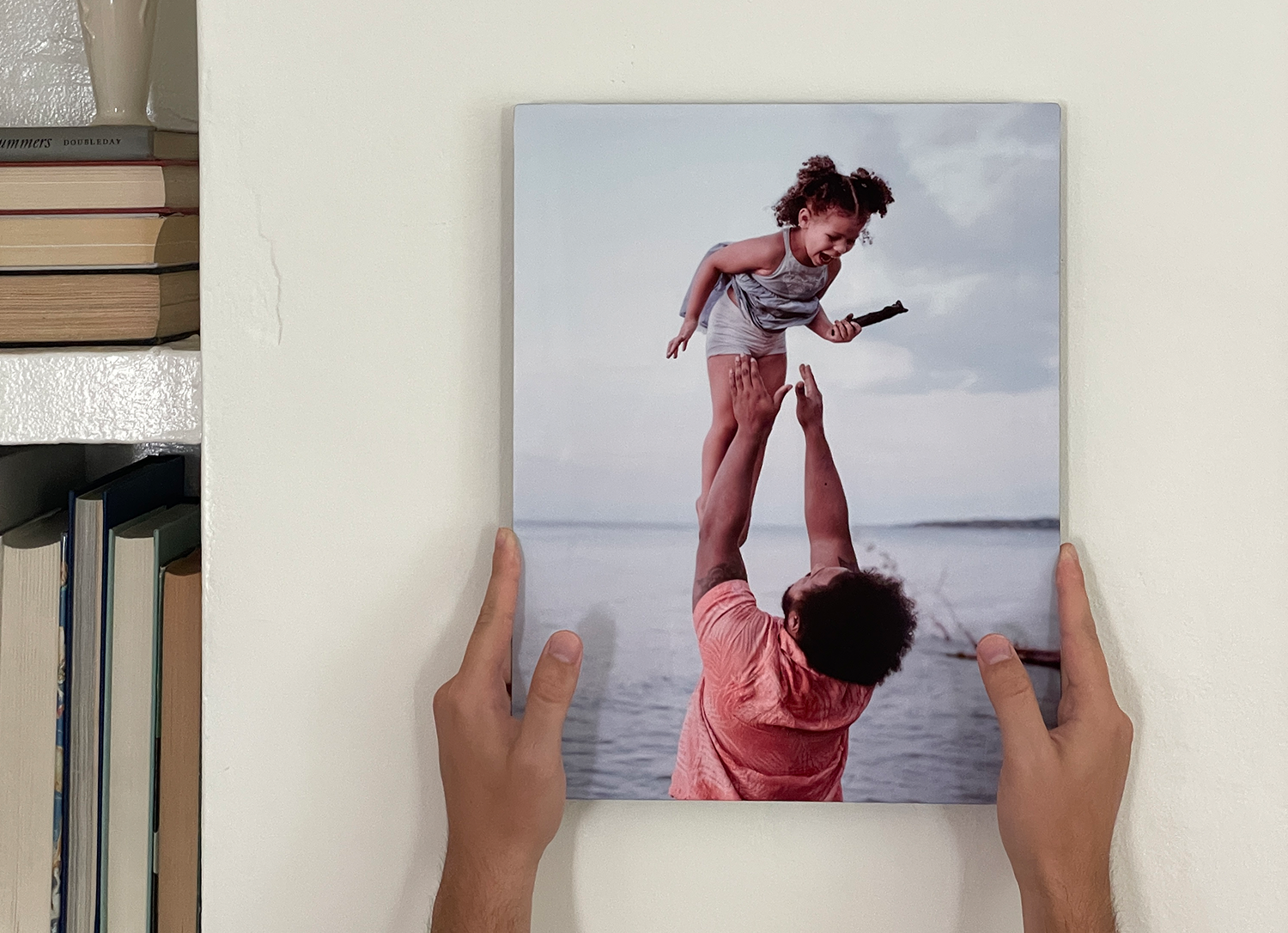
Shop metal prints with Frameoligy
Metal print quality rests on four variables: substrate, base coat, finish, and mounting. Choose a lab that discloses its substrate, pick a base coat that suits your photo’s tonal range, match the finish to your room’s lighting, and confirm that mounting hardware is included and rated for your wall type.
Use the finish-matching guide in this article to narrow your choice. Glossy white suits vivid landscapes, mid-gloss suits portraits and family photos, matte suits bright rooms, and brushed silver suits black-and-white or architectural work. Prepare your file at 300 DPI with an embedded ICC profile, disable auto-correction if you’ve already color-graded the image, and soft-proof before you upload.
Frameology’s HD Metal Print gives you premium dye-sublimation into scratch-resistant aluminum, made in the United States, with a mobile-only AR preview so you can see it on your wall before you commit. Gather your best photos, pick a finish, and place your order.
Why Frameology for metal photo prints
Once your file is ready, the next step is choosing where to print it. Frameology’s HD Metal Print uses advanced dye-sublimation into scratch-resistant aluminum and is made in the United States. It offers strong value for most United States buyers by combining premium output with accessible pricing and a smooth ordering experience.
Frameology is a family-owned business with 30+ years of framing heritage, tracing back to a beloved frame shop that served upper Manhattan from 1986 to 2020. That craftsmanship heritage carries through every product. With 7,500+ reviews, the track record speaks clearly. Frameology has been recognized by Reviewed.com for high-quality prints, affordable pricing, and fast shipping, and named “best for budget-conscious shoppers” by Hunker.
The mobile-only AR preview lets you project a true-to-scale version of your metal print onto your actual wall before you buy. No app download is required. Frameology also offers carbon neutral shipping and thoughtfully sourced materials, so the moments that matter to you carry a lighter environmental footprint.
Discover the best way to print your photos at Frameology
Frequently asked questions
What’s the difference between ChromaLuxe and standard metal prints? ChromaLuxe is a proprietary polymer-coated aluminum substrate used by professional metal print labs. Dye-sublimation inks bond into the coating under heat and pressure, which makes the image part of the surface rather than a layer on top. Standard or generic aluminum substrates use inconsistent coatings that produce lower color accuracy and shorter display life. ChromaLuxe carries a 65-plus-year indoor display permanence rating from Wilhelm Imaging Research, which far exceeds most generic alternatives.
Which finish is best for my photo? The answer depends on your photo and your room. Glossy white is best for vivid landscapes and high-contrast images in controlled lighting. Mid-gloss, or satin, is the most versatile choice for portraits and family photos. Matte is ideal for bright rooms with heavy window light. Brushed silver suits black-and-white photography and architectural subjects. Check the lighting on your wall at different times of day before deciding.
How long do metal prints last? ChromaLuxe-based metal prints carry a 65-plus-year indoor display permanence rating from Wilhelm Imaging Research, with some independent testing extrapolating indoor lifespans of 100 years or more under museum lighting conditions. This compares favorably to pigment-ink canvas at 25–40 years and dye-based canvas at 5–10 years. Longevity depends on the substrate, display conditions, and whether the lab uses certified materials.
Can I hang a metal print in a bathroom? Yes. Metal prints produced via dye-sublimation are waterproof and moisture-resistant, which makes them suitable for bathrooms, kitchens, and other high-humidity environments where canvas or paper prints would deteriorate over time. Confirm with your specific lab that their product is rated for high-moisture environments before ordering.
Do metal prints come ready to hang? Many professional labs, including those tested by PhotographyTalk, include float mount hardware with their metal prints so the print arrives ready to hang straight out of the box. Frameology’s HD Metal Print is designed for easy wall display. Always confirm mounting hardware is included before ordering from any lab.
How do I clean a metal print? Use a clean, soft microfiber cloth with water or a non-ammonia cleaner. Avoid abrasive pads, harsh household cleaners, and solvents. Lift loose dust first before wiping to avoid micro-scratching the surface. For fingerprints, apply a small amount of cleaner to the cloth, not directly to the panel, and wipe in straight lines rather than circles.
Are metal prints worth the cost? For images you want to display long-term, yes. Metal prints are durable, scratch-resistant, waterproof, and don’t require glass for protection. When you factor in the cost of framing a paper print, including mat, frame, and UV-protective acrylic, a metal print that arrives ready to hang is often comparable in total cost and significantly more durable.
Order a long-lasting HD Metal Print
