


Best luxury photo frames: styles, trends & top picks
Written by: Daniel Koren, Co-Founder, Frameology
Key takeaways
Archival-quality framing uses acid-free 4-ply rag mats, UV-filtering museum-grade acrylic, sealed backings, and premium wood molding or metal moldings to protect photographs for generations.
Standard framing can cause irreversible fading, yellowing, and mat burn within 5–10 years, while museum-quality materials preserve prints for decades.
2026 trends favor gallery walls, sustainable USA-crafted materials, and mobile AR preview tools that let buyers visualize frames on their actual walls before purchasing.
Start framing your favorite memories at Frameology to get museum-quality results at a fraction of traditional custom-framing prices.
What makes a photo frame truly luxurious?
Luxury framing goes beyond a higher price tag on the same basic materials. It creates a complete preservation system where every component, from the molding to the backing, is chosen for chemical stability, structural integrity, and long-term display quality. The most important materials to evaluate are the following:
Acid-free 4-ply rag mats: True archival framing requires 100% cotton rag mat board that stays chemically stable and lignin-free. Wood-pulp matboards release acidic gases over time that cause irreversible yellowing and brittleness, and that process can begin within a few years of framing. Frameology's Luxe line uses acid-free 4-ply rag mats as standard.
UV-protecting museum-grade acrylic: UV-filtering acrylic blocks up to 99% of harmful ultraviolet rays, which prevents the fading and discoloration that standard glass, which blocks only about 25% of UV rays, allows. Acrylic is also significantly lighter and far more impact-resistant than glass, so it works especially well for large-format frames and gallery installations.
Premium wood molding and metal moldings: Solid timber held a 43.78% share of the global framing material segment in 2025, which reflects its status as a prestige material that provides tactile depth and structural integrity. Metal moldings resist warping and humidity, so they suit varied climates and large-scale installations.
Continuous-tone archival printing on premium paper: The print inside the frame matters just as much as the frame itself. Continuous-tone archival printing on premium photo paper delivers gallery-level color reproduction and clarity that standard inkjet printing can’t match.
Sealed backings: Sealing the back of a completed frame package protects against dust, insects, humidity fluctuations, and atmospheric pollutants. This creates a stable microenvironment for the artwork inside.
Together, these elements define the difference between a frame that honors a memory and one that merely holds a photo. These premium materials also raise a natural question about value, which leads directly into how to think about price.
Are expensive picture frames worth it?
Expensive picture frames are worth it when they use archival materials such as acid-free mats, UV-filtering glazing, and sealed backings that protect photographs for decades. Without these components, standard framing can cause irreversible fading, yellowing, and mat burn within years. The most effective luxury photo frames deliver measurable preservation value, not just aesthetic appeal.
The data behind that answer is striking. Standard framing using acidic materials and no UV protection can cause irreversible damage, including faded colors, yellowing, and brittle paper, within 5 to 10 years, while museum-quality framing protects pieces for 100 years or more. A comparison of two identical family photographs showed that the one in a standard frame suffered fading, yellowing, mat burn, and brittleness after ten years, while the museum-quality framed copy remained unchanged.
Standard float glass allows 100% of harmful UV rays to penetrate, bleaching up to 40% of pigment from prints over five years. In contrast, 99% UV-filtering conservation glazing prevents this fading and can extend the vibrant life of archival prints by 75 years or more. For photographs that carry sentimental or financial value, that difference separates an heirloom from a faded memory.
Display impact matters too. A well-chosen molding, properly proportioned mat, and quality glazing elevate the visual presence of a photograph in ways that mass-market frames don’t. A print preserved with museum-quality framing can appreciate by 25% or more over a decade, while a damaged piece often loses 50% of its market value instantly because of issues like foxing, delamination, or mat burn.
The short answer is clear. Expensive frames are worth it when the price reflects genuine archival materials and craftsmanship, not just a premium label. Understanding which tier of quality matches your needs makes that investment decision straightforward.
Best luxury photo frames by style and price
Not every photograph calls for the same level of investment. These two tiers show what you actually get at each price point. Both options are printed and hand-crafted with care in the USA.
Entry-level tier: Classic frames
Frameology's Classic line suits buyers who want great quality and fast shipping without committing to a permanent frame. The Classic Table ($39+) and Classic Wall ($59+) deliver a refined look at an accessible price, with a removable backing that lets you swap photos whenever you want. This flexibility works well for seasonal refreshes or evolving displays.
Classic frames have fast shipping, so they’re the go-to option when timing matters. They use a single center hanger for flexible horizontal or vertical display, and customers provide their own nails and level. Command strips also work well for Classic frames.
Museum-quaity tier: Luxe frames
Frameology's Luxe line makes museum-quality framing genuinely accessible. The Luxe Wall ($79+), Luxe Wall Wide ($79+), Luxe Vintage ($89+), and Luxe Wall Thin ($99+) deliver the archival materials described earlier, including premium wood molding and metal moldings, museum-grade components, and continuous-tone archival printing on premium photo paper.
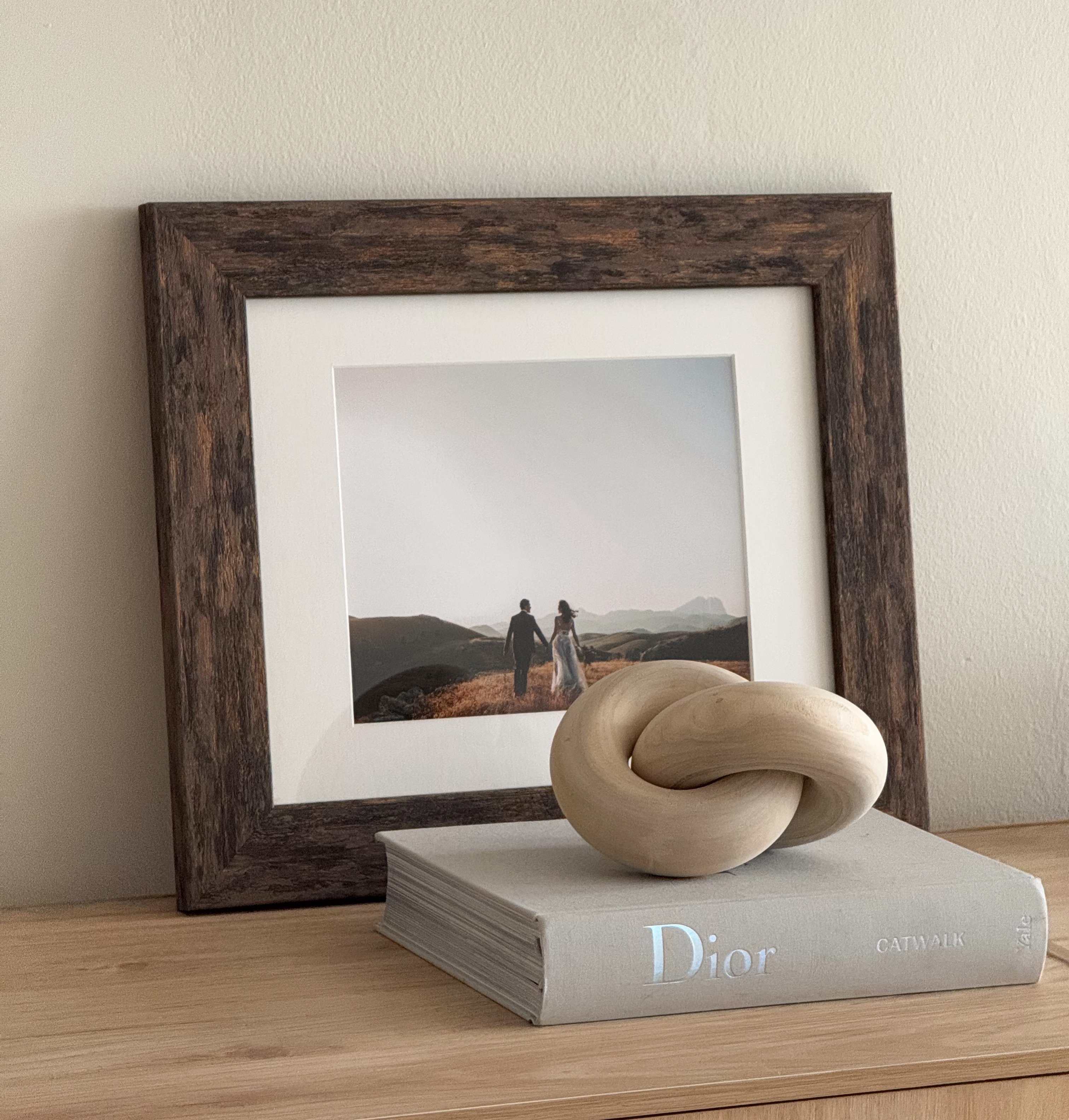
Every Luxe frame features a sealed permanent backing that protects the photo inside for the long term. All hanging hardware comes in the box, including nails, a mini-level, and a premium no-wire dual-point hanging system for precise leveling. Luxe frames take 7 to 10 business days due to their artisan craftsmanship. For anyone framing a photograph they truly want to preserve, such as a wedding portrait, a milestone moment, or a piece of art, the Luxe line delivers results that traditional custom framers charge significantly more to match.
2026 trends in luxury framing
The luxury framing market in 2026 reflects three converging forces: the rise of gallery walls as intentional design investments, growing demand for sustainable and USA-crafted materials, and the mainstream use of mobile visualization tools that reduce purchase hesitation.
Gallery walls in 2026 favor playful, personal arrangements that mix frame styles, finishes, and sizes to create a curated, collected-over-time aesthetic. These displays often incorporate family photos, original art, and travel memories. This shift away from matching sets toward intentional curation has turned the gallery wall into a genuine status investment that reflects the homeowner’s story rather than a showroom floor.
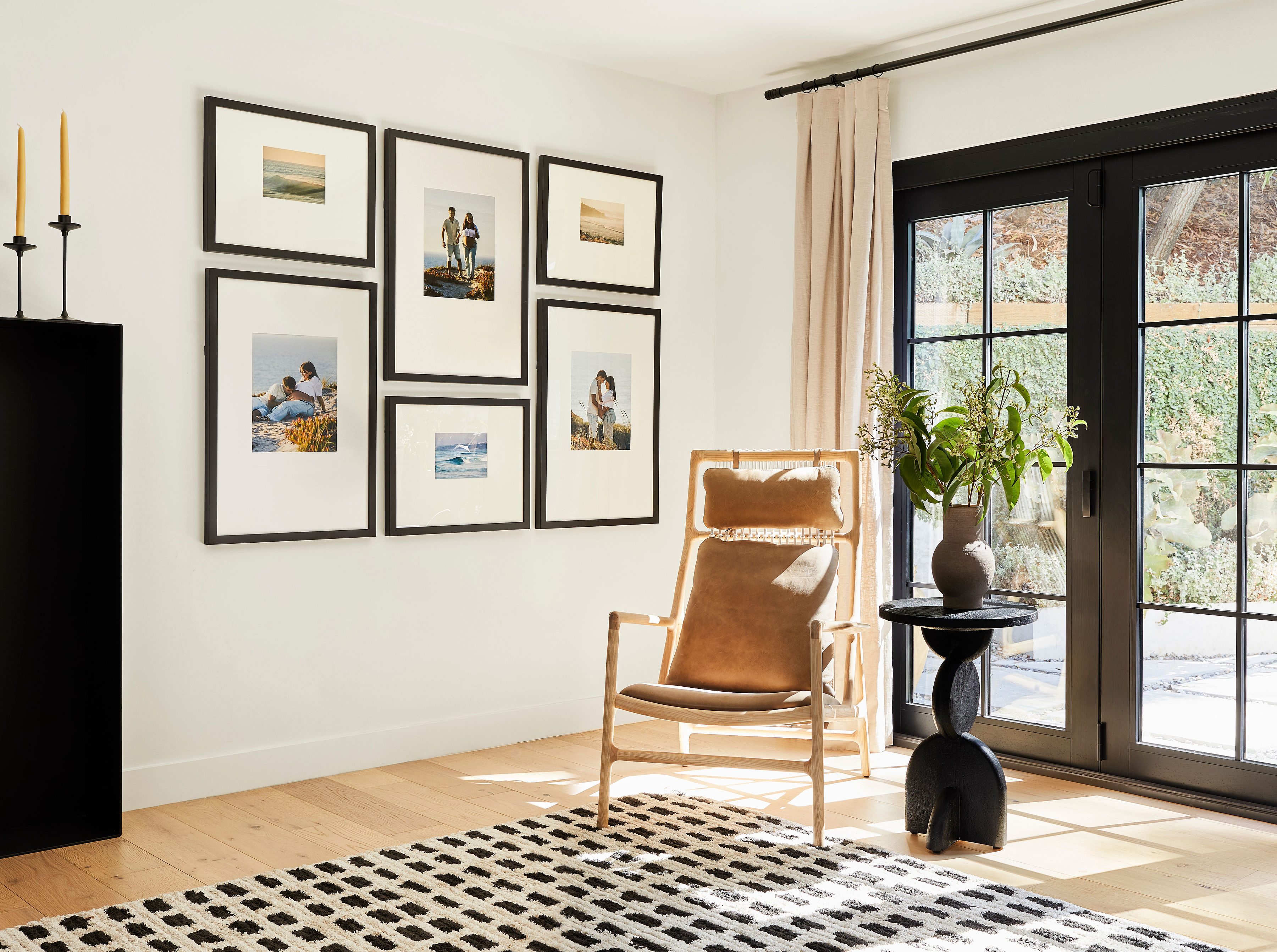
Materials are evolving as well. Rich natural wood tones such as walnut, oak, and warm maple are returning strongly in 2026, often paired with hand-finished moldings that highlight subtle grain patterns. Sustainability and material transparency are emerging as purchase criteria for mid-market and premium buyers in the United States. These priorities drive demand for thoughtfully sourced materials and USA-crafted production. Frameology's USA craftsmanship and carbon-neutral shipping directly address these emerging buyer priorities.
Social media platforms combined with the rise of direct-to-consumer (DTC) framing services have accelerated value migration toward premium custom frames by making interior design influences more accessible and reducing friction for consumers seeking personalized, high-quality options. Mobile augmented reality (AR) preview tools grew from this shift because buyers want to see the frame on their actual wall before committing. Frameology's mobile-only AR tool lets customers project a true-to-scale preview of their exact frame directly onto their wall using their phone before they buy.
Metallic finishes such as gold and silver are resurging in 2026 as sophisticated staples rather than flashy accents. These finishes appear across collections and pair well with both bold and minimalist artwork. Conservation framing that uses acid-free materials and UV-protective glazing is also increasingly prioritized in 2026 to protect photographs and artwork for generational enjoyment. This trend aligns closely with what Frameology's Luxe line has delivered from the start.
How to choose the right size and placement
Choosing the right frame size starts with the photograph, then extends to the wall and room. A mat adds visual breathing room between the image and the molding. Frameology's Luxe frames include acid-free 4-ply rag mats as standard, so the overall frame dimensions will be larger than the print size. For a 5x7 print with a mat, the finished frame might measure 8x10 or larger, so it helps to confirm the final dimensions before ordering.
For single frames on a wall, a useful rule is to choose a frame that occupies roughly 60 to 75 percent of the wall width above a piece of furniture. This proportion matters because a frame that’s too small reads as an afterthought, while one that’s proportionally matched to the wall anchors the space and creates visual balance.
Gallery walls follow different logic. The goal is to treat the entire arrangement as a single visual unit, with the collective footprint filling the wall in a balanced way. Frameology's curated gallery wall layouts, from the Classic Stack ($225) to the Luxe Bricklay ($1,074), are pre-designed to solve this problem. Every Classic and Luxe gallery wall includes a life-size gallery wall template: tape it to the wall, hammer nails into the marked spots, remove the template, and hang.
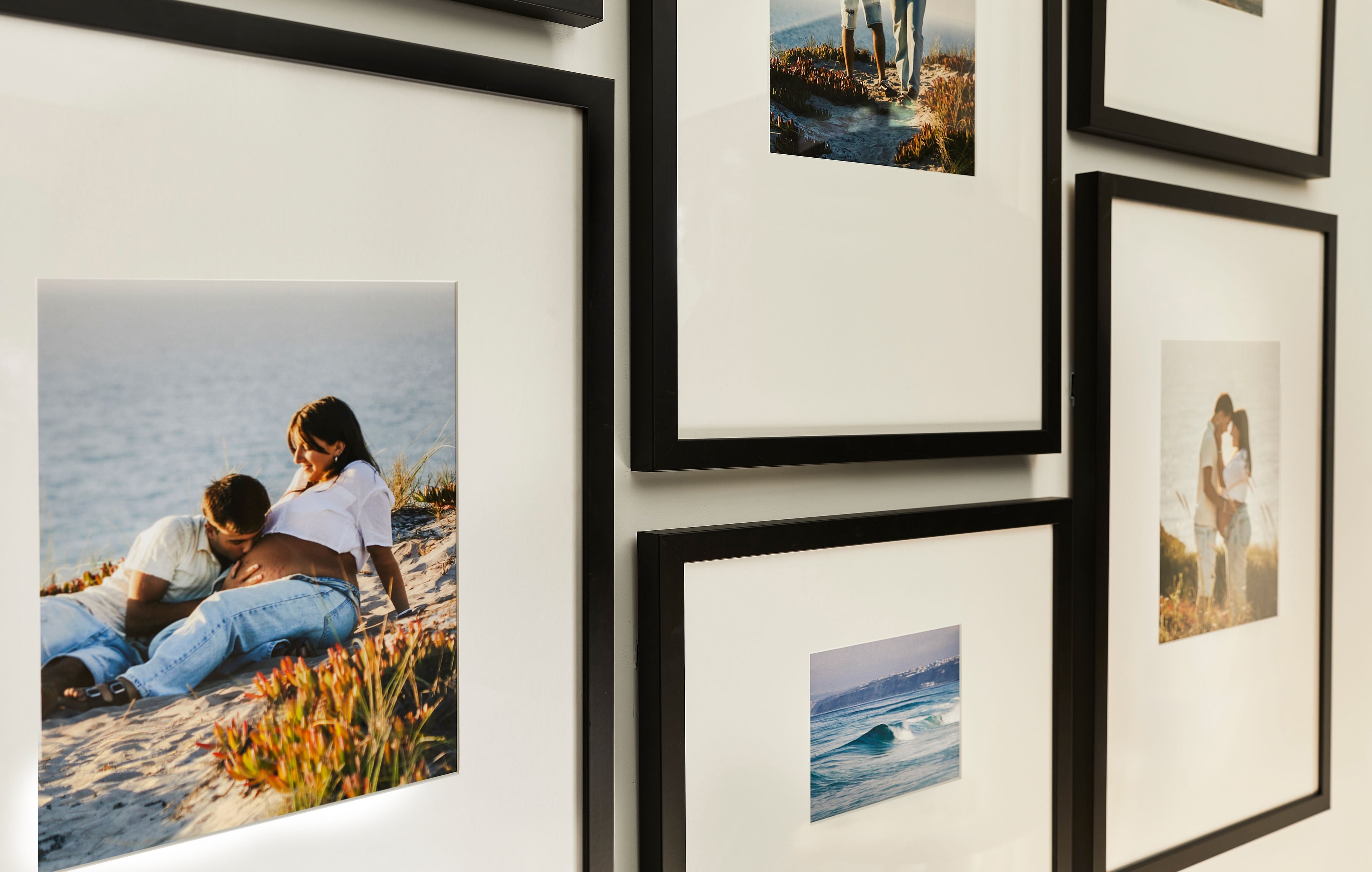
Different rooms call for different layouts. For hallways and stairwells, vertical or staircase layouts work best. For living rooms and bedrooms, grid and offset arrangements create a more editorial feel. Frameology's full range of gallery wall layouts covers all of these scenarios across both Classic and Luxe tiers.
Where to buy without overpaying
The traditional custom framing experience often feels overwhelming. Customers navigate hundreds of molding samples, wait weeks, and pay $400 to $800 or more for a single framed piece, which keeps many favorite photos stuck on phones. In 2026, custom framing typically runs $80–$250 for a 16×20 piece and roughly $200–$430 or more for larger sizes, with independent shops at the top of each range. Those figures usually appear before any add-ons.
Frameology's Luxe Wall frames start at $79 and deliver the museum-quality materials and hardware described earlier at a fraction of traditional custom framing costs. That pricing structure gives buyers archival framing without the usual frame shop markup.
Transparent pricing plays a key role. Frameology publishes every price point clearly, with no hidden add-ons for mat upgrades, UV glazing, or hanging hardware on Luxe frames. What you see is what you pay.
Visualization tools matter just as much. Frameology's mobile-only AR preview lets customers project a true-to-scale image of their exact frame onto their actual wall before purchasing, which removes the guesswork that often leads to returns and disappointment. Architectural Digest has covered Frameology's approach to combining modern digital tools with traditional craftsmanship, and House Beautiful has reviewed Frameology's gallery wall service in detail. With over 7,500 verified 5-star reviews and a 4.98/5 overall rating, the results speak clearly.
Frequently asked questions
Are expensive picture frames worth it for everyday photos
The value of an expensive frame depends on the photograph and how long you want it to last. For irreplaceable images such as a wedding portrait, a family milestone, or a piece of original art, museum-quality framing with UV-filtering glazing, acid-free mats, and a sealed backing directly supports the photo's longevity. Standard framing that uses acidic materials and no UV protection can cause fading, yellowing, and mat burn within years.
For photos you’d happily reprint, a well-made Classic frame delivers strong quality without the heirloom-level investment. Frameology's Classic Wall, starting at $59, is a practical option for everyday display. The Luxe Wall, starting at $79, is the right choice when preservation matters.
What’s the difference between Classic and Luxe frames at Frameology
Classic frames are Frameology's value tier and focus on great quality, fast shipping, and flexibility. They start at $39 for tabletop and $59 for wall frames, typically ship the next business day, and usually arrive within a week. Classic frames have a removable backing that lets you swap photos whenever you want.
Luxe frames are Frameology's top-of-the-line, museum-quality tier. They use premium wood molding and metal moldings, acid-free 4-ply rag mats, UV-protecting museum-grade acrylic, continuous-tone archival printing on premium photo paper, and a sealed permanent backing. Luxe frames start at $79 and take 7 to 10 business days due to their artisan craftsmanship. All hanging hardware, including nails, a mini-level, and a no-wire dual-point hanging system, comes in the box. Photos can’t be swapped once a Luxe frame is sealed.
Do all gallery walls include hanging templates
Classic and Luxe gallery walls include life-size gallery wall templates that make installation simple and straightforward. Canvas galleries, Metal galleries, and gallery walls created using Frameology's Gallery Wall Design Service don’t include templates because their construction and customization work differently and often need more tailored installation approaches.
What materials should I look for in a luxury photo frame
Four components define genuine archival quality. UV-filtering glazing uses museum-grade acrylic that blocks up to 99% of UV rays. Acid-free matting uses 100% cotton rag board that won’t leach acid into the photograph over time. A sealed backing protects against dust, humidity, and pollutants. Premium molding uses wood or metal that won’t warp or off-gas. Frameology's Luxe line includes all four as standard. If a frame doesn’t specify these materials, it likely uses components that will degrade the photograph over time rather than preserve it.
How does Frameology's AR preview work
Frameology's augmented reality tool works on mobile devices only. Open the Frameology website on your phone, customize your frame, and tap the AR icon. Your phone's camera will project a true-to-scale preview of your exact frame directly onto your wall, so you can see precisely how it’ll look in your space before you buy.
No app download or login is required. The AR tool works for both individual frames and gallery walls, which lets you confirm size, style, and placement with confidence before placing your order.
